
All societies consist of their fair share of ne’er-do-wells, addicts, cheats and liars. Others with no such character flaws become engulfed in such destructive behaviours due to not overcoming life’s challenges. The calamities that befall them comprise the kaleidoscope of events such as the loss of a child, serious injury or collapse of one’s business. In all probability the Chinese of Port Elizabeth were no more or less guilty of engaging in such destructive behaviours. For the most part, the bulk of the Chinese population was law abiding and industrious citizens to boot.
Opium: The drug of preference
Opium was introduced into China as a medicinal herb during the Tang dynasty (618–907 AD). Recreational use spread in the 17th century with the practice of mixing it with tobacco for smoking, a method that increased its addictive potential. When the Chinese emigrated, they clung to their vices. For the most part, that is how opium smoking was introduced into South Africa. It then gained local adherents thereby perpetuating this ill..
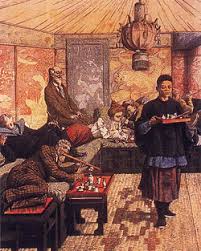
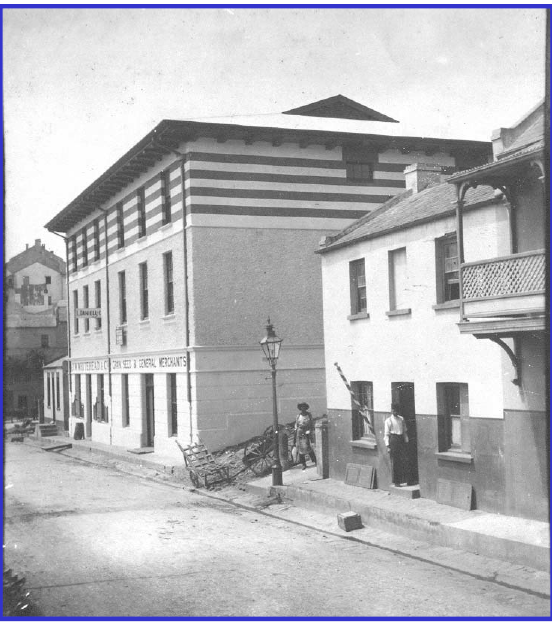
In the 1930s, Evatt Street, named after the first Commander of Fort Frederick, Captain Francis Evatt, had gained notoriety as an opium den. This street ran parallel to Queen Street but on the Richmond Hill side. All the shoppers on the ground floor of this building were aware that above the bean and curd shop was the opium den. Unlike a bar serving alcohol, the sounds of fist fights and bottles and glasses breaking never emanated from this shop. Instead addled patrons reclined on cushions and makeshift beds taking long puffs at pipes with its sweet smelling perfume. Later Evatt Street became associated with the opium trade
Under the watchful eye of the owner known as “Fa Tai Buk”, clouds of smoke arose from these reclining patrons. In dulcet tones they recounted their tales, experiences and memories shutting their eyes as they slipped into oblivion.
Historically, Port Elizabeth has been linked to the global opium trade; records from the early 1900s indicate large amounts of gum opium were cleared at the port as “gum meconium” en route to other parts of South Africa. Up until the formation of the Union in 1910, the Cape Colony was an independent entity controlled by its own government under its own Prime Minister. That resulted in the acting Chinese Consul General having to negotiate with separate entities. In the case of the Cape Colony, Liu Ngat had to negotiate with Prime Minister John Merriman in July 1908. The pleas relating to the suppression and the gradual reduction in its usage while simultaneously prohibiting opium dens. By 1909, new legislative measures were introduced to curb opium smoking. Nonetheless, elderly addicts continued to patronise the opium dens especially those in Evatt Street.
Gambling
While gambling addicts might not endanger anybody else but themselves, gamblers could bankrupt themselves leaving their families and themselves destitute. Gambling was a popular pastime among local Chinese who viewed it as a social activity and not as a vice. The countervailing attitude saw many Chinese being charged under the relevant Act. This legal prohibition did not detract from the Chinese passion for gambling extending to numbers games and lotteries such as fan tan, poker and mahjong. This popularity also extended to other sectors of the population who participated in draws organised by Chinese.
Police often used ’traps’ to uncover illegal gambling activities using various gambling paraphernalia as evidence of gambling in court. The terms of the Cape’s Chinese Exclusion Act, imposed more stringent penalties on those who indulged in gambling, stipulating that a Chinese person convicted twice for gambling would be deported to China but only after they had served whatever sentence had been imposed by the South African authorities.
Social Clubs formed by Chinese invariably included some form of gambling as recreation amongst members. By levying a commission on the gambling, the Clubs raised substantial sums of money for charitable activities and relief work.
Sources
Colour, Confusion and Concessions: The History of the Chinese in South Africa by Melanie Yap & Dianne Leong Man
Wikipedia
Raymond ah Sing