A Chronological Account of William Fleming Senior, William Fleming Junior and William Fleming #3, 1796–1992
A note on names. Three generations of this family bore the same name, and the sources rarely distinguish them. Throughout this account, William Fleming Senior is the Londoner born in 1796 who died at Port Elizabeth in 1861; William Fleming Junior is his son, born at Uitenhage in 1833, who married Adelaide McCleland and died in London in 1894; and William Fleming #3 is the eldest child of that marriage, born at Port Elizabeth in 1858 and died in 1941. Elsewhere he is sometimes called William III. Where a source does not say which man it means, the ambiguity is noted rather than guessed at. Firms, streets and buildings that carry the name — Heugh & Fleming, W. Fleming & Co., Fleming Street, Fleming House — appear without a generation attached.
This blog is an extension of a previous blog on the same subject. Instead of having to write a completely new blog, I presented the original blog together will all the additional information which I had gathered in the interim and presented it to ChatGTP to rewrite. This blog is the result of that process. A further request of AI was to present a list of date errors At the end of the blog a list of 14 errors is shown.
Chapter 1 — A London Boy at the Cape, 1796–1827
William Fleming Senior was born in London in 1796, in the last years of the eighteenth century, and came out to the Cape as a young man of twenty-one. He stepped ashore in Table Bay on 24 April 1818 from the brig Hottentot. He had trained as an attorney, and practised law in the Colony before commerce claimed him. One later account, in Redgrave, has him landing at Cape Town in 1821 and taking charge of a large mercantile concern before moving almost at once to the Frontier; the two versions may describe the same journey remembered at different removes, but the 1818 date is the one carried by the almanacs and by Harradine.
What is not in dispute is where he went. The eastern districts were the making of him. Petrus — variously Pieter or Peter — Heugh was a successful Cape Town merchant who moved to Uitenhage in 1819 and afterwards opened branches at Graaff-Reinet, Colesberg and Port Elizabeth. Fleming Senior appears to have worked for him almost from the moment of his arrival, and in time was admitted as a partner in the long and favourably known Frontier house of Heugh & Fleming. The exact year of that partnership has not been fixed.
The firm was already a landmark by 1815, when William Brooksby Frames came ashore in Algoa Bay and made his way to Uitenhage to join it. Frames was a shrewd trader who would load a small boat on top of his wagons, trek down to Port Elizabeth, and row out to the vessels lying in the open roadstead to do business with the crews aboard. He later acquired Gomery Farm and built the town’s first piped water supply; his path and Fleming Senior’s would cross again in the sand dunes south of the town.
Around the two men the town itself was being laid out. In 1820 Sir Rufane Donkin, during his short stay at Algoa Bay, arranged for the memorial pyramid that still overlooks the place. Colonel J.S. Cuyler, who was present, would set down the story of that morning nearly thirty years later in a letter addressed to a Mr Fleming in Port Elizabeth — Donkin walking the ground with Captain Fairfax Moresby, pointing and saying that here he would put it, then sending for a pickaxe to mark the spot.
Meanwhile, on 12 February 1824, a young woman named Frances Charlotte Andrews arrived in Table Bay aboard the Thetis, travelling with her mother, her brother and her sister. She was a daughter of Captain Caesar Andrews of the 57th Regiment.
Chapter 2 — Uitenhage and the Frontier Firm, 1828–1841
William Fleming Senior and Frances Charlotte Andrews were married on 11 February 1828 in the Dutch Reformed Church at Uitenhage. It was a long and productive marriage: most accounts give ten children, though one gives twelve, and all agree that the family was still living at Uitenhage when the first of them was born.
The firm’s interests reached deep into the interior. On 17 November 1830 Charles Lennox Stretch, the Government Surveyor at Graaff-Reinet, drew a diagram of a hundred square roods of ground on the summit of a bare hill north of the village, and on 21 March 1831 Sir Galbraith Lowry Cole granted the land to Antonio Chiappini and Company — a partnership that included Chiappini himself, Thomas Ansdell, Petrus Johannes Heugh and William Fleming Senior. The powder magazine went up at once; when Chiappini and Ansdell sold out to Heugh and Fleming in 1833, the deed already spoke of a magazine standing on the ground. The building survives on Magazine Hill to this day, and was declared a National Monument in November 1971.
In November 1831 the Government offered several plots above the 1820s grants, on the slope between Cuyler and Bird Streets in Port Elizabeth, and among the local men who bought was Fleming of Uitenhage. The position was superb and the access wretched, and for close on twenty years the land stood empty. In 1834 Heugh & Fleming took possession of the ground on which Fleming Street would later be laid out and named.
By 1836 Fleming Senior was listed in the almanacs as a Justice of the Peace at Uitenhage, and on 28 August 1833 his son William — the William Fleming Junior of this account, and the source of a good deal of subsequent confusion — was born there.
Chapter 3 — The Public Man of Port Elizabeth, 1842–1850
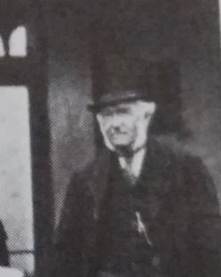
William Fleming Senior
In 1842 William Fleming Senior moved his household down to Port Elizabeth, and from that year until his death nineteen years later he was at the centre of nearly everything the town attempted. He was made a Justice of the Peace there in 1843. His son, then a boy of nine, received part of his education in the town, and in 1846 carried off the first-class prizes in Grammar and Geography at the Government Free School before going on with his brother Charles to Edinburgh High School, where both were noticed in a literary contest.
The bare list of the father’s commitments gives an unusually complete picture of what a colonial port needed in those years. He sat on the St Mary’s Church committee, the Prison Board, the Commercial Hall Committee, the Commission for Improving the Port, the Committee of Management of the Maitland Mining Company and the British and Foreign Bible Society. He was behind the Port Elizabeth Wharf Company and the Port Elizabeth Water Company, both formed to supply the town with the jetty and the water it urgently lacked. He chaired the board of the P.E. Bank, was a director of the P.E. Trust Bank and President of the Branch Savings Bank, chaired the Chamber of Commerce, and helped found the Guardian Assurance and Trust Company. He served on the provisional committee and later the Board of Managers of the hospital.
The social side began early. The Port Elizabeth Quoit Club was formed in 1842 — an old and surprisingly skilful game of iron rings pitched at a pin, which suited all ages — with Charles Hugh Huntley as its first secretary and the Rev. Francis McCleland, Captain Dunsterville and William Fleming Senior as honorary members. Nearly every prominent man in the town belonged.
On 1 July 1844 a group of them formed the Port Elizabeth Trust Association, to administer insolvent and assigned estates and to act as executors for those who preferred their affairs in responsible hands. John O. Smith took the chair; Fleming Senior’s name stands first among the members, alongside William Smith, William Higgins, Caesar Andrews, Alfred Jarvis, John H. Clark, John C. Chase and William M. Harries, with Joseph Graham as secretary. The Grahamstown Journal carried the announcement in March 1845.
That same year a visiting officer’s wish to give a fancy dress ball exposed how little the town could offer: the Commercial Hall stood roofed but unfloored for want of funds. Colonel Sutherland paid for the floor, the north wing became a reading room, and a small society gathered around a table, a few chairs and a rack of pigeon-holes for the magazines. Its principal supporters were C. Andrews, W. Fleming, J.O. Smith, the Rev. F. McCleland, Father Corcoran and others. Towards the end of 1847 an arrangement with the shareholders allowed a proper reading room and library to be built onto the north side of the hall, and concerts were got up to buy books — the first in May 1847, in aid of the Irish and Scotch sufferers, and the second on 15 November 1848.
In January 1846 the Port Elizabeth Bank was founded, with William Fleming Senior, William Smith, Daniel Phillips, J.O. Smith and Joshua W. Kemp as its first directors; a building designed by D. Macdonald followed in Main Street in 1854.
The great civic question of the decade was municipal government. John Paterson had argued for years that a “light tax” would let the town improve itself, and Fleming Senior supported him. Meetings in 1843 and 1845 came to nothing. Then, on 9 January 1847, a general meeting of householders with J.O. Smith in the chair resolved in favour of a municipality and appointed a committee — W. Fleming, W. Smith, C. Andrews, W.M. Harries and J.C. Chase — to draw up regulations. These were adopted on 8 February and forwarded to the Government; the requirements of the place had long outgrown the Resident Magistrate and his small staff. On 3 December 1847 the town was divided into eight wards and its first Board of Commissioners elected: J.W. Kemp, W.H. Coleman, W.M. Harries, C. Andrews, J. Crawford, W. Fleming, W. Smith and T. Proudfoot. Later that month Fleming Senior was also named to the Commission for Improving the Port and Harbour of Algoa Bay — the Harbour Board — with W. Lloyd, T.A. Bennett, W.M. Harries and E.H. Salmond. The Board was granted land to give it an income, took wharfage dues, grew to seven members in 1861, and was absorbed by the Cape Government in 1908 and by Railways and Harbours after Union.
Paterson, freed at last from colonial service, took over the Eastern Province Herald as proprietor, publisher and editor on 1 January 1848. William Fleming Senior and John Owen Smith each put in £150 to Paterson’s £300, and stood as guarantors besides. In July 1849 Fleming Senior chaired the first annual meeting of the Public Library, whose rules he had helped draft and in which he held two shares. In 1850 he appears in the almanac as Treasurer of the Anti-Convict Association — of a piece with his politics, for he supported the movement for Eastern Province independence and opposed Sir Harry Smith’s plan to land convicts at the Cape.
Chapter 4 — The House on the Hill, 1851–1855
Fleming Senior’s Bird Street land had waited twenty years. The date of the house was long a puzzle until a notice in the Government Gazette of 23 October 1851 turned up, offering ground for sale on the Hill “near the house now in course of erection” for him; a second notice of 5 July 1852 refers to plots in Cuyler Street near his residence. By his own family’s account the house was built in 1851, and by 1864 it was assessed at £4,000 — the nearest figures on the roll were a few at £3,000, and most houses in the town were valued at under £500.
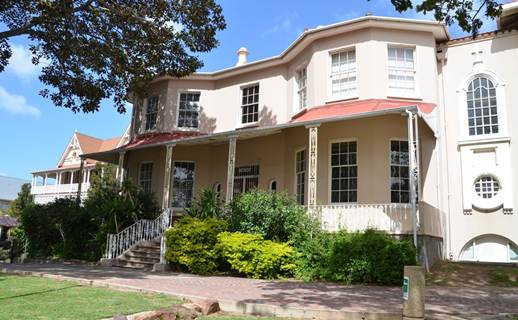
Fleming House, 20 Bird Street
The setting nearly went wrong. In April 1852 his neighbour Jonathan Board advertised his intention to run a line of cottages across the erf between Bird Street and Cuyler, next to Fleming’s property in Cromwell Ward. It must have been an unwelcome prospect for a man who had just built the finest house in Port Elizabeth; Fleming Senior acted quickly, and Board’s erf was registered in his name within months. (One account places this transfer in 1850, but the sequence in the Gazette notices favours 1852.) That is why Fleming House stands to one side of its own garden today. The stone wall, railings and gates that went up at the same time shut out the dusty roads and the empty veld while leaving the view intact.
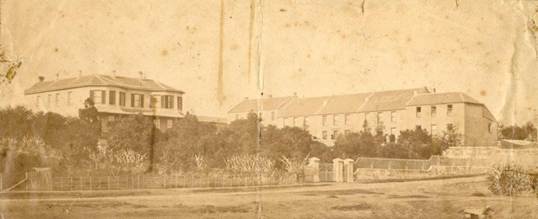
Fleming House on the left in Bird Street, with Cora Terrace on the right
Business and public life kept pace. On 11 August 1853 the Guardian Assurance and Trust Company was founded, its prospectus having appeared in June, with William Fleming Senior as chairman and A. Wares, J. Paterson, T.W. Gubb, W. Mackie, G. Chabaud and J.G.S. de Villiers as fellow directors and Thomas Wormald as secretary. The company put up a handsome building in Main Street in 1857 — the first grand structure there — and replaced it on the same site in 1938 with an art deco design by Herbert McWilliams.
From 1854 the almanacs give Fleming Senior’s address as Bird Street; earlier they had him in Jetty Street, Baakens Street and Belmont Terrace. In that same year he sat in the Upper House of the first Cape Parliament, and he represented the Eastern Divisions as a Member of the Legislative Council from 1854 to 1858.
Chapter 5 — The Son Comes Forward, 1856–1860
In September 1856 the Port Elizabeth Volunteer Rifle Corps was raised, the Cape Town Rifles having been formed the year before at Sir George Grey’s request. Captain Hill was commissioned as Colonel over a unit of only fifty men in dark green; the early officers were William Smith, Alfred Ogilvie, Bernard Lee, A.C. Wylde and William Fleming Junior. The son had come back from Scotland and gone into his father’s merchant importing business.
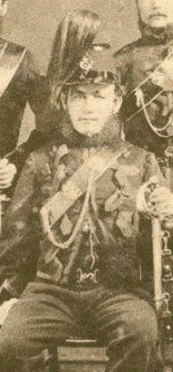
Captain William Fleming Junior of the P.E. Rifle Corps
At the end of 1856 the old partnership was wound up and the firm became W. Fleming & Co., with branches at Colesberg, Graaff-Reinet and Uitenhage; there was a Mossel Bay house too, trading as Fleming & Mudie. Heugh had already sold his Graaff-Reinet interest and the powder magazine in 1857 to Skelton Edward Wimble, who traded for a time as Fleming and Wimble. Peter Heugh died in July 1858. The Port Elizabeth house had a long afterlife of its own: H.B. Christian joined it as a partner in later years, and the firm is reckoned the forerunner of Pagdens, one of the oldest legal practices in the town — a thread that runs back to Fleming Senior’s original training at the bar, and forward to the man who would one day buy his house.
On 21 January 1858 William Fleming Junior married Adelaide McCleland at St Mary’s Church. She was born in Port Elizabeth on 22 May 1831, the sixth child of the Rev. Francis McCleland, the first colonial chaplain to Port Elizabeth, who had built St Mary’s and whose parsonage is now a monument. The two fathers had been close for a decade: both sat on the Vestry Committee and the Public Library Committee, both were active in the British and Foreign Bible Society and on the committee of the Branch Savings Bank, and their children had been at school in the town together. It was a large wedding with five groomsmen and five bridesmaids. William Fleming Senior was there; so were Adelaide’s brother George, then eighteen, and her sister Georgina; so were the bridegroom’s brother Charles and, probably, his sisters Margy and May, along with Fleming connections named Maynard and Andrews.
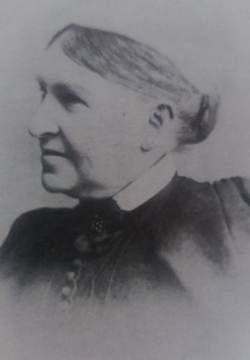
Adelaide Fleming, née McCleland
The couple set up house in Pearson Street, at Hamilton House, where all five of their children would be born. Their first, William Fleming #3, arrived on 28 November 1858; a daughter, Elizabeth, followed on 6 September 1860.
Then came the event by which the town measured everything else. On 6 August 1860 Prince Alfred, the second son of Queen Victoria and a midshipman in the Navy, landed at Port Elizabeth. The visit had been Sir George Grey’s idea, and it was a triumph: the Prince spent his sixteenth birthday there, and for years afterwards the day was kept as a public holiday. The Prince and his party, the Governor included, were lodged in William Fleming Senior’s Bird Street house — chosen from every house in the place because its furniture, carpets, fittings and articles of vertu were of the best and in good taste. There was a tour of inspection by day and, in the evening, a ball and dinner in a transformed wool store, with the buildings decorated and the Volunteers everywhere in evidence. At the dinner held in the house itself, Fleming Senior, described as one of the oldest of the Bay merchants and long their representative in the Legislative Council, was asked by the Prince to preside, with His Royal Highness on his right hand and Sir George Grey on his left. The reception room to the left of the entrance hall — bay windows north and east, wood panelling, a black fireplace with floral tiles and white herons at its base — was perhaps the room in which they dined.
The Rifle Corps furnished the guard of honour, and with the Prince’s consent took the name it still bears: Prince Alfred’s Guard.
Chapter 6 — Death and Inheritance, 1861–1867
The year 1861 opened badly, with the wreck of the Hero on 27 January, and on 15 June William Fleming Senior died suddenly one evening at his home on the Hill. He was sixty-five, though one account gives sixty-four. The Herald remembered his courtesy, the breadth and liberality of his views, his fine manly figure and his pure and spotless life. A very large concourse followed him to the old cemetery on 16 June; J.C. Chase, who noted the day in his pocket diary, was one of the pallbearers. Of all the men who had worked for the town in those years, Redgrave observed, Fleming Senior was the one who did not live to enjoy the results of his own efforts. He had served as wardmaster, commissioner and committee-man; the street that bears his name was part of the land Heugh & Fleming had held since 1834.
The business passed to his son, three years married. That year the officers of the P.E. Rifle Corps sat for a photograph — du Toit, Aston and Gordon standing, Griffith, Wylde and Fleming seated in front — and Captain William Fleming Junior looks out of it in full dress with his sword across his knees.
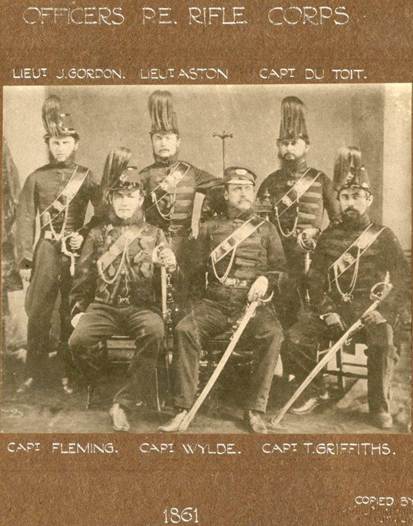
Officers of the P.E. Rifle Corps, 1861. Back row: Capt T.M. du Toit, Lieut Aston, Lieut J. Gordon. Front row: Capt T. Griffith, Capt A.C. Wylde, Capt W. Fleming
The family multiplied and thinned in quick succession. Frances Charlotte, always called Fanny, was born on 22 January 1862; Elizabeth died on 16 December of the same year, not yet two and a half. Alice Mary followed on 21 November 1863, and Mabel Katherine on 30 September 1865.
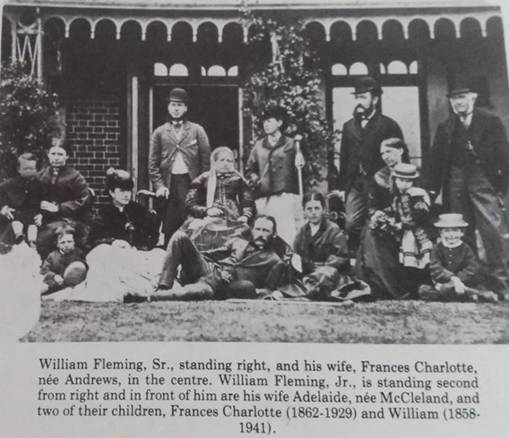
The family group, with its original printed caption — which cannot be wholly correct: see Chapter 9
The great house did not stay with them. In July 1863 it was announced that Frances Fleming, the widow, was about to leave the Colony, and in October a notice offered the family mansion to let for a term of years, replete with every convenience, immediate possession, applications to William Fleming. The property was registered in her name in 1864 and remained in the family until 1880, but the tenants were now other men: Alfred Ebden, the merchant and later chairman of the S.A. Mutual, who seems to have been there from the mid-1860s and was certainly in residence from 1871 until he retired to Rondebosch; and Charles Tennant Jones of Dunell, Ebden & Co., the “financial genius” who carried that firm through the depression of the sixties and in 1871 bought the farm Vooruitzigt from the De Beer brothers — land the company sold four years later for a small profit, not realising what lay under it.
The son’s own public career now took the shape of his father’s. On 22 March 1865 the foundation stone of a new custom house was laid at the corner of Fleming and North Union Streets, on ground belonging to the Flemings; Alfred Warren designed it in the Italian style and Inggs and Ablett built it, and a third storey was added in 1922. The building is still known as the Fleminggebou, and is sometimes confusingly called Fleming House.
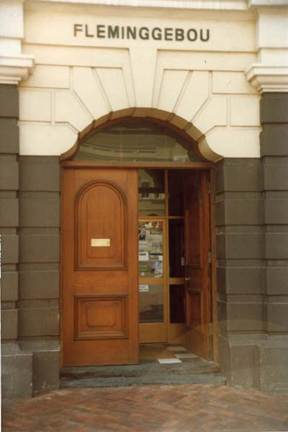
The Fleming Building on the corner of Fleming and North Union Streets
In May 1865 the Port Elizabeth Club was founded and advertised for premises; William Fleming Junior sat on its first committee with Alfred Ebden, John Campbell, H. Schabbel, J.W. Salamon, L. Bramson, F.D. Deare, William Hume and C.T. Jones. The Club took the Bird Street house built by D.P. Blaine and bought it in 1874. In 1866 he was a provisional director, with J.C. Chase, Joseph Simpson, Robert D. Buchanan and William Hume, of the Zwartkops Land, Irrigation and Waterworks Company, capitalised at £50,000, which bought Zwartkopsrivier Wagendrif and Fishwater Flats with a view to building reservoirs for the whole area; Woodford Pilkington was engineer and manager.
Unlike his father, who served on the St Mary’s committee, William Fleming Junior belonged to Holy Trinity, and as one of the men responsible for its management he ordered four windows from London. They came out in the barque Balaklava, insured for £130, and on 14 May 1867, on the last stretch to the landing beaches, she struck Despatch rock. She took water fast; a pump belonging to the Fire Brigade was sent out by tug, but she went down in seven fathoms and the windows were lost. The church, fortunately, was covered.
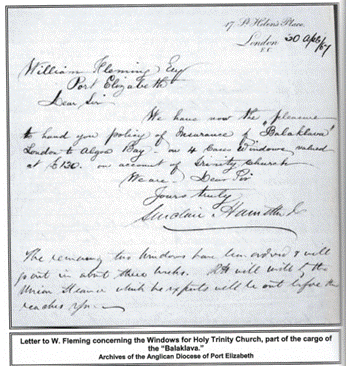
The insurers’ letter to William Fleming covering the Holy Trinity windows shipped in the Balaklava. Archives of the Anglican Diocese of Port Elizabeth
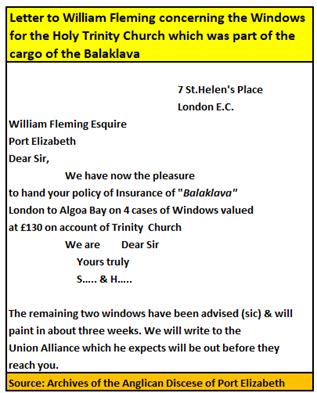
A transcription of the same letter
Somewhere in these years the family also took to the dunes south of the town. Small bungalows began to appear on the Gomery — on what had been Frames’s farm — occupied through the summer by the older and wealthier families: the Flemings, the Heughs, the Andrews, the Kemps and the Kemsleys. It cannot have been comfortable when the south-easter blew sand through everything, but those first cottages were the beginning of Humewood.
Chapter 7 — Departure and Afterwards, 1869–1962
William Fleming Junior sat in the Legislative Council in 1869–70. He had built the necessary apprenticeship in local affairs first: Justice of the Peace, founder member of the Chamber of Commerce, member of the Harbour Board, captain in the local militia, committee man of the Provincial Hospital and the Grey Institute. He was an enthusiastic advocate of harbour works, and wrote a brochure to set before the mercantile and maritime public all the reliable data that could be collected about the flourishing and rapidly increasing seaport of Algoa Bay. He was also remembered for his generosity: the Herald wrote of a class in Port Elizabeth to whom his hand had always been open, people who knew better than most the difference between a friend in need and a friend in deed.
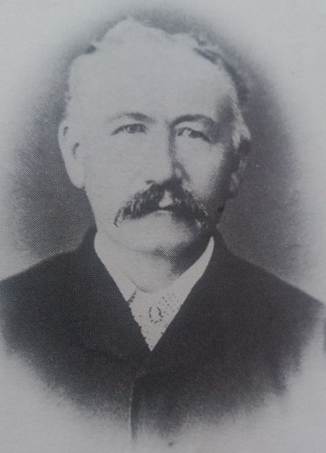
William Fleming Junior
In 1874 he and Adelaide left. At a farewell dinner at the Port Elizabeth Club he spoke of the struggle of tearing himself away from a place that had been his home since infancy, his wife’s home too, and the birthplace of all their children. In the same year Wimble bought the remaining share of the Graaff-Reinet magazine out of a deceased Fleming estate, closing the last of the old Frontier holdings.
They went to Europe first — whether meaning to settle there is not known — and then returned to the Cape and made their home at Wynberg. William Fleming Junior continued in public life at the other end of the Colony: a Justice of the Peace, a member of the Legislative Assembly, a member of the Cape Town Harbour Board, a server on many commissions, and Mayor of Cape Town in 1881 and again in 1882–83. He died on 1 July 1894 while on a visit to London.
Sir Lewis Michell, surveying the Port Elizabeth men he had known, set down his own verdict on a William Fleming — a “versatile genius”, he called him, who ended his career as mayor of the town. The mayoralty points to the son rather than the father, and the father was in any case long dead by the time Michell was writing.
Painting was his private passion. He painted sailing ships and sea pictures, and many of the water-colours still hung on the walls of his descendants’ houses a century later; a number of them survive at Number 7 Castle Hill. His granddaughter, Mrs Lister-Wright, wrote that though he was a businessman he was a true lover of the sea, that all his pictures were of ships that had called at the Cape, and that his knowledge of design and rig made them a genuine heritage. She believed he had known the artist Thomas Bowler, whose influence can be seen in the work.
Adelaide never came back to the Cape. She lived at a house called Deeping Bank in Camberley, Surrey, with her two unmarried daughters, Frances and Alice, and died there in 1917 at the age of eighty-six.
Of the five children, the eldest, William Fleming #3, was not prominent in Port Elizabeth affairs; he seems to have left the Cape as a young man and not returned, and died on 12 February 1941. Elizabeth had died in infancy in 1862. Fanny and Alice never married and lived in England, dying on 24 January 1929 and in 1940 respectively. The youngest, Mabel Katherine, married Surgeon Captain Alfred Wright on 24 July 1890 and stayed in the Cape. Two daughters were born of that marriage; both married and both outlived their parents. Alfred Wright, by then a Colonel of the R.A.M.C., died in 1935, and Mabel died at Wynberg on 7 November 1962, aged ninety-seven — the last of the five, and a life that had begun in the year her grandfather’s town laid the foundation stone of its custom house.
Chapter 8 — The House After the Flemings, 1880–1992
The Bird Street mansion was transferred to H.B. Christian in April 1880. Henry Bailey Christian, born in Cape Town in 1823, was a partner in the Fleming firm and a prominent man in his own right — founder and later reviver of the P.E. Agricultural Society and the Turf Club, first chairman of the Jockey Club of South Africa from 1883 to 1903, Member of the Legislative Council from November 1881, director of the P.E. Bank, Harbour Commissioner, chairman of the Chamber of Commerce, and merchant in the firm of J.O. Smith & Co. He renamed the house Ronaldswaye after the family’s ancestral Isle of Man. His wife Mary Ann died in 1888; when he died in September 1903 the flags in the town and on the ships in the Bay flew at half-mast, and the tug H.B. Christian lay at anchor at the buoy while the funeral took place. His daughter Hilda inherited the house and lived there until 1907, when she went to London; she died there in 1912.
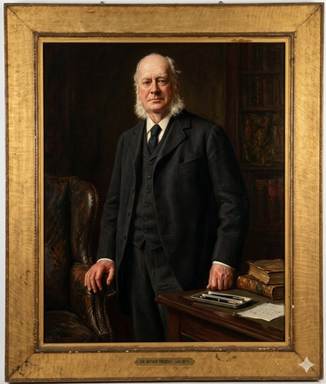
Henry Bailey Christian
In 1911 the house was sold for £4,000 to the Marist Brothers, who had come to Port Elizabeth in April 1878 at Bishop James Ricards’ request, opened a school at Glendalough in the Baakens Valley, moved to Prospect Hill in 1882 and opened St Patrick’s in 1891. Ronaldswaye became St Patrick’s School for Boys, and a plain double-storey classroom wing went up on the west side, linked to the old house by an enclosed stairway; the dedication tablet between the two records that the stone was blessed by the Right Rev. H. Macsherry and laid by the Mayor, J.C. Kemsley, in September 1916. The senior school moved to Walmer in January 1954 and the junior school stayed in Bird Street until the mid-1960s. The house was briefly the Port Elizabeth campus of Rhodes University and then, on 19 January 1967, passed to the new University of Port Elizabeth.
What Prince Alfred saw is still largely there. It is a fine double-storeyed house whose north front carries two full-height faceted bay windows, giving it a distinctly Regency air, with a single-storey veranda across the full width, cast-iron balustrading and supports, flagstone paving and a broad flight of stone steps up from the garden. The main roof is red clay tile, with two octagonal chimneys on the ridge and a joined pair on the rear gable. The garden rises steeply from the street; several mature trees survive, including a huge ficus matching the one in front of the Port Elizabeth Club, and the original pillared boundary wall and iron fencing remain, with the old stone wall of the Cora Terrace lane closing the site on the west. Inside, past a pair of heavy wooden doors, the circular staircase in the middle of the entrance hall still makes its effect, with cast-iron balustrading and curved hardwood handrails rising to a semicircular stairwell on the first floor, and white marble squares on the hall floor. Beneath the north-west room a stone stair leads down to the wine cellar, still divided by its rough wood partition, with the original racks inside and an old doorway to the garden in the former west wall.
Fleming House, 20 Bird Street — Ronaldswaye, and later Eendrag — was declared a National Monument in 1992.
Chapter 9 — A Note on the Sources
Anyone tracking these men soon discovers that the difficulty is not scarcity but attribution. Two of them were called William, were merchants, were Justices of the Peace, sat in the Legislative Council, and served the harbour and the Chamber of Commerce; their working lives overlap by about five years. The convention followed here is the natural one: entries before June 1861 belong to Senior unless a source says “Junior”, and entries after it to Junior. A few points are worth flagging.
- Arrival at the Cape. 24 April 1818 aboard the Hottentot (Harradine, Looking Back, both blogs) against 1821 (Redgrave).
- Frames and the firm. Redgrave has Frames joining Heugh & Fleming at Uitenhage in 1815 — three years before Fleming Senior reached the Cape, and longer before he became a partner. Either the date or the firm’s name at that date is wrong. No source gives the year the partnership was formed.
- Age at death. Sixty-five, from the 1796 birth year, against Redgrave’s “sixty-four years”.
- The family photograph. Its caption identifies the elderly man standing at the right as William Fleming Senior, while also identifying a grandchild born in 1862 among the group. Senior died in June 1861, so both cannot be true: either the figure is someone else, or the child is misidentified.
- Number of children of the senior marriage. Ten (Looking Back, and both blogs) against twelve (Harradine). The weight is with ten.
- Age of Junior at death. One chronology gives sixty-one; born 28 August 1833 and dead on 1 July 1894, he was sixty.
- Profession. The blogs state plainly that Senior trained as an attorney and practised before going into trade; some other entries describe him only as a merchant importer. The Pagdens descent supports the legal beginning.
- Hamilton House. Placed in Pearson Street by most accounts and dated 1864 to A.G. Warren, but one source states that its site later became the Marist Brothers College — which was in fact the Bird Street house. The two have probably been conflated.
- Board’s erf. Transferred to Fleming Senior in 1850 by one account, in 1852 by another.
- Tenants of the Bird Street house. Ebden is placed there from the mid-1860s to 1875 and Jones from 1872 to 1879/80; the overlap is unexplained.
- The Legislative Council. Senior sat for the Eastern Divisions 1854–58 and Junior in 1869–70, but one passage credits Junior with representing the Eastern Divisions until his move to Cape Town in 1874.
- The deceased estate of 1874. Wimble is said to have bought out “William Fleming’s deceased estate” in 1874, thirteen years after Senior’s death and twenty before Junior’s. Presumably Senior’s estate was still being wound up.
- Michell’s subject. Sir Lewis Michell does not say which Fleming he means; the reference to a mayoralty makes it the son.
- A fourth William. A William Fleming opened a draper’s shop at No. 35 in 1905; on the dates he is unlikely to be #3, and the connection, if any, is unproved.
Dates still unfixed, as the chronology tables in the appendix show: the year Senior co-founded Heugh & Fleming, and the years in which Junior went to Edinburgh, joined his father’s business, was appointed a Justice of the Peace, took his captaincy in the Volunteer Rifle Corps, and joined Holy Trinity.
Sources drawn on in the compilation
This account rests on the material gathered in the compilation The Fleming Family from Port Elizabeth and its later addition. The named sources are:
- Margaret Harradine, Port Elizabeth: A Social Chronicle to the End of 1945 (1996, E.H. Walton (Packaging) (Pty) Ltd, Port Elizabeth, on behalf of the Historical Society of Port Elizabeth) — Social Chronicle entries for 1842, 1846, 1847, 1853, 1856, 1860, 1865, 1866, 1878 and 1919, the biographical entry, and the article “William Fleming’s Home, 20 Bird Street”
- J.J. Redgrave, Port Elizabeth of Bygone Days — pages 55, 65, 102 and 105
- Looking Back — the extracts at pages 538, 696, 1016, 1017, 1895, 2175, 2218, 2336, 2643, 2781, 2874, 2906, 3016, 3019, 3492, 3802, 4315, 4475, 5019, 5020, 5021, 5022, 5023, 5027, 5028, 5116, 5338, 5491 and 5501
- Richard Tomlinson, “Three Elegant Houses of Bird Street” — the architectural description of the house
- Dean McCleland, “Port Elizabeth of Yore: William Fleming Senior & Junior”, 21 August 2021
- Dean McCleland, “The Flemings of Port Elizabeth: Biographies of William Fleming Senior and Junior”, 31 October 2025. The author states that the biographies in this piece were drafted by ChatGPT from his material; it is therefore a derived account rather than a primary one, and nothing has been taken from it here that is not corroborated elsewhere, except the legal training and the Pagdens descent, which the 2021 article also carries
- Sir Lewis Michell, autobiography — his assessment of Port Elizabeth residents
- G.S. Walton, History of the E.H. Walton Group: 1845 to 1995 (1995, E.H. Walton Packaging (Pty) Ltd, Port Elizabeth)
- Gabrielle Churchouse, The Reverend Francis McCleland: Colonial Chaplain to Port Elizabeth 1825–1853 (1976, Human Sciences Research Council, Pretoria)
- Margaret Harradine, Hills Covered with Cottages — Port Elizabeth’s Lost Streetscapes, the source of the sketch of the house
- The pocket diaries of J.C. Chase, selected entries and notes by Mrs M.D. Nash
- Archives of the Anglican Diocese of Port Elizabeth — the Balaklava insurance letter
- Photographs from Dean McCleland’s collection
Full publication details are given only where the compilation itself supplies them.
Appendix — The Two Chronology Tables
These summaries accompany the 2025 article. Entries marked XXXX are events for which no date has yet been established.
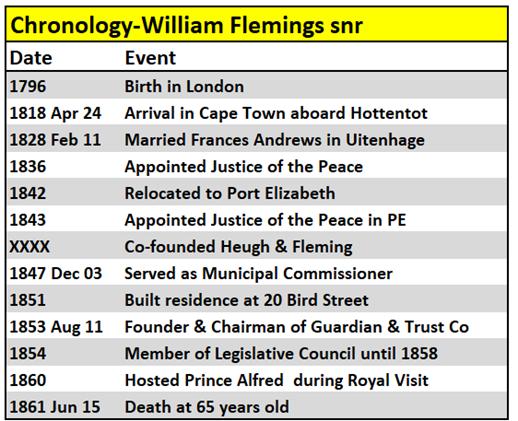
Chronology — William Fleming Senior
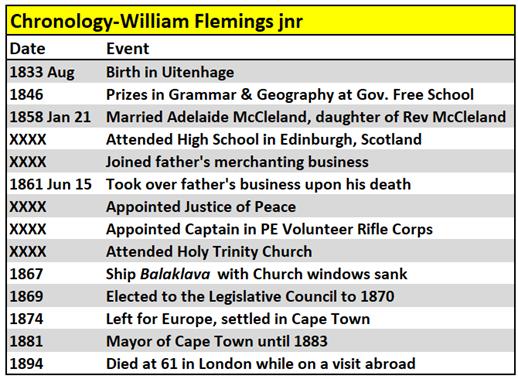
Chronology — William Fleming Junior
Index of Dates
| Date | Event | Chapter |
| 1796 | William Fleming Senior born in London | 1 |
| 1815 | William Brooksby Frames joins Heugh & Fleming at Uitenhage | 1 |
| 24 Apr 1818 | Fleming Senior arrives in Table Bay aboard the brig Hottentot | 1 |
| 1819 | Peter Heugh moves from Cape Town to Uitenhage | 1 |
| 1820 | Donkin’s memorial pyramid sited on the Hill | 1 |
| 1821 | Alternative date given for Fleming Senior’s landing at the Cape | 1 |
| 12 Feb 1824 | Frances Charlotte Andrews arrives in Table Bay aboard the Thetis | 1 |
| 11 Feb 1828 | Fleming Senior marries Frances Charlotte Andrews at Uitenhage | 2 |
| 17 Nov 1830 | Stretch surveys the powder-magazine ground at Graaff-Reinet | 2 |
| 21 Mar 1831 | Crown grant of the magazine land; Heugh and Fleming Senior among the partners | 2 |
| Nov 1831 | Government sells plots between Cuyler and Bird Streets; Fleming Senior buys | 2 |
| 1833 | Heugh and Fleming acquire the whole Graaff-Reinet magazine property | 2 |
| 28 Aug 1833 | William Fleming Junior born at Uitenhage | 2 |
| 1834 | Heugh & Fleming acquire the land that became Fleming Street | 2 |
| 1836 | Fleming Senior listed in the almanacs as a Justice of the Peace | 2 |
| 1842 | Fleming Senior settles in Port Elizabeth; founding of the Quoit Club | 3 |
| 1843 | Fleming Senior a Justice of the Peace in Port Elizabeth; first municipal meeting fails | 3 |
| 1 Jul 1844 | Formation of the Port Elizabeth Trust Association | 3 |
| 1845 | The Commercial Hall reading room; second municipal meeting fails | 3 |
| Jan 1846 | The Port Elizabeth Bank founded, Fleming Senior a first director | 3 |
| 1846 | William Fleming Junior takes first-class prizes at the Government Free School | 3 |
| 9 Jan 1847 | Householders’ meeting appoints Fleming Senior to draft municipal regulations | 3 |
| 8 Feb 1847 | The regulations adopted and sent to Government | 3 |
| May 1847 | The first public concert in Port Elizabeth | 3 |
| 3 Dec 1847 | Fleming Senior elected to the first Board of Commissioners | 3 |
| Dec 1847 | Fleming Senior appointed a Harbour Commissioner for Algoa Bay | 3 |
| 1 Jan 1848 | Paterson takes over the Eastern Province Herald with Fleming Senior’s backing | 3 |
| Jul 1849 | Fleming Senior chairs the first annual meeting of the Public Library | 3 |
| 1849 | Colonel Cuyler writes to a Mr Fleming about the Donkin pyramid | 3 |
| 1850 | Fleming Senior Treasurer of the Anti-Convict Association | 3 |
| 23 Oct 1851 | Government Gazette records the Bird Street house under construction | 4 |
| Apr 1852 | Board’s neighbouring erf passes into Fleming Senior’s name | 4 |
| 11 Aug 1853 | The Guardian Assurance and Trust Co founded, Fleming Senior chairman | 4 |
| 1854 | Fleming Senior’s address given as Bird Street; elected MLC for the Eastern Divisions | 4 |
| Sep 1856 | The Volunteer Rifle Corps founded; William Fleming Junior an officer | 5 |
| End 1856 | Heugh & Fleming becomes W. Fleming & Co. | 5 |
| 1857 | The Guardian building erected in Main Street; Heugh sells out at Graaff-Reinet | 5 |
| 21 Jan 1858 | William Fleming Junior marries Adelaide McCleland at St Mary’s | 5 |
| Jul 1858 | Death of Peter Heugh | 5 |
| 28 Nov 1858 | Birth of William Fleming #3 | 5 |
| 6 Aug 1860 | Prince Alfred lands at Port Elizabeth and lodges with Fleming Senior | 5 |
| 6 Sep 1860 | Birth of Elizabeth Fleming | 5 |
| 15 Jun 1861 | Death of William Fleming Senior | 6 |
| 16 Jun 1861 | His funeral; J.C. Chase a pallbearer | 6 |
| 1861 | William Fleming Junior photographed as a captain of the Rifle Corps | 6 |
| 22 Jan 1862 | Birth of Frances Charlotte (Fanny) Fleming | 6 |
| 16 Dec 1862 | Death of Elizabeth Fleming in infancy | 6 |
| Jul–Oct 1863 | Frances Fleming leaves the Colony; the mansion offered to let | 6 |
| 21 Nov 1863 | Birth of Alice Mary Fleming | 6 |
| 1864 | The house registered to Frances Fleming and valued at £4,000 | 6 |
| 22 Mar 1865 | Foundation stone of the Custom House laid on Fleming ground | 6 |
| May 1865 | The Port Elizabeth Club founded, William Fleming Junior on the committee | 6 |
| 30 Sep 1865 | Birth of Mabel Katherine Fleming | 6 |
| 1866 | The Zwartkops Land, Irrigation and Waterworks Co formed | 6 |
| 14 May 1867 | The Balaklava sinks with the Holy Trinity windows aboard | 6 |
| 1869–70 | William Fleming Junior sits in the Legislative Council | 7 |
| 1874 | William Fleming Junior and Adelaide leave Port Elizabeth for the Cape | 7 |
| Apr 1880 | The Bird Street house transferred to H.B. Christian | 8 |
| 1881–1883 | William Fleming Junior serves as Mayor of Cape Town | 7 |
| 24 Jul 1890 | Mabel Katherine marries Surgeon Captain Alfred Wright | 7 |
| 1 Jul 1894 | Death of William Fleming Junior in London | 7 |
| 1911 | The house sold to the Marist Brothers for £4,000 | 8 |
| 1917 | Death of Adelaide Fleming at Camberley, Surrey | 7 |
| 24 Jan 1929 | Death of Fanny Fleming | 7 |
| 1940 | Death of Alice Mary Fleming | 7 |
| 12 Feb 1941 | Death of William Fleming #3 | 7 |
| 7 Nov 1962 | Death of Mabel Katherine Wright at Wynberg, aged 97 | 7 |
| 19 Jan 1967 | The house passes to the University of Port Elizabeth | 8 |
| 1992 | Fleming House declared a National Monument | 8 |