The Opinion Pieces are an eclectic bunch on current affairs & history often with a human interest aspect. The Movie/DVDs reviews are mainly on documentaries with a smattering of movie reviews.
Welfit Oddy represents the second wave of economic development of Port Elizabeth. Whereas the first wave was predicated upon agricultural products, the next wave broadly encompassed engineering of which the vehicle industry was a substantial component.
Main picture: Welfit Oddy’s premises from 1946 to 1944-Plants #1,2 & 3
Adversity never deters the determined individual and John Roland “Dummy” Brown had to face much adversity in his truncated life. Hence his life would be somewhat out of the ordinary.
Main picture: Painting of the Baakens River Valley by John Roland Brown
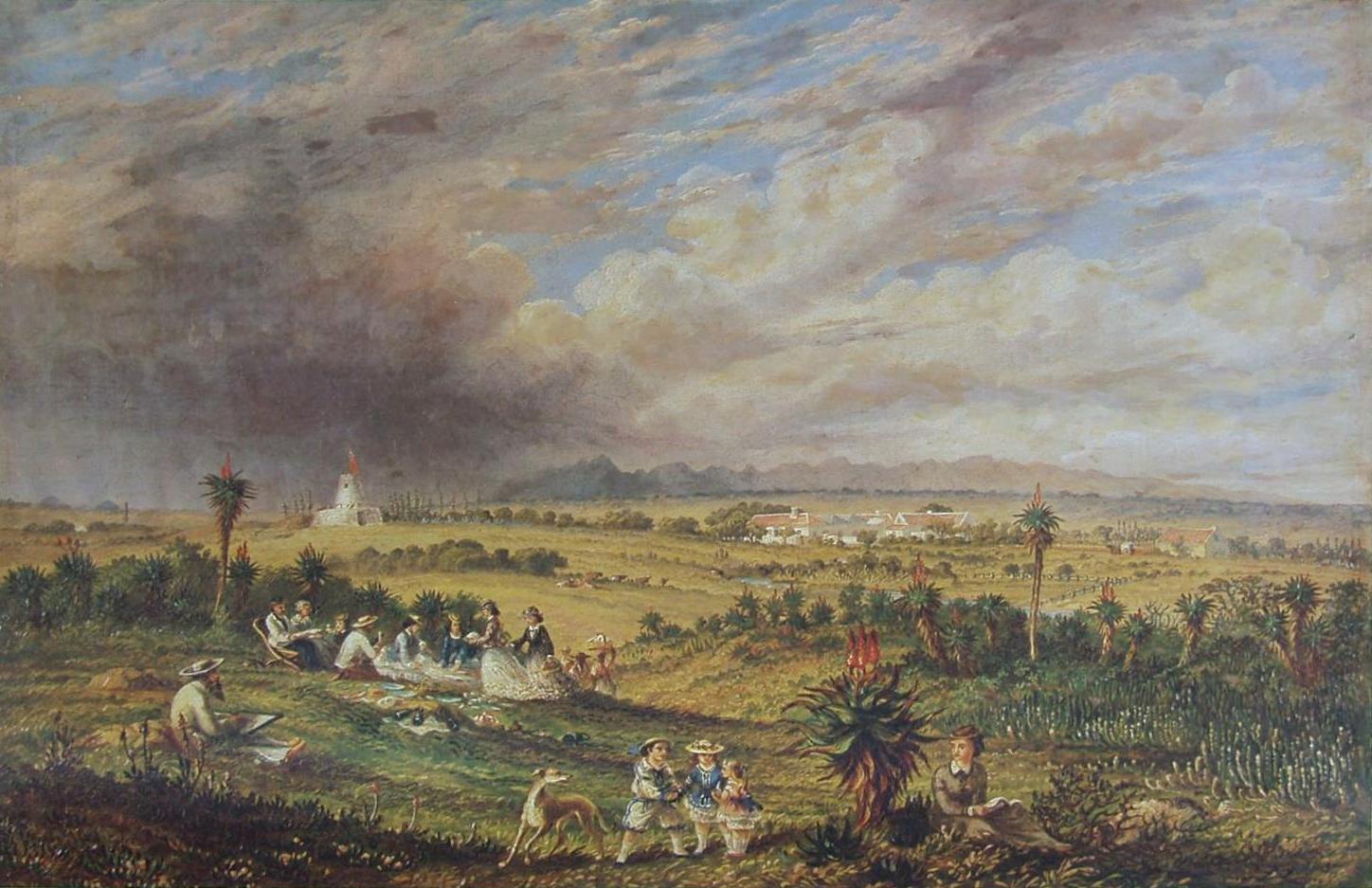
The English artist, Thomas Baines, was a prolific painter as well as a prolific explorer, travelling extensively over British colonial southern Africa as well as Australia. Born on the 27th November 1820 at King’s Lynn in the United Kingdom, he died 55 years later on the 8th May 1875 in Durban. Baines was one of the greatest African travellers, his geographical coverage, variety of subject and prolific output far exceeded any other artist based in South Africa. It was during a visit to Port Elizabeth during 1873 and 1874 that he was to paint a picture of Cradock Place amongst others.
The commentaryon the painting in this blog is derived verbatim from the thesis of Marijke Cosser entitled Images of a Changing Frontier Worldview in Eastern Cape Art, From Bushman Rock Art to 1875 which was submitted in fulfilment of the requirements for the Degree of Master of Arts of Rhodes University in December 1992
In its heyday, Fogarty’s was the pre-eminent bookshop in Port Elizabeth occupying premises in Main Street commencing in the basement of No 59 Main Street in 1946. The range of books was extensive especially in military history of which I was an ardent fan. Not having money to purchase, I would nevertheless spend hours perusing the books on display.
The central areas of Port Elizabeth are experiencing degeneration commonly known as urban blight which is a consequence of neglect. Urban blight is cumulative and self-reinforcing as blighted buildings cast a pall on land around them, discouraging upkeep, and stifling renewal. Once this process is entrenched, it engenders further degeneration which hinders a process of renewal or gentrification.
Unfortunately neither the city fathers of the 20th century understood the gravity and necessity of the preservation of this cultural gem nor do the existing civic leaders.
Main picture: Donkin row showing the original balcony
In the firing line Perhaps the most egregious example of the lack of forethought regarding the cultural or architectural significance of a building must be the proposal regarding the future of the Public Library during the 1960s. For some unknown reason, the City Council acquired the Cleghorn’s building. As the Provincial Administration in 1960 showed an interest in acquiring the building, the Town Council sold it to them. It then came to light that the Provincial Administration proposed to demolish both Cleghorn’s and the Public Library in order to build offices on the site. This proposal was abandoned when sense prevailed. The Cleghorn’s Building was not as lucky as it was demolished in July 1972 for road widening purposes. If the City Fathers had prevaricated instead for a decade or two, this decision might had been questioned as history will illustrate.
Perhaps the demolition of the Cleghorn’s Building instigated the notion that the City Hall was not fit for purpose as the City Council in 1972 debated the motion to demolish the Town Hall. Yet again wisdom prevailed, and the conservationists won the day by having it declared a National Monument in November 1974. Swaying the argument was its role in the settlement and the establishment of Port Elizabeth as a town. Surely apart from its cultural significance, its elegant design should have motivated for its retention.
Barely were the victory celebrations over for its retention when in 1977, tragedy struck. A fire ravaged the hall, reducing it to a smouldering memory of its original grandeur. Would the grand old building with its timeless elegance be reprieved twice in quick succession? However, in 1977, thanks to its importance and significance to the city and its people, it was decided to restore and rebuilt it. A local consortium of architects, in collaboration with specialist architectural consultants, were appointed to redesign and restore the City Hall. The attitude to restoration was thus that the facades be authentically restored and the interior be redesigned in keeping with traditional Victorian detailing. Restoration work commenced in 1979 and was completed in November 1981.
Lack of foresight The project mentioned hereunder can be termed a monumental faux pas perhaps driven by megalomania with a huge dollop of lack of foresight. Conventional wisdom dictated that as the Central Business District lacked parking space, unless action were taken to address this issue, the existing tenants would flee the area for the suburbs. Their supposition was correct, but their remedy was not. What the Council had failed to do was to demolish the stereotypes by understanding that conventional wisdom does not have to be necessarily true, but it must be simple, convenient, comfortable and comforting. Hence it is beguiling.
Above: Buildings L-R Mosenthals, Richardsons, Reserve Bank
What the Council proposed was to provide a massive park and ride scheme from town to the Hill. For this purpose, they acquired the dormant Collegiate School buildings in Bird Street to serve as a parking lot. Next, equally scandalous, they purchased the Union Castle Building as well as the Mosenthal and Richardson Buildings. These buildings including others in Jetty Street were all demolished to serve as a Bus Terminus. In one fell swoop the Council had achieved in several years what urban blight might have taken half a century. This scheme was doomed to fail as it failed to address the core issue which most cities around the world were experiencing – the dispersion of retail palaces into the suburbs. This process was ineluctable and like King Canute, the Council was unable to prevent the inevitable viz the development of malls in the suburbs.
Above: Collegiate School Bird Street
A Civil Engineer’s Dream The Sixties were idyllic for civil engineers in Port Elizabeth. The City was on a role. The City’s industrialisation policy of the 1950s of providing cheap commercial and Industrial land and as well as adequate supplies of electricity and water, had attracted new entrants to establish their motor plants in Port Elizabeth. A shot across the bow was Toyota when it elected to erect a plant in Durban. Unbeknown to the residents of Port Elizabeth, this would be the proverbial hole in the dyke. The mood had soured on PE. Militant unions and the Sullivan Codes implemented by American firms were the final straw. The birthplace of militant unions in Port Elizabeth would be the death knell of motor plants in the town. Naturally, other issues were equally compelling such as 70% of the market being in the Transvaal.
Above: The Russell Road interchange
What did the Civil Engineers perceive? The plight of a congested town with a drive from town to Deal Party being insufferably long. Also due to the lack of a road from the western suburbs to the industrial areas meant that the drive was becoming ever more tiresome. What the city lacked was a series of freeways to cater for this need and what better profession to ease the City’s pain than that of the Civil Engineering fraternity. Their plans would ultimately consist of three major aspects:
A freeway from Deal Party along the North End beach to Humewood
A freeway from the western suburbs to Deal Party which would also serve as the National Road bypassing the centre of the town.
A massive civil engineering works comprising multiple tunnels and impressive bridges along the Baakens River thereby obliterating Port Elizabeth’s green lung.
Once more common sense prevailed. The salivating Engineers were restrained by reality and by the Council from proceeding with item number 3 on their to-do list. As reality dawned that the 1960s were the high tide mark of Port Elizabeth’s growth, the professional people such as the Civil Engineers were in retreat heading for greener pastures with as the satellite towns to Joburg mushrooming.
Above: Damage to the Harbour Master’s Building which has been stripped of lead
But what did these freeways have to do with Port Elizabeth’s heritage. Plenty. To connect Deal Party with Humewood meant the obliteration of one of the most historic parts of Port Elizabeth. Instead of placing the elevated roadways above the railway lines, they demolished a substantial portion of Strand Street. If one includes the flattening of Jetty Street and the historic buildings at its entrance at Market Square, a significant fraction of the town’s heritage was eliminated in one fell swoop.
In conclusion, instead of building the park and ride parking area under the Donkin Reserve and by saving money by marginally lengthening the overhead freeway at Strand Street, irreparable damage was done to the original architecture of the area.
Insouciance In this context, insouciance represents a casual lack of concern or even indifference to the destruction of Port Elizabeth’s architectural heritage. In attributing blame, the parties culpable are the developers, the owners and the relevant authorities.
It must be borne in mind that when a structure has been formally declared to be a National Monument, any repairs, maintenance, or reconstruction have to comply with the prescripts of the Heritage Act. Per Shakespeare’s Hamlet, it is “more honoured in the breach than the observance”. In effect, these actions should not change the structure in whatever manner or form. For instance did the recent changes to the Feather Market Hall comply with the Heritage Act. Another example that I frequently allude to is the renovation of the Donkin Row. Many changes from the original units are easily spotted such as the design of the balconies. Another personal bugbear is the removal of original distinctive features.
Bridges featured prolifically in Port Elizabeth’s storied history. In the early days the town was bifurcated into Town and South End by the pesky Baakens River with its the rude predilection for periodically wash away the bridges leaving the South Enders trapped on the south side of the river until the water subsided. Local ingenuity would emerge and entrepreneurs would provide alternative means of crossing usually by means of a makeshift raft.
Amongst the treasure trove of entrepreneurs that were conceived by this unlikely town, was as equally unlikely character: James Somers Kirkwood. Initially he arose to prominence due to his wit, showmanship, bonhomie and vitality in the auctioneering business. Why these character traits created the “Kirkwood Show” was James’ ability to convert even the unlikeliest and most mundane of sales into a skit, a parody or a comedy. Perhaps entertainment would have been a more rational vocation for him. The trait that most defines a comedian is that of intelligence and Kirkwood probably possessed it in spades. However, what he is best remembered for today, is his vision for the development of the Sunday’s River. Recession, drought, vision before its time as well as the discovery of diamonds at Dutoitspan, all drove potential investors to forsake the local developments and instead to seek fame and fortune in Griqualand West. Mores the loss for Kirkwood and Port Elizabeth.
The only major Colonial Military Unit formed in Port Elizabeth during the 19th century was the Prince Alfred’s Guards. This unit had already been bloodied in the Battle of Umzintzani on Saturday the 24th February 1877. This battle can be catagorised as the unit’s baptism of fire. In this case, the PAG would be involved in a conflict of a very different nature as many of the Basutos were armed with Martini-Henry rifles that were superior to the Sniders of the colonial forces. Besides this, the magnitude of this campaign was fraught with other difficulties such as concurrent rebellions and uprisings.
The details of the military actions are based upon the book Prince Alfred’s Guards 1856-1966 by Neil Orpen.
Main picture: Grand review of the PAG on Donkin Reserve in 1873
James Laing was a Scottish missionary who spent the greater part of his life ministering to the needs of the amaXhosa who used the sobriquet indoda ebisithanda -The Man Who Loved Us – to describe him. Even though Laing never stayed for long in Port Elizabeth, as he was merely passing through, he has left us with a verbal sketch of the town together with his view of the town.
The Port Elizabeth Museum has taken a winding journey using temporary accommodation until it was relocated to purpose-built facility. This location was Bayworld in Humewood. Instrumental in this final relocation was one of their most noteworthy directors, Dr Geoffrey Roy McLachlan. Through his endeavours, Bayworld, as it is now called, is a scientific repository of the local natural history – birds, mammals, fossils, shells and relics of the early inhabitants of our hinterland. As the Herald in a tribute to Dr Geoff McLachlan put it: “He was internationally renowned as an ornithologist, a respected natural scientist and an imaginative museum director.”
This blog celebrates the life of this outstanding person. This blog has largely been based upon an online obituary.