

Better known as Darby, the Whaler, David Doit only appeared on the local whaling scene in the latter half of the 19th Century after having spent time in Grahamstown after his birth circa 1838. Doit obtained employment with the P.E. Boating Company as an oarsman and later promoted as a coxswain, a position that he held for nearly 30 years. It was during his extended stint as a crewmember of James Searle’s boat that his sailing skills were finely-honed.
Competition between rival firms was keen in those days and the crews used to spend hours on the Donkin watching for a whale to ‘blow’ in the Bay. As soon as one was spotted, there was a race to the beach in order to launch their boats and the first crew to harpoon a whale were handsomely paid by the owners.
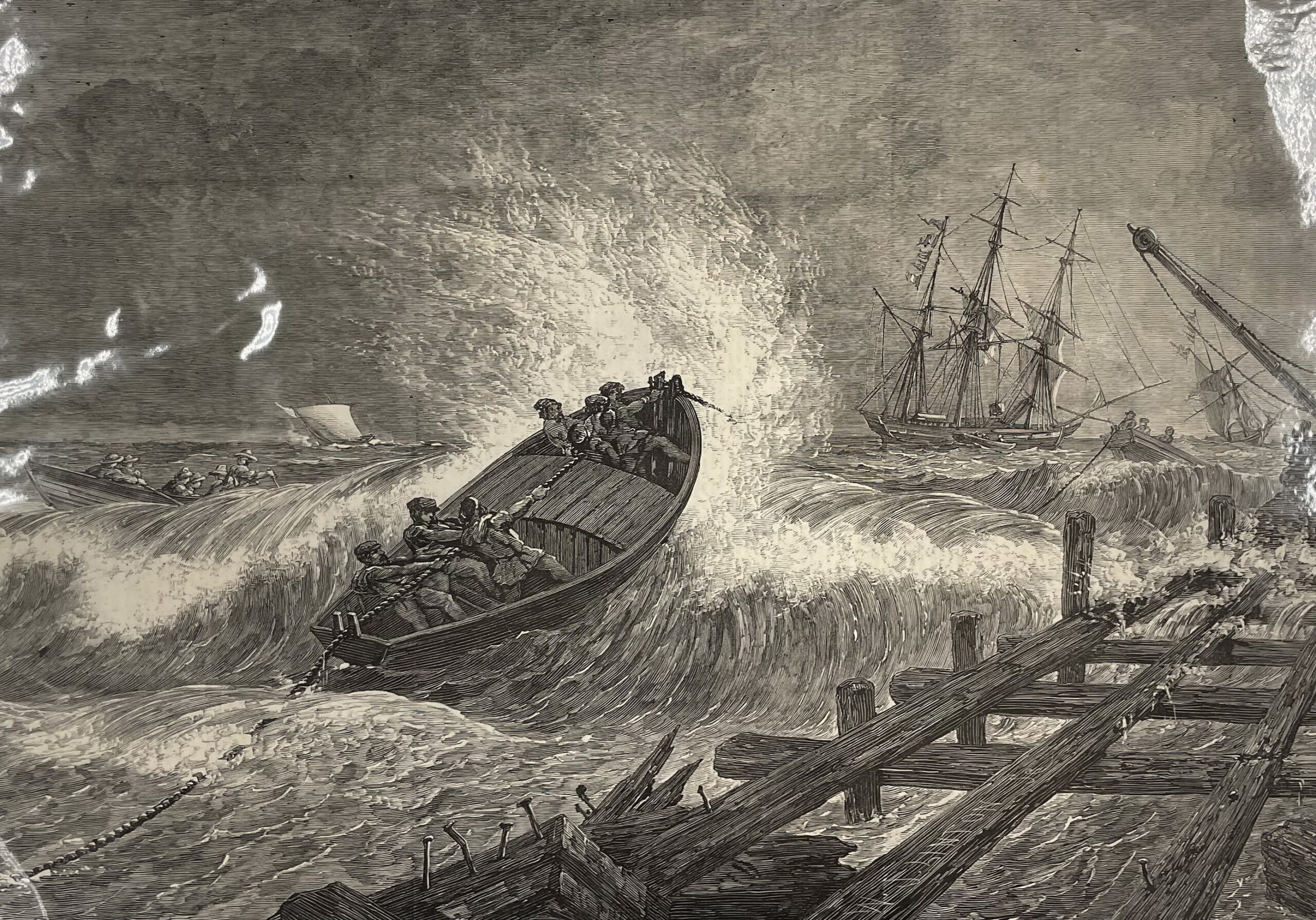
Main picture: Painting by Thomas Baines of a surfboat being launched through the breakers
It was only during their spare time that Darby and his crew could go whale hunting. As time passed and Darby honed his skills as a whaler so did his reputation as a whaler gain prominence. Despite being 2 metre tall, this Malay was recognised as a gentle giant but he simultaneously gained a reputation as being fearless. It was told that he was capable of firing a 40 lb. brass gun from his shoulder while standing in the bow of a whaleboat. More often than not, the end result would be a dead whale being landed on North End beach where the whale would be sliced up and its oil extracted. For this they would be handsomely paid. For the crew it could total up to £300 with an extra £50 being awarded to the coxswain for the level of skill displayed. On occasions details of Darby’s exploits would even appear in the local newspaper. In the case of harpooning a whale during August 1891, it was reported that “by a lucky throw” he had killed his eighth whale that year with the 5 oarsmen being praised for their skill in manoeuvring Darly so close to the whale.

The whalers’ modus operandi was later amended. Instead of standing on the Donkin, a signalman would be posted on St. Croix Island to alert the whalers to the fact that whales were in the vicinity. In this case, the signal was in the form of a more prominent marker viz lighting a fire. During August 1896 after noticing that the fire had been lit, Doit set off after the whale and harpooned it successfully. With the sun setting, they released the whale and set off for the shore but would retrieve the corpse the following morning.
The wrecked barque Cambusnethan near Springmount
On a Saturday morning news was received through Mr. Dalton of Mr. John Deverin’s farm in the Alexander district that the barque Cambusnethan had been wrecked off the coast near Springmount on the 5th May 1897. The incident had occurred at 2 30am the previous Wednesday, but notwithstanding that the distance to town was only 35 miles, the agents, Messrs. Reiners, von Laer & Co had no knowledge of the wrecked vessel until Saturday, owing to the difficulty of getting the news through.

As soon as possible the tug Sir Frederick left for the scene of the wreck to ascertain what could be done despite the long hiatus. Messrs Reiners and Chase left in the tug while a whaleboat with Darby and his crew were towed along too. Without too much effort, the tug, Sir Frederick, came upon the wrecked Cambusnethan. This vessel had been eponymously named after an historic village and parish in North Lanarkshire, Scotland, located about 1.5 miles southeast of Wishaw.
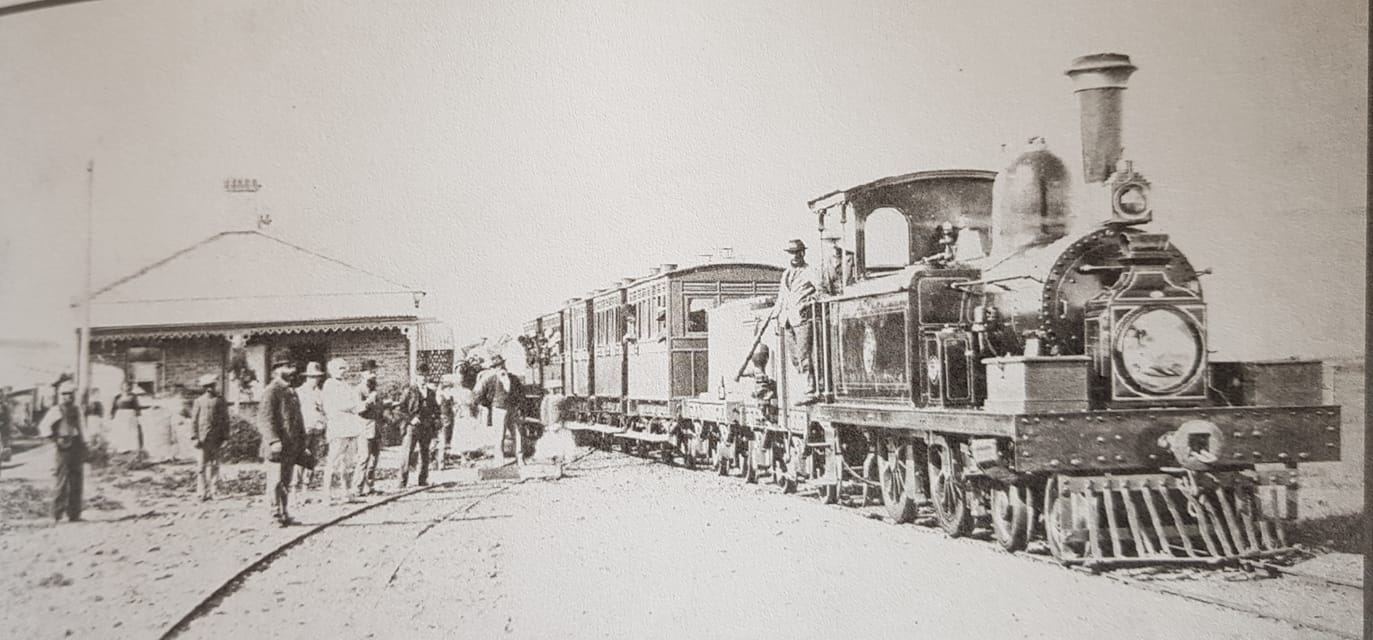
The tug, Sir Frederick, came upon the wreck at 4 p.m. Because there was a heavy sea running at the time, it was believed to be inexpedient to get on board the Cambusnethan. Instead they elected to land the Sir Frederick, this proved to be no easy task as not only was the sea very rough, but there was also a heavy current running around that part of the coast. Notwithstanding the difficulty, Darby was an expert at the art of steering and hence he managed to safely land the whaleboat with Reiners and Chase on board. The party then trekked up to Daverin’s farm where the captain and crew of the recked vessel were patiently awaiting their arrival. All told including the boat’s crew, there were 28 people in the farmhouse.

About two hours afterwards, an attempt was made to get to the Sir Frederick, but this proved to be an extremely arduous task. With heavy rollers beating against the shore, it proved impossible to get past the breakers. No sooner had they released the whaleboat from the land, than it was swamped. At length, the attempt was abandoned. Instead Messrs Reiner and Chase as well as Captain Hughes of the Cambusnethan resigned themselves to a long walk home. They were supplied with cart which they used as far as Coega where they expected a train service to be available. To their chagrin no train was available from Coega so the trio resigned themselves to walk to the Zwartkops station. Much to their relief a train was available at Zwartkops. The trio finally arrived home on Sunday night.
As the Cambusnethan steadily disintegrated in the breakers the 23 man crew was left with no option but to follow in the footsteps of Messrs. Reiners and Chase along the coast. They arrived at Port Elizabeth on Monday night.
Severe damage caused by a whale attack
In June 1898 they again set out after a whale was sighted in the Bay. When the harpoon entered its body, it returned and attacked their boat, causing severe damage. Luckily for the men, a tug Sir Frederick was in attendance and it towed both the dead whale and the severely damaged whaler back to port. A month later Darby and his crew landed a 50 foot female.
Award by Emperor of Germany
The barquentine Ludwig was a regular visitor to the port invariably bringing a cargo of sugar from Mauritius. By being a regular, Captain Aden, in all probability felt comfortable to handle the fresh south easter which had been blowing throughout the previous day, the 7th November 1899. Even though the wind moderated later in the afternoon, the sea was very rough and waves rolled onto the beach with great force.
Those on the North Jetty cast a concerned eye on the Ludwig. The south easter concerned them but with the anchors still holding concerns were muted. But as time passed, it became noticeable that the Ludwig had shifted a considerable distance towards the shore. Like a concerned parent, James Searle watched the unfolding danger. Searle set off in the Eland to offer a warp or anything else which might assist the Ludwig. Even though he considered it not necessary, he returned the Eland to the jetty to pick up a spare anchor and warp as well as a whaleboat and its crew.
By then it was too late. The rocket was shot off to indicate that their assistance was required. But it was too late. The Ludwig was already in the breakers. Efforts were made to pass a warp across to the Ludwig but for an inexplicable reason, it slipped. A second attempt was made to pass the warp across. It slipped as well.
It was then that one of the boatmen, slipped between the vessel and the boat being severely crushed in the process as the two vessels collided side-on. Noting the predicament, another boatman named Sherith, George Burness from South End, plunged into the water in an attempt to rescue him, but he drowned in the attempt. The Ludwig was unsalvageable. With the whaleboat on hand, the crew of the Ludwig were picked up and taken to shore at North End beach.
The German Consul
The Geran Consul, Mr. Schabbel, was awaiting them on the beach to offer condolences and physical assistance to the shipwrecked master and crew. The crew were taken to town to be supplied with new clothing courtesy of Messrs. Newton and Co. Their final destination was the Seaman’s Institute under Capt. Howseason.
Doit received £10 from the Emperor and the King of Germany Award for his part in the rescue of the crew of the German barquentine Ludwig wrecked in the Bay in November 1899
Death
Despite the number of extremely dangerous actions and rescues that Doit had undertaken in his extensive boating career, David died from natural causes on the 4th October 1903 at the age of 65. During his life, he was recognised as the best handler of a surf boat on the coast and the word danger never entered his vocabulary.
During the Anglo-Boer War, Darby was selected to take charge of landing military stores through the surf on the Zululand coast using a hand-picked crew. During the operation, he chose to use his own boat’s crew which was completely successful.
Darby died at his home in South Union Street on the 4th October 1903 at the age of 65 surrounded by his family and the steersman, Abdul Salem Madat, and the crew of his boat Weltevrede. It is believed that after his death, some of his descendants have adopted the surname Davids or Dawood.
Darby was recognised as the best handler of a surfboat on the coast and it is said that the Southern Right whale skeleton hanging in the Bayworld Museum belongs to another victim of Doit’s accurately thrown spear.
Sources
Port Elizabeth in Bygone Days by JJ Redgrave (1947, Rustica Press, Cape Town)
Algoa By in the Age of Sail (1488-1917)- A Maritime Story by Colin Urquhart (Bluecliff Publishing)
The Shipwrecks of Algoa Bay & St Francis Bay on the West Coast of South Africa by Warren Morris (2005, Xpress Print &Copy)
Port Elizabeth: A Social Chronicle to the end of 1945 by Margaret Harradine
Good day. Who can I speak to about the one photo The Steam Tug “The Sir Frederick”. Id love to obtain a copy to print. We bought a large print years ago but it has now faded and I can’t seems to find anyone else with a copy. Please could Dean McCleland possibly let me know. Thank so much
Hi Erin
Try Mike Wilkinson at mwships4u@gmail.com
Dean McCleland
082 801 5446
Hi Erin
Email me a copy of the faded one & I will check whether I have better copy
Dean McCleland
082 801 5446
deanm@orangedropdesigns.co.za