The Opinion Pieces are an eclectic bunch on current affairs & history often with a human interest aspect. The Movie/DVDs reviews are mainly on documentaries with a smattering of movie reviews.
HB Smith was the instigator and progenitor of the plan to rescue No. 7 from a dystopian future unless the house which he recognised as one of the oldest houses in Port Elizabeth was restored. He selflessly undertook this task in the twilight of his life. After writing an article on the role that HB had played in setting this house on its path to restoration, I was contacted by a member of the family, HB’s granddaughter, Angela Hidden (nee Smith). When she told me of her experiences of No. 7 during its final days as a home, I made a humble request that she write a blog of her experiences as a youngster to which she willingly agreed.
Angela Smith was born is 1955 and this blog relates to the period 1959 to 1962 when HB passed away. This is her story in her own words.
I can vividly recall my father fixing, servicing and repairing his own vehicle, a Vauxhall Victor during the 1960s. He was probably the final tranche of backyard mechanics who would never admit to using a qualified mechanic to service or repair his vehicle. What enabled home repairs was the fact that the vehicles possessed no electronics as everything was mechanical. I recall in the ’60s bleeding my Beetle’s brakes and setting the engine’s timing. Today I battle to find the lever to open the bonnet!
In this blog Norman Smith recounts the idiosyncratic methods used by him to keep his Morris Ten on the road.
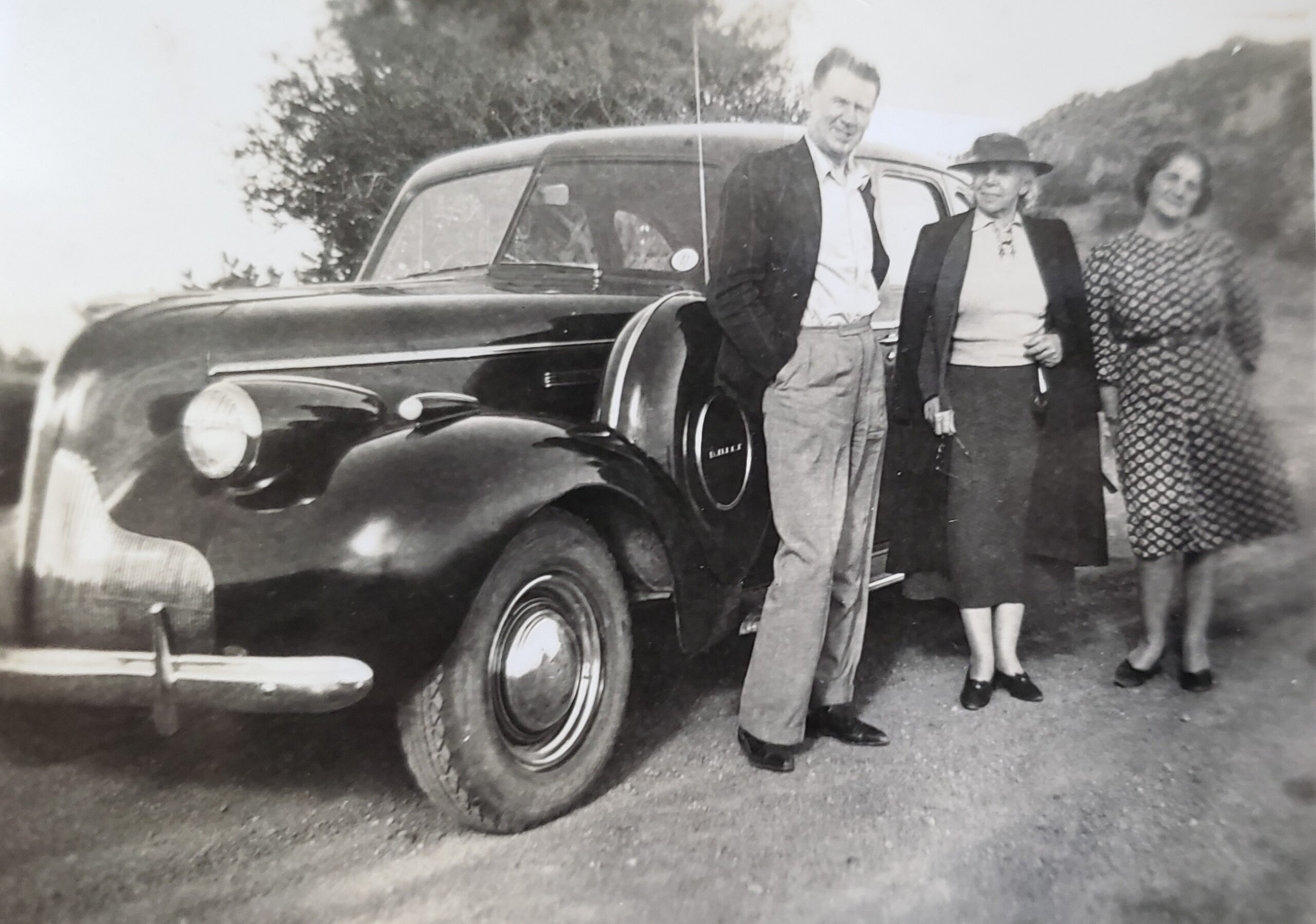
Main picture: Morris 10 of Norman Smith
We could at last afford a cheap second car. I sniffed around and eventually located a 1948 Morris Ten, re-sprayed in a fair imitation of “British Racing Green” and with passable seat covers. At £275 and with 33000 miles on the “clock” it seemed reasonable, so I took it for a test run. It battled manfully in 2nd gear up Albany Road (gradient about l in 10) while the salesman assured me that “She just needs to warm up”. On the level along Cape Road, with the accelerator flat on the floor she managed to get up to just over 30 miles per hour – the warming-up period seemed excessive. I said that although my wife was not a hell-driver she would need something a little more vigorous. He suggested that we stop and check to see if there was anything wrong.
The Morris 10 with Norman’s mother, Mae Marguerite Smith and friends
With the bonnet open, we regarded the engine. I observed one sparking-plug lead hanging dismally down alongside the engine- and waited for him to re-unite it with its colleague. A nasty little imp on my shoulder prevented me from reaching out to do the job myself. He muttered something about not understanding, and then I suggested that we return to the showroom and forget about the sad machine.
Back in the showroom he excused himself for a moment. He returned with a hopeful look on his face and asked whether £250 would interest me. We agreed on the new price and in due course I took delivery and headed for home with my lame duck. Once clear of the premises, I stopped and opened the bonnet. Seconds later, with the offending lead back on the plug top we set off up Albany Road as if Beelzebub were determined to demand his ransom from me.
He got his own back a couple of years later when Sheila rang me at work to ask for help. Her car started OK but wouldn’t move an inch. Inspection revealed that one of the half-shafts in the back axle had sheared as a result of historical over-exertion. It also became apparent from the excessive “play” in the crown-wheel and pinion that the mileage reflected on the speedometer could have been accurate if one accepted that it was “second time round”.
After many thousands of miles (in those days kilometres were just funny things beloved by queer types like Continentals!) she began to burn unacceptable quantities of oil. At a little over 40 years old, I had no qualms about replacing the piston rings. I’ll draw a veil over the details of the stripping-down process. Experience in Electrical Engineering proved a poor substitute for a motor mechanic. However, the new rings having been purchased, they proved to be a few microns too large for the bores. Many laborious hours with a carborundum file later reduced their diameter just enough to admit them to the bores.
As I re-assembled the parts it became apparent that I might have a fairly tight engine on my hands, but with hope and liberal quantities of colloidal graphited oil I pressed on and completed the assembly. When I tried to turn the engine with the starting handle it wouldn’t budge. I tried again with Sheila operating the starter. Solid as a rock! We pushed her out into the road and coupled up a tow-rope from the Vauxhall, which Sheila drove slowly down Water Road. When I tried to engage the clutch in top gear there was a fearsome juddering but no sign of the engine turning. I had disconnected the ignition because the last thing we needed at this juncture was heat on those pistons, and now I played my last card. I operated the starter while engaging the clutch. It worked! I let the Vauxhall drag the re-vitalised Lena for a couple of hundred yards down the road, stopped and re-connected the ignition and switched on. Praise be – she started! She never again burnt a drop of oil up to the day we parted.
Leapin’ Lena had many endearing characteristics and the kids loved her. ( In fact, when we replaced her some years later in 1960 with a spanking new Vauxhall Victor station wagon there were many dewy eyes and not a little grizzling to bid her farewell.) One of her idiosyncrasies was her movement along roads with a little waviness. She adopted an up-and down motion combined with a charming roll. This was due to only one shock-absorber functioning.. The other three had long since given up the unequal struggle against anno domini and we couldn’t afford to replace them.
On another occasion I had to drive out to Lovemore Park to retrieve Sheila. She drove the Vauxhall back to Walmer while I struggled after her with Lena. The problem was a broken throttle linkage. I replaced it with a temporary jury-rig consisting of strings to control throttle opening and closing, not unlike a puppeteer’s controller, with the strings passing out through a gap in the bonnet and in through the driver’s window. This arrangement called for some very precise anticipation of traffic situations! Needless to say, proper repairs were conducted without delay.
One could continue ad infinitum, as on the occasion when ” the chimney went on fire” – this was after the great piston-ring replacement, when the running-in process was complete. Driving briskly down the Schoenies road in the dusk I became aware of a strange shower of sparks appearing in the rear-view mirror. It transpired that in her oil-guzzling days much of the oil that remained unburnt simply passed out of the engine and was deposited in the exhaust system. On this interesting evening, with my enthusiasm pushing the revs up a bit, the resulting heat set fire to the oily deposits!
As already mentioned, the children briefly mourned her passing but I think Sheila was not quite so unhappy. Our finances had improved somewhat by 1960 and I was able to negotiate a satisfactory deal with the salesman at Williams Hunt regarding the Victor. When he offered me £50, I said sorrowfully “£50? My dear chap, you’re looking at a dying breed. They don’t make them like this any more!”. With a sardonic smile, he said “L75?”. I said “Done!”.
So ended my relationship with one of the most interesting cars I have ever owned. But now, in 1999, much of what she taught me is useless. Everything under the bonnet is either sealed or incomprehensible. Verily, they don’t “make them like that any more”. Perhaps it’s just as well!
Note: The Morris was called Lea for short. Harold named all of his cars with girls’ names). This one was Leaping Lena because of her rather less than smooth drive! I think Dad chose Lena for alliteration with the L in leaping. He enjoyed playing with language! Also the name would have to have 2 syllables to balance with ‘Leaping. X
Source: Article entitled Leapin’ Lena by Norman Smith
In a series of articles, Norman Smith, the son of HB Smith, records events of his life in Port Elizabeth. In this one, he records what life was like in early Mill Park shortly after it became the suburb in the country. This is a lightly redacted copy of that article.
Norman Smith, the son of Harold Bayldon Smith, a well-known local architect and surveyor, recalls the houses in which he lived. In this blog he describes living in No. 22 Bird Street. In doing so, he provides us with a peep into what life in Port Elizabeth was like in that era.
Of all the houses in early Port Elizabeth, only No. 7 Castle Hill has been sketched or painted over the ages. The reason is obvious. Initially it was the fact that it was owned by the Rev. Francis McCleland, the first clergyman at St Mary’s church but for later painters it was that fact that the dwelling occupied a prominent position on the hill.
Early pictures of Port Elizabeth in which No. 7 Castle Hill can be identified are helpful, but as Mrs Trehaeven, the curator notes in an article in Looking Back, that these sketches seem to present conflicting evidence. One must bear in mind that the aim of the artist was generally to present a panoramic view. He would not be much concerned with details of specific buildings. What the artist failed to appreciate was that future generations would only have these sketches and drawings as their reference work.
Main picture: No. 7 Castle Hill [supplied by Angela Hidden nee Smith]
Both Amsterdam Hoek and the Amsterdam Flats near Zwartkops are named after the Dutch warship turned troopship Amsterdam. After being badly damaged in a storm in order to save the crew and passengers, the captain elected to run her aground halfway between the Coega and Zwartkops Rivers on the 16th December 1817.
This would be the proverbial race against time. Notwithstanding all of the pumps working flat-out and the crew manually bailing out the water, the rate of water removal was lower than the rate of ingress. Slowing their rate of movement was the loss of masts and sails. Furthermore with the internal water rising, the vessel became unresponsive while the onboard water sloshed left and then right, making the ship unstable. Adding to the water internally were huge waves which broke over the floundering vessel.
This is the story of that desperate race against the sea largely extracted from the book The Bay of Lost Cargoes being a record of the Shipwrecks of Algoa Bay by Warren F. Morris
Main picture: Captain Hermanus Hofmeijer of the Amsterdam
Within several years of the first permit for the slaughter of seals in Algoa Bay being issued, the seal population on St Croix island was exterminated. Steadily the seals on adjacent islands followed their fate until it was only the seals resident on Black Rocks near Bird Island which remained. This colony would be the only one to survive and even today it is the only island or outcrop populated with a colony of seals.
This is the story of the slaughter of the Algoa Bay seal population until it collapsed, except on Black Rock, never to regenerate. The only plausible explanation for this is that the waters around the Black Rock outcrop were too treacherous for the seal hunters to ply their trade there. In fact, the seas are so treacherous that many seals die in their endeavours to reach their patch of rock.
Main picture: Islands and outcrops on which seals used to reside
Pierre-Antoine Delalande (1787-1823), a naturalist of French extraction, formed the rearguard of a cohort of explorers such a Sparrman, Thunberg and Burchell to the southern tip of Africa in the latter half of the 18th century and early 19th century.
When passing through Algoa Bay – Port Elizabeth would only be established in 1820 – Delalande would encounter Frederick Korsten, an entrepreneur with fingers in a multitude of pies: exporting salted beef to Mauritius, milling flour, whaling and sealing amongst a host of activities based at Cradock Place.
Another visitor was contemporaneously staying at Cradock Place with Frederick Korsten: Samuel Eusebius Hudson, the diarist. Would they coexist peacefully, or would they be analogous to oil and water?
In establishing Cradock Place, Frederick Korsten broke the template for the development of a new town. Instead of rough-hewn dwellings gently suffusing an area until steady increments in wealth enabled the increasingly wealthy elite to build houses of distinction, Cradock Place dispensed with these steps. Instead Korsten built a huge integrated enterprise which encompassed all the processes in producing salted beef. Attached to it was a majestic home on a par with the best homes in the Mother City. Korsten even owned a ship, the 500-ton Helena, to transport the finished product to its final destination being the British garrison on Mauritius.
The house was destroyed in a malicious arson attack on the 13th March 1909 whereas the impressive mill was lost due to lack of maintenance and repairs by a parsimonious town council detached from saving Por Elizabeth’s heritage.
Instead of Korsten and Cradock Place being revered in South Africa as the epitome of development, and acknowledgement of Korsten’s role in its establishment, both largely remain unknown by the majority of residents over 200 years later.
Main picture: Cradock Place before the fire of 13 March 1909. Originally the farm Papenkuilsfontein, it was the home of Frederick Korsten from 1812.
In writing a historical piece, at worst one is confronted by a set of facts that reveal little of the real person, their motivations and their personality. At best, only glimpses of the inner person will be exposed usually insufficient to no more than titillate.
The release of the book entitled Pepysian Perceptions of the Cape 1798 to 1828 has led to a numerous long-held assumptions being debunked in spite of previously being cast as immutable and indelible.
The blog will cover the extraordinary life of Samuel Eusebius Hudson as well as pealing back invalid assumptions of life in Port Elizabeth from 1810 to 1825.
Main picture: Sketch of Samuel Eusebius Hudson by Lady Ann Barnard