The Opinion Pieces are an eclectic bunch on current affairs & history often with a human interest aspect. The Movie/DVDs reviews are mainly on documentaries with a smattering of movie reviews.
Not many buildings in Port Elizabeth have experienced such a varied usage over their lives. If buildings could divulge their secrets, this humble unprepossessing tiny building on the corner of Belmont Terrace and Western Road, would have many tales to tell.
Main picture: The Diocesan Grammar School on the corner of Belmont Terrace and Western Road
The lack of street lighting in the pre-electricity era must have made walking outdoors at night particularly dangerous. If nothing else, this factor must have induced the Town Council to expedite the installation of street lighting as the technology enabled this feature. Furthermore commerce and industry required electricity to operate all manner of equipment, apparatuses and appliances which the use of electrical power enabled.To do so, Port Elizabeth would ultimately require its own generating equipment which in turn would require it to import coal.
To say that the introduction of electricity would fundamentally change society was a gross understatement. It would transform society in ways which were unthinkable previously. Apart from facilitating nocturnal social intercourse, it would also facilitate the introduction of shift work in industry.
Main picture: Installing overhead electricity cables
The renowned economist John Maynard Keynes once famously exclaimed that “The
difficulty lies not so much in developing new ideas as in escaping from old
ones”. Whilst that might have been true in most instances, it is
doubtful whether anybody except the most curmudgeonly would have objected to this
innovation. But who knows? Progress always has its naysayers. Perhaps others ignored
it as being fatuous!
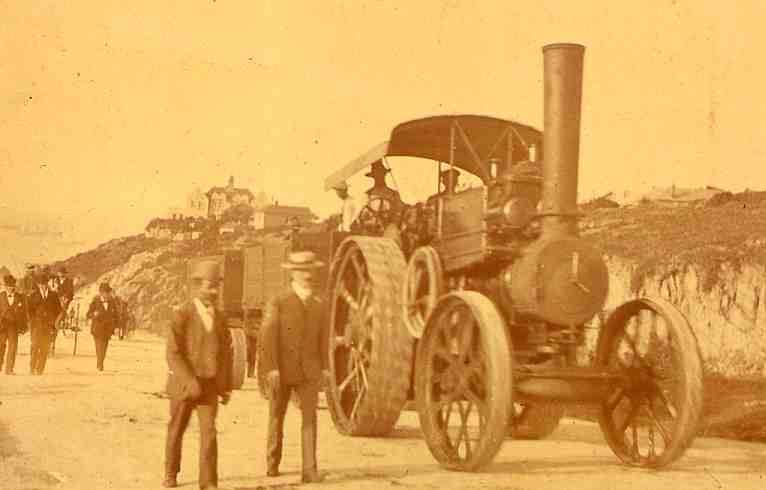
Main picture: Steam roller on the opening of Albany Road. The prominent building on the hill is the Erica School for Girls, designed by architect William White Cooper and opened on 4 November 1903.
Human nature seeks freedom and the best for themselves and their children. It is an innate urge. By now the dismal track record of politically motivated false choices should have been exposed as a chimera. So it was for Korsten. Instead of readily agreeing to their being relocated to the new “model township” of New Brighton, the black residents of the inner-city locations defied the authorities and moved to an unserviced area outside the municipal boundaries called Korsten.
Thus Korsten’s roots are nourished by the natural human desire for freedom.
Main picture: Elkana Street, a respectable area in Korsten where children play happily in the street
In a manner of speaking, the salt pans which span over the northern areas of Port Elizabeth, are its mineral wealth. Unlike the mines in the north, their minerals are easy to extract without expensive machinery or underground excavations. Furthermore their lifespan is measured in millennia and not decades.
It is thought that in all likelihood, these salt pans have been used for millennia by the local Khoikhoibut not on an organised basis. The saline deposits of this district have long been famous, but until the foresight of Frederick Korsten, that there had been no attempt at systematic development. It was the entrepreneurial spirit of this one man that turned this untapped resource into an asset for the area.
Balfour Turton Dix-Peek (1868-1932) was one of the sons of my maternal great-great grandfather, George Dix-Peek, thus aking him my second great uncle. In these letters by Arthur to his great-niece Anita, (and thus a cousin of mine) in 1931 and 1932, he elaborates what life was like in Port Elizabeth during the 1870s i.e. when he was very young
The morning of the Thursday 24th December 1931
was not unlike any other Christmas Eve. Whether those passengers crammed into
buses and trams had already completed their Christmas shopping, this was a day
when many residents of Port Elizabeth would make that trip to Main Street to
experience the thrill and excitement of this special day.
Instead many would witness a tragedy which would blunt
their enthusiasm and joy over the festive season.
Main picture: St Mary’s Church in 1931 showing the businesses on Main Street being demolished
Even though farmers had been living in the area since 1776, the tiny settlement of Bethelsdorp, nestled on a hillside 10km north -west of Port Elizabeth, near the Little Swartkops River, was Port Elizabeth’s first organised settlement. Founded in 1803 by a missionary from the London Missionary Society, Dr Johannes Theodorus van der Kemp, and assisted by the Rev James Read, the settlement became a catalyst for racial conflict. Bethelsdorp is the site of the oldest London Missionary Society (LMS) station in South Africa and today it forms part of Port Elizabeth.
Main picture:A fanciful view of Bethelsdorp with van der Kemp Kloof in the background
It is safe to say that South Africa was one of the foremost exponents of ultra-marathon running events in the 20th century. What is more amazing is that South Africa produced a mindset where the most non-athletic citizen could participate in events that were clearly in the domain of the specialist ultra-marathon runner. Yet they would participate. This situation occurred as a result of the conflation of two events; firstly the creation of the Comrades Marathon commencing in 1921 and then later in the century with South Africa’s exclusion from participation in international sport.
Just as important was the calibre of the athletes produced in South Africa starting with Arthur Newton, then succeeded by Wally Hayward, Jackie Mekler and finally Bruce Fordyce, the doyen of road runners.
Under normal circumstances, trials are usually only
undertaken to determine who should be selected to attend a future event. In
this case, however, it was much more significant in that this race witnessed
the passing of the baton by Wally Hayward and the birth of a new star: Jackie
Mekler.
Main picture:Jackie Mekler coming 2nd to Wally Hayward in Hyde Park in the record breaking 100 mile race from Box in Wiltshire to London in 1953
Mekler’s early life
Mekler did not have an easy upbringing. His parents had
emigrated from Eastern Europe in the late 1920s with little more than the clothes
on their backs. They struggled to survive financially. Initially the family
stayed with friends in Bertrams, Joburg, then upgraded to rented accommodation
in the same suburb and finally purchasing a house in Bertrams. Mekler’s mother
was a trained nurse and his father earned a living hawking fruit from the back
of a horse-drawn cart.
Jackie Mekler alongside Arthur Newton in London in 1955
Mekler’s mother developed Parkinson’s disease at a young age, growing increasingly incapacitated by this debilitating disease. She spent long periods convalescing at home and at the Otto Beit Nursing Home. Due to his father’s long working hours, he was unable to raise Jackie and his elder sister Hannah, resulting in their being placed in a home.
As can be imagined, this separation from his family made a
huge impact on the young Jackie Mekler, who increasingly sought solace in his
own company and running. It swiftly dawned on him, that he had a natural talent
for long distance running. He might not have had the turn of speed as his
peers, but he possessed the stamina to run extremely long distances without
being subject to the same stress, tiredness and loss of vigour.
This ability to train
at weekly distances of greater than 150 miles would prepare his body for the
greatest tests of endurance: The Comrades and the London to Brighton Marathons.
The Wally Hayward era
Wally Hayward won the Comrades Marathon for the
first time on his first attempt in 1930 at the age of 21. It would take another
twenty years before he competed again. Surprisingly he won that year and the
subsequent three years from 1951 to 1954, except for 1952 when he chose to
rather represent South Africa at
the 1952 Summer Olympics in Helsinki. He finished tenth in the Olympic marathon event. In 1951 and 1953 (first athlete under
6 hours) he broke the down-run record, and in 1954 he broke the up-run record
and became the oldest man to win the race at age 45 (later overtaken by the
Russian, Vladimir Kotov, in
2004).
In 1988 he returned once again
to participate. He beat half the finishers with a time of 9h44m. Wally’s most
dramatic moment came the following year, in 1989, when he completed the down
run at the age of 80. There was hardly a dry eye in the stadium as he staggered
across the line in an obviously distressed state, making the cut-off time by a
mere 1min 57sec, after which he finally quit the race for good. To this day, he
has the distinction in the record books of being the oldest finisher in the
history of the Comrades Marathon.
Rise of Jackie Mekler
Hayward and Mekler were teammates at Germiston Callies
Athletic Club. In that era, this running club possessed one of the finest minds
on all aspects of running; Fred Morrison. With little scientific knowledge but
a curious mind at his disposal, he provided dollops of useful advice to the
fellow members. What was little appreciated at that time was that the human
body was not a machine and required rest as much, if not in greater measure,
than hard training. On the 9th May 1954, Jackie Mekler won the 56km
Pieter Korkie ultramarathon which was hosted by Germiston Callies. Three weeks
later, on the 31st May 1954, would be the Empire Games Trials
Marathon.
Marathon Trials in Port Elizabeth
These are Jackie Mekler’s recollections of this titanic
battle of wills: the middle-aged Hayward and the aspiring Comrades winner, the 22-year-old
Jackie Mekler.
Mekler describes this race as follows:
“The trials in Port Elizabeth were now three weeks away.
It was likely to become a battle between [Jan] Barnard, [Wally] Hayward and myself
as favourites. But there were many other talented hopefuls in the race,
including Gerald Walsh, Mercer Davies, Piet Kriel and Jackie Goldie. We
travelled down to Port Elizabeth by train. As the train pulled into the Port
Elizabeth station, I noticed that all the trees were growing at an angle thanks
to the prevailing strong coastal winds. Port Elizabeth is known as the Friendly
City but also the Windy City.
On the evening before the race, the wind started blowing
as only it can at the coast. When we went to bed the windows were rattling,
banging and thudding, noise that continued throughout the night. I knew that we
could not expect a calm day on the following morning.
Jackie Mekler with his ‘dirty black look’ as he focused intently on the race
It will still dark and the wind still howling when the
race started at 7am. We started at Newton Park and went out around Greenbushes
Hotel, Cows Corner, Linga Longa, back to Crossroads and then back to the
stadium.
The first eight miles were straight, head-on into the
wind. Wally, who was short on natural speed and whose age was against him, realised
that he had to win the race in order to gain selection. He therefore had no alternative
but to force the pace from the start. This was in any case his normal style.
Both Jan [Barnard] and I had the speed to beat him in a
fast finish, so Barnard tucked in behind Wally, effectively shielding himself
from the wind. I felt sorry for Wally, so I purposely moved out alongside him
so as not to gain an unfair advantage. These were perfectly legitimate tactics
by Barnard, but I could not in all fairness do the same.
We ran like this for the first 11 miles [17 kms], which
was mainly uphill. Shortly after that I decided to push the pace and moved into
the lead. I hung onto this lead for a mile until Jan came shooting past saying,
‘OK Jackie. Let’s go now’. This remark left me puzzled. Was he inviting me to
join him in pushing the pace or was this a challenge for me to try and keep up
with him? Whatever it was, his pace was too fast, and he gradually opened up a
lead on the downhill stretch.
We were now turning for home. The rest of the course was
fast and mainly downhill with the wind behind us. The weather had improved, and
I needed only one sip of tea at 19 miles and a couple of sponges. Barnard drew
steadily ahead and try as I might, I was unable to hold him. This was the type
of course that suited Jan and he took full advantage of it.
He finished in 2:25:31, the fastest time ever run in
South Africa and the first time that 2:30 had ever been broken by a South
African. I finished second in 2:28:57 as inside the existing record of 2:30:45
set up by the late Jackie Gibson in 1927. Gerald Walsh was 3rd in
2:31, Wally 4th and Jackie Goldie 6th in 2:40:40.
Mekler did not know it yet but from now onwards the South
African running hero, Wally Hayward, would forever be behind him instead of
being in his sights.
The Empire Games Marathon Trials in Port Elizabeth represented
the swansong of the Hayward era and the dawn of the Mekler era of long distance
running in South Africa.
Events after the Trials
Three Comrades greats – Jackie Mekler – 5 wins- Bruce Fordyce – 9 wins and Alan Robb with 4 wins
Later that evening the athletics team for the Empire Games
in Vancouver was announced. Jan Barnard and Jackie Mekler were selected for the
Marathon. Jackie had made the breakthrough at the tender age of 22, normally
regarded as too young for marathon running. Jackie’s development and
improvement over the previous two years had been phenomenal.
Even though the Empire Games were some 10 weeks away on the
7th August 1954, Mekler even seriously considered running the
Comrades being held on the 12th June that year. Fortunately the
athletics authorities got wind of this plan and swiftly nipped it in the bud.
It was just as well. It was speed that Mekler needed and not distance work
It was now Wally’s swansong. Having missed out on the Empire Games, he made his mark on the Comrades that year by smashing Hardy Ballington’s up record in the 1954 Comrades in 6:12:55. In spite of this achievement, Wally nevertheless ran a superb 100 miles from Standerton to Germiston in 13:08:05 in freezing cold weather.
During his running career, Mekler would win
the Comrades Marathon five
times as well as various other marathons around the world. He competed for South Africa in various international games. A 25km
Jackie Mekler race is held annually in Gauteng in his honour.
Jackie Mekler died in Cape Town on 1st July
2019, when he was 87 years old.
Source
https://en.wikipedia.org/wiki/Jackie_Mekler
Running
Alone by Jackie Mekler (2019, Quickfox Publishing, Cape Town)
Sporting-wise, Port Elizabeth has achieved a number of
firsts as many of the sporting codes have their roots in St George’s Park.
Amongst the firsts were the first international cricket test between South
Africa and England, South Africa’s first rugby test and South Africa’s first
cricket tournament.
Of all the firsts that Port Elizabeth failed to achieve was being the first tennis club to be formed in South Africa but it only missed this honour narrowly.
Main picture: SA Lawn Tennis Championships, 1893.
Court No. 1 – Port Elizabeth Lawn Tennis Club.