Port Elizabeth of Yore: A Description of the Town in 1861

This blog is a verbatim copy of an article of unknown origin or authorship. That begs the question of who indeed wrote it. As a best guess it was Tennyson Bodill as it came from his files.   

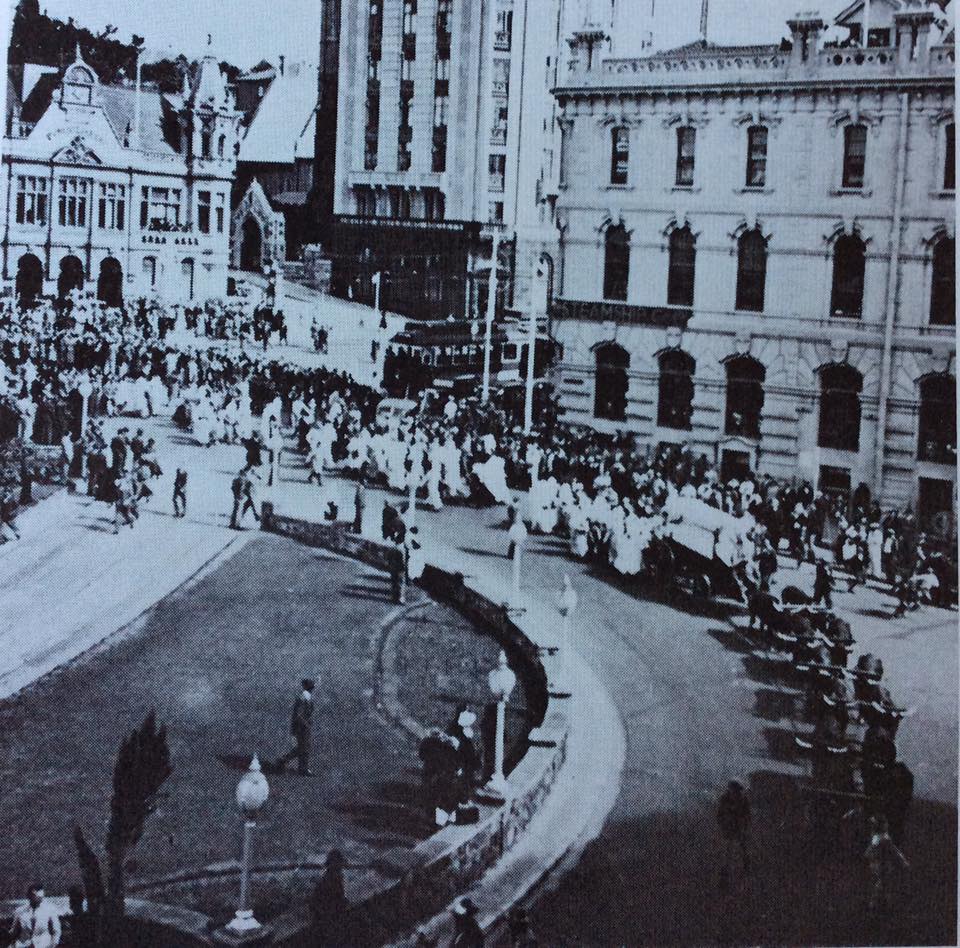
Notwithstanding vigorous growth during its first forty years, Port Elizabeth was still a dinky-sized town in 1861. From a scruffiness in its early years, which was unbecoming, it was the debut of the Town Hall which ushered in a whole array of elegant buildings such as the original Standard Bank building. What the town lacked then, and the city does now, was greenery. This paucity of vegetation has deprived its inhabitants of its aesthetic beauty, which would have enhanced the attractiveness of the town.

Main picture: The original St Mary’s Church before it was burnt down in 1895. Never an object of beauty, it was a plain unadorned box of a building.

Continue reading

Port Elizabeth of Yore: The Early Days of Cycling

John Howard, an American cyclist, once quipped: “The bicycle is a curious vehicle. Its passenger is its engine.” As an epigram, a wit could have rejoined that “2nd class cycling is better than 1st class walking.” Surprisingly in an era post the advent of bicycles but prior to the arrival of motor vehicles, photos of cyclists are rare; so rare that I only possess two.

If social cycling did not prosper, competitive cycling did with Cycling Clubs soon being formed. From curiosity value in the Penny-Farthing, bicycles evolved into more practical machines.

Main picture: Members of the P.E. Amateur Bicycle Club, which was formed in 1881 and later amalgamated with the Amateur Athletic Club, in front of the Pearson Conservatory in St. Georges Park. A penny-farthing can be seen in the centre. Some of the club’s rides were from the park to Fitch’s at Witteklip which represented a 26 mile ride.

Continue reading

Port Elizabeth of Yore: An Allen who Entered the World of Shipping

This member of the Allen family in Port Elizabeth did not follow the preceding two generations and enter the building trade. Instead he made his mark in the shipping business as well as various other organisations. This blog is the story John William Gordon Allen whose stellar career in the shipping business spanned five decades. In addition he contributed immensely to the MOTHS [Memorable Order of the Tin Hats, A club for returned service men after WW I and WW II] over many decades. Fortunately for society he was called Gordon to distinguish him from others bearing the family name of John William.  

Main picture: Gordon Allen immediately prior to a MOTH’s dinner. He looks a bit pensive. He often sat quietly for a few minutes or scribbled some quick notes just before giving a welcome address or giving a speech.

Continue reading

Port Elizabeth of Yore: Two Generations of Master Builders

Like many of the settlers to the Eastern Cape, the Allen family thrived. Maybe it is an indomitable adventurous spirit which would produce three generations whose contribution to the development of this area was inestimable. The endowments of the first two generations, both named John William, were as master builders whereas the subsequent generation forsook this business to enter the world of shipping. Then sadly, like many other South Africans, the subsequent generations are spread across the globe.  

This blog is the tale of two men, both confusingly named John William Allen as well as their Settler roots. The third Allen member will be covered in a separate blog.

Main picture: Standard Bank Building in 1882 after the second half – a mirror image of the first half – was built in 1879 by the Builders, Allen and Winter. It was demolished in 1962 

Continue reading

Port Elizabeth of Yore: The Railway Line to Humewood and the Driftsands

Of all the Branch Lines in Port Elizabeth, this one appears to be the least known. Initially it was laid as part of the project to tame the supposedly deadly driftsands which would encroach and smother the site chosen for the harbour. To prevent this apocalypse, it was decided to cover this moving sea of sand with the garbage generated by the residents of Port Elizabeth. The garbage was required as fertiliser for the planting of the chosen species of grasses, bushes and trees, the sand being further stabilised by spreading tree branches and erecting wooden fences at intervals as required.

This standard-gauge railway line was constructed in late 1892 or early 1893, and the use of the coastal section of this railway for passenger traffic followed the sale, on 30 May 1893, by the Harbour Board of 20 marine villa sites between the original Happy Valley (where the Apple Express railway line now runs) and Klein Shark River.

Main picture: The platform adjacent to Customs House to embark on the journey to Humewood

Continue reading

Port Elizabeth of Yore: The Mystery Cannons near Schoenmakerskop

Even though the well-known local diver, David Allen, is touted as the earliest discoverer of the guns of the Portuguese man-o-war, Sacramento, there are in fact several earlier claimants to the prestigious title. The first, from the 1920s has a strong family connection whereas the other claim is undated but probably dates from the 1930s or 1940s.

I will let you be the judge of that.  

Main picture: Per Dale Poulter, on the left is Bunny Hodges and on the right, bending over to obtain a closer look, is the elderly Louis John Poulter. Presumably the person in the middle is Harraway  

Continue reading

Saving a person suffering from Covid-19

This is not a scare tactic or crying wolf to get everybody to adhere to the recommendations regarding Covid-19 but hopefully it will have the required salutary effect. Having had a wife who was intubated for six and  half weeks, I can comprehend what these patients are experiencing. For them it is far worse as unlike Janine, these patients are not in a coma. And the ICU was 50% full.

This is a Facebook post pasted from a doctor in the Eastern Cape.

Main picture: An intubated patient

Continue reading

Port Elizabeth of Yore: The Ore Terminal

Fifty-seven years ago on the 1st April 1963 the Port Elizabeth ore berth was opened and the first carrier to load was the Swedish bulk carrier ‘Lappland’. The Shigeo Nagano operated by the Norwegian company Berge Sigval of Bergeson called on the 16th August 1965 to load ore, which was the largest single consignment of ore , 64,613 tons to be exported out of a South African port. She loaded the record cargo in 55 hours at the berth for four days. Due to her size , the J.R. Moore was brought from Durban for the berthing of the carrier as the T. Eriksen was under repairs at the time due to her sinking with the loss of three lives. The ‘Shigeo Nagano’ sailed at high tide at 08:50 am on Friday the 20th August 1965. She held the record for being the biggest carrier to call and load in Port Elizabeth only to be broken in November 1981 when the giant carrier ‘Neckar Ore’ arrived and loaded a record cargo of ore which to this day is still standing.

Main picture:  Picture taken on the 1st April 1963 the day of the opening of the ore plant in Port Elizabeth showing the Swedish bulk carrier ‘ Lappland’ the first ship to load ore from the new berth.

Continue reading

Port Elizabeth of Yore: The S.S. Western Knight-The Death Shriek of a Ship’s Siren

So far, 1929 had proved to be a disastrous year for shipping on the South African coast. To add a liberal dose of salt to that wound, at 8:30 on a foggy Monday morning, the American freighter, the 5,779-ton SS Western Knight, would be added to that tragic total.

In the impenetrable fog and along this treacherous coastline, the vessel blindly groped its way past Schoenmakerskop, a disaster waiting to happen. Then my grandmother, Elizabeth Daisy McCleland, granny Mac to us, heard the death shriek of a ship’s siren.

Main picture:  Salvage operations underway on the SS Western Knight

Continue reading