
Being a Settler in an undeveloped land with unfriendly neighbours to their east, non-existent infrastructure and a paucity of work opportunities apart from farming their land, would they not only survive but thrive? Ultimately not being unscrupulous opportunists but the opposite, hard working entrepreneurs, the Reed family would rise to the challenge and thrive.
Sailing to a new homeland
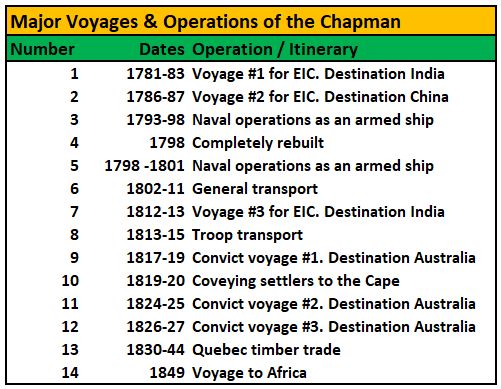
Aboard the Chapman, the first ship in the 1820 Settler Armada to arrive at Port Elizabeth, was the Reed family. Previously known as the Sybilla, the 558 ton ship would faithfully serve the British Empire for many more years. But now it was transporting settlers from Cork to Algoa Bay as Port Elizabeth did not yet exist. Ultimately approximately 33 years later it would be lost in the North Atlantic during a voyage from Quebec in the early 1850s.
Shipboard romance
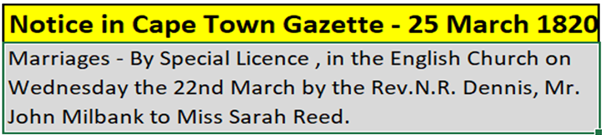
It was the roving eye of the ship’s captain, John Milbank, that was attracted to the young slip of a female, Sara Eliza Reed, the sister to James and Samuel Reed. With the Reed boys being too young at the time, with James being only 7 as he was born in 1813, neither boy would in all likelihood have been aware of the budding romance. Over a voyage of 92 days there was plenty of time for Milbank to woo the 20 year old albeit surreptitiously. The romance must have blossomed during the voyage and so, upon arrival in Cape Town, John Milbank proclaimed that the couple would be married within several days. Sarah never disembarked from the ship. Instead she returned with her husband to England.
[LB15]
Whether dared or on their own volition, two young boys would vie to be the first person ashore. One was a 13 year old boy by the name of James Samuel Reed [SC1] and the other was William Collen [SC2]. Whether they were even aware of the others plot to be first ashore, is unknown but two boys would claim this distinction. In the case of the latter, the family claims that William absconded with the ship’s bell. Passed down from generation to generation this assertion and the bell were ultimately passed down the family until today when Mr. JAS Collen is in possession of the bell. Based upon its inconsequential size, the title of Ship’s Bell is probably too grandiose. Downgrading it to galley bell would probably appease skeptics and naysayers. [SC3] As contestants in the game Chinese Whispers can attest, by the fourth retelling of a fact, the accuracy of the detail no longer bears any resemblance to the original message. All facts are subject to distortion.
An example based upon my family history will emphasise the fact. My maternal great great grandfather was George Dix-Peek. At the apex of his career as an architect, he designed the Standard Bank building in Main Street, Port Elizabeth. The remainder of his drawings were of lessor import, originality and importance. Yet despite that fact, one of my cousins claimed that he designed buildings such as the Union Buildings!
Creating a career as hotelier
Nothing is officially known of either of the brothers’ activities for many years except that James’ initial occupation was that of a blacksmith [3]. Next the trail wends its merry way to being hoteliers.
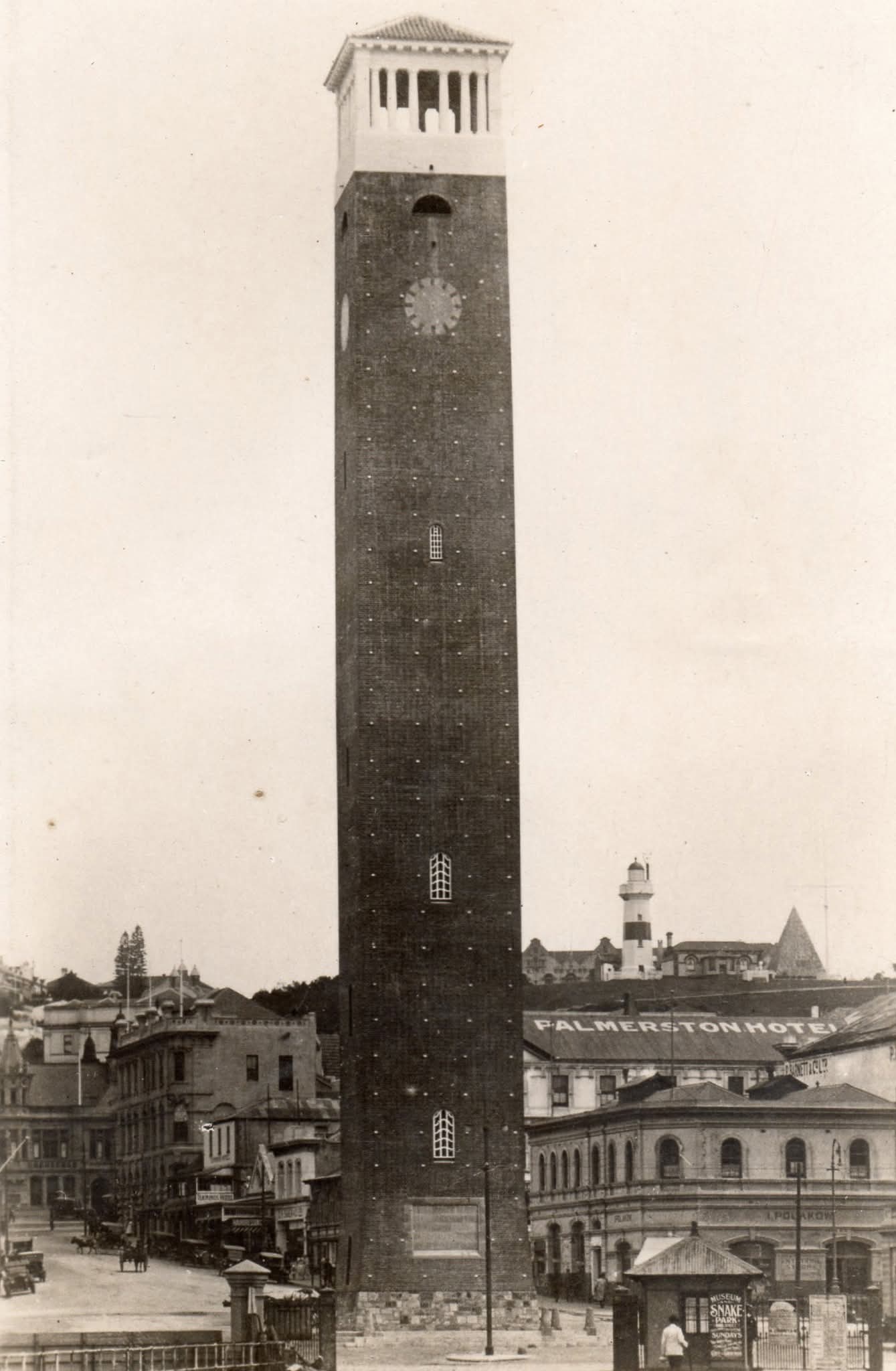
In January 1840 James Samuel Reed opened the Pier Hotel [SC4] in a house located in Jetty Street which later became the Palmerston and ultimately the Campanile Hotel. There was an hotel on this site for 150 years with the original house being considerably extended over the years and becoming known as the “Palmerston”. To cater for the influx of settlers, visitors and businessmen this hotel could no longer be extended. The solution was to demolish the existing hotel and to replace it with a far larger hotel, the “Campanile” which was built in 1934/5.
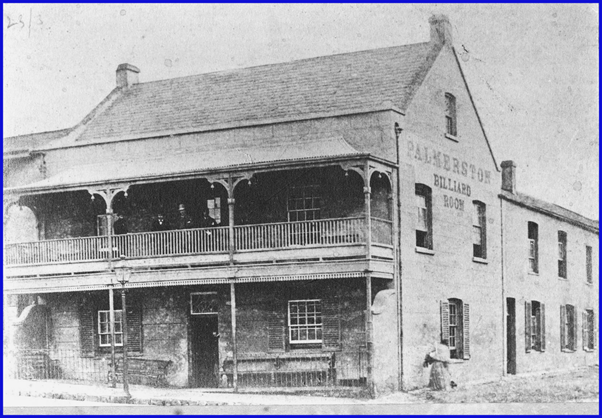
On the birth of his eldest son William James Reed, Samuel Reed was the manager of the Pier Hotel. Samuel worked at this trade for 10 years. Combined with the butchering trade, his partners were his brothers George and James William.
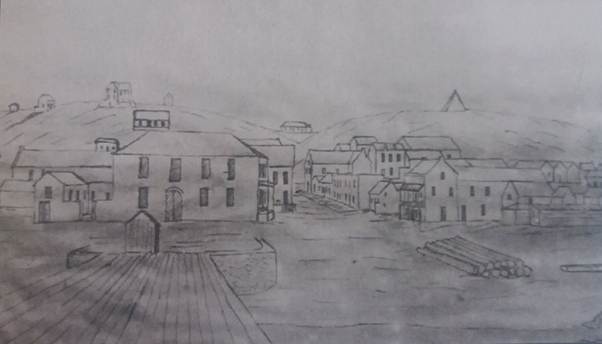
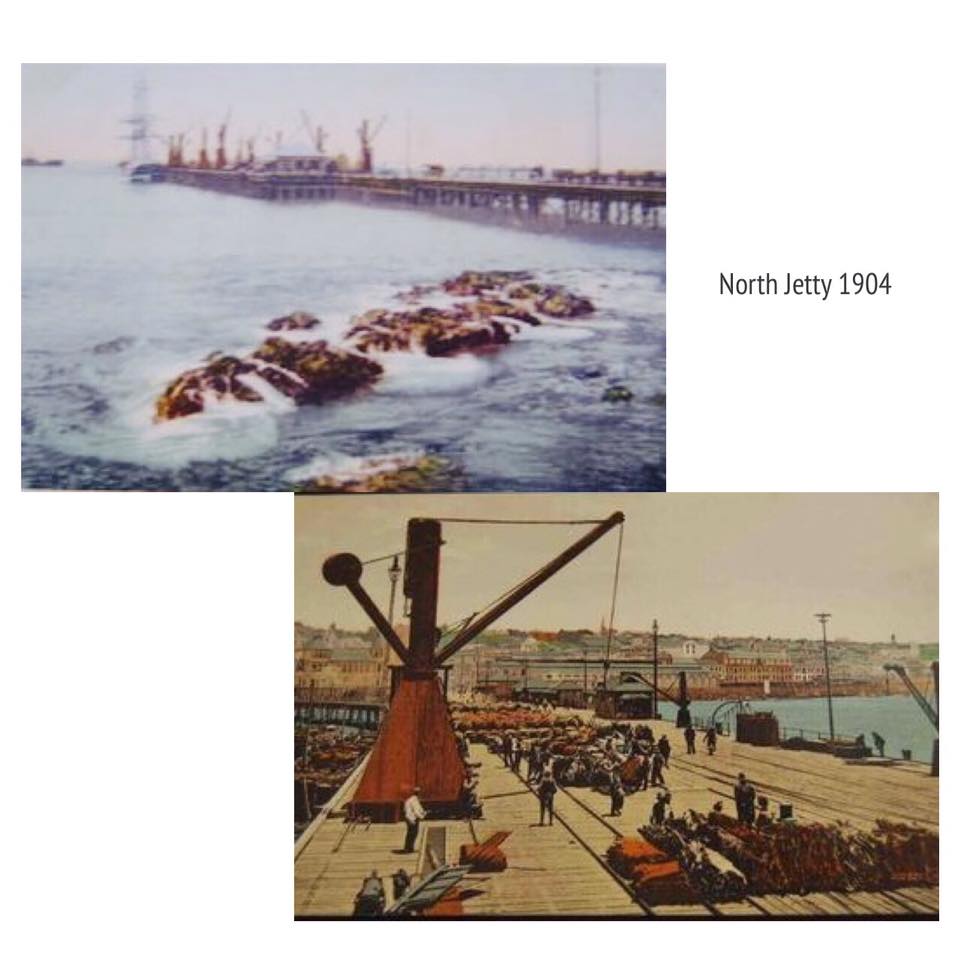
It was originally the home of Alexander William Tennant before James Samuel Reed converted it into a hotel. It was not Tennant who would hit the jackpot, but James Samuel. In January 1840, he placed an advertisement that he had taken over Tennant’s house near the proposed new jetty envisaged by the Port Elizabeth Jetty Company. In anticipation of this jetty’s construction literally on his doorstep, he had christened his inn and boarding house, “The Pier Hotel”. In fact, at that stage, even the foundation stone had not been laid yet. Even though the jetty was only finally completed in 1842, using the wreck of the ship Feejee as a base, the expected goldmine had barely commenced production when misfortune befell the jetty. Within five months after officially coming into operation, on Saturday night, 26th August 1843, Port Elizabeth experienced a violent gale, the worst south-easter since 1835. In a matter of hours, three ships broke their anchors smashing into the jetty and utterly destroying it.
James Reed arrived as an 1820 Settler on the Chapman aged seven. In 1846 Tennant was declared insolvent and at the same time Reed announced that he had returned to his earlier trade as a blacksmith.
Together with chartering vessels taking stock, horses and bullocks to Mauritius in exchange for their products principally being sugar, they did very well financially. Samuel’s brother, George, was the buyer of livestock and William was the bookkeeper. That meant that when the chartered boat was loaded, Samuel had to remove his apron and sail to Mauritius. As part of this job was an extremely difficult portion. This entailed catching wild oxen and loading them on board the ship using slings.
In 1849 James William was listed as cabinet makers in Queens Street.
Trying their hand at auctioneering
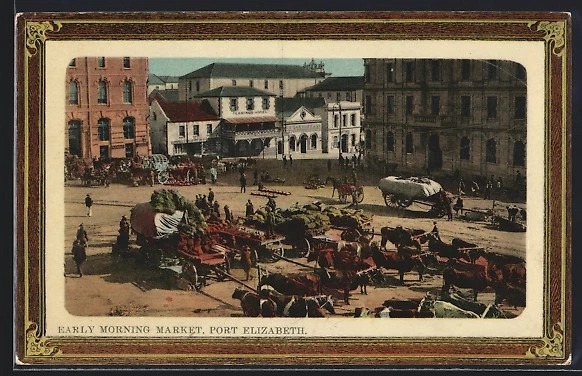
The family dissolved the partnership, and Samuel started auctioneering. By 1861 he had sold all what were called the Hospital Lands. These properties lay between Bird and Pearson Streets and in the western portion encompassed the first substantial hospital in the town. These lands had been granted by Sir George Grey in 1858 to the town with the intention of selling them to provide funds for the erection of the hospital on Richmond Hill.
The Reed family operates a pont
Prior to the opening of the Mackay Bridge on the Sunday’s River in 1895, passengers and vehicles were taken across the river by means of a pont. J.S. Reed held the lease from 1859 to 1869. James Reed then purchased The Sunday’s River Punt property from Capper for £4750 and Thornhill for £3500. [There are two Thornhills; the farm settled by Christopher near Bathurst in 1820 and the village of Thornhill just beyond the Van Staden’s Pass, named after Christhopher, son of Christopher] After occupying the Punt Property for 10 years, the Uitenhage Council sued Samuel Reed to deliver up the right of way and remove his Punt. He duly refused to relinquish what he had legally acquired from Thomas Capper (b 1811) son of Thomas Capper senior, of George Smith’s party. The case was heard in the Supreme Court. When Reed lost the case, Capper was already dead, and he had no redress which caused him to surrender the property. His son William J Reed then made an offer with the principal creditor W R Metelerkamp through Mr. J S Kirkwood. [James Somers Kirkwood (d.1888) had arrived in Port Elizabeth in 1855 and was a well-known auctioneer and was elected as Town Councillor in 1860 and M.L.A. from 1876 to 1880] had to pay an amount and Reed’s estate was released from Insolvency.
To settle the debt, their property across the Baakens River bridge was sold and realized £600 which was ample to pay the debt. ·
Property magnet
Besides being extremely successful in his occupations as farmer, butcher and auctioneer, James Reed also amassed a great deal of property including farms. [SC5] By 1849, J.S. Reed had acquired half of the farm Nooitgedacht on which Frame’s Drift is located. He eventually played a role in the political management of the town by being elected as Councillor onto the first Town Council and later he was also appointed onto the board of the Divisional Council.
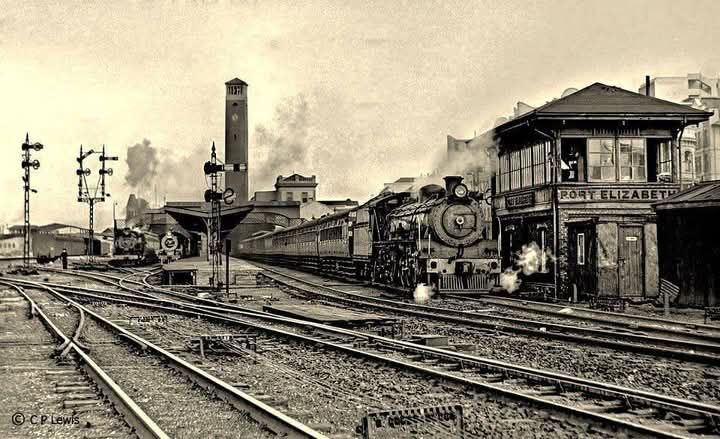
Over the years James Reed was involved in numerous successful and unsuccessful business ventures and amassed a great deal of property.
Fox hunting [LB 14]
One of the British customs which our stubbornly traditional forefathers attempted to import into Port Elizabeth was fox hunting. They had the horses, the hounds, the “pink” which implies or signifies perfect health and happiness. The Eastern Cape offered splendid hunting country but no foxes! As an alternative they resorted to “running duikers or oribi to earth.”
The Herald [EPH 1] described “the “run” of ·the previous Saturday. The hounds were under the charge of Messrs. Ted and George Reed and they usually met at Harries Kraal at 6 a.m. twice a week. There were 5 couples of hounds and they had a particularly good run that day covering 15 to 20 miles before killing within sight of the Kragga Kamma lands.
Sources
[SC1] Social Chronicle to the end of 1945. Harradine Page 275
[SC2] Blog: https://thecasualobserver.co.za/port-elizabeth-yore-settler-ship-chapman/
[SC3] S.C. page 275.
[SC4] SC page 27
[SC5] SC Page 21
[LB14] Looking Back Vol VII No. 1, March 1966 Page 14, Fox hunting]
[EPH 1] E.P. Herald 24 October 1862 Fox Hunting
[LB15] Looking Back Vol XVI No. 3, Sept 1976 Page 84]
[LB] Looking Back Settler Memories by William & James Samuel Reed. Volume 20 No. 1 March 1980 Page 18 to 26
| Name | DoB & DoD | Comment |
| George S. Reed | B. 1818 | Youngest of W. Reed’s 5 children |
| William James Reed | 1840-c1920 | Son of James Samuel Reed, 22 Queen Street |
| James Samuel Reed | 1811-1902 | Grandson of James Samuel Reed |
| William Reed | 1774-1827 | 1820 Settler, John Baillie’s party. Arrived with wife & 5 children aboard Chapman. |


