

Many magazines including Time and Popular Science list their choices of the best innovations for the year. Time Magazine has just released theirs. Whilst many of them may be classified as innovative none will significantly improve the lives of the majority on earth. None are particularly earth-shattering nor do many inspire my imagination. My list of breakthroughs and innovations for 2016 is not a prophesy but rather a wish-list. Instead they should be transformative second order changes. This blog deals with the intractable problem of non-polluting power.
Main picture: 1000 years temperature versus CO2 readings
The State of Play
The disquieting news is that COP21 in Paris bore all the hallmarks of political posturing rather than hard, firm and irrevocable positions being adopted. An example of such an approach could have included a binding agreement by the First World [including China] that they take the lead and agree not to build any further carbon generating power plants. Instead of resolute determination, the ominous forebodings of the pundits were not heeded. The only charitable comment that I can utter is that they tried.

As an aside, South Africa did what most bankrupt African countries did at COP21; they took a bloated delegation. South Africa had 139 delegates. The only persons who were not given a free trip to Paris at a Five Star Hotel were the cleaners and security officials.
The vocal naysayers and strident climate change denialists have created the lamentable situation where ones natural tendency to do nothing has been reinforced. The ostrich mentality prevails as wishful thinking abounds that somebody somewhere will resolve the problem for us.
Doing nothing is not a strategy.
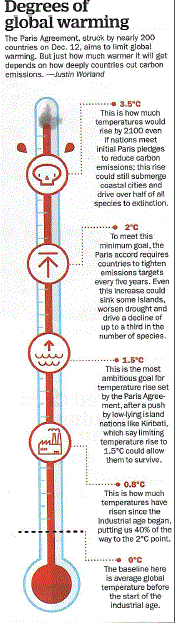 Objective evidence based on ice core samples extracted from Antarctica dating back thousands of years has proved conclusively that the percentage of carbon in the atmosphere has been rising exponentially since the commencement of the Industrial Revolution. Aside from this, the role of carbon in runaway greenhouse type situations was conclusively established half a century ago. This explains what caused the climatic catastrophe on Venus eons ago.
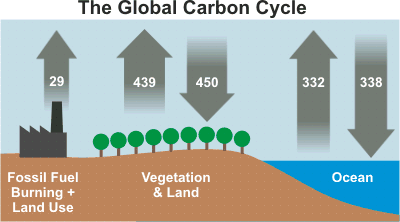
Instead of declining, the rate of carbon production has been steadily increasing. The chief culprit has been China. Since becoming the workshop of the world, its rate of carbon producing coal-fired power has been ramped up. Power stations at the rate of one per month are currently being commissioned.
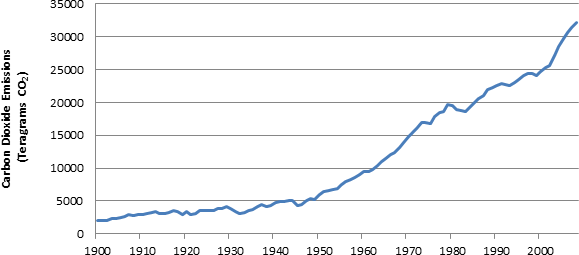
Trends of global CO2 emissions
Instead of commissioning new coal-fired power plants, they need to be decommissioned. This is the world cannot afford to do.
Non-polluting power sources are required urgently. One interim solution gaining wide currency and coming back into vogue in certain quarters is nuclear power. In spite of two positives – being non-polluting and providing an excellent base-load – its prospects are gloomy. The recent destruction of the Fukushima nuclear power plant in Japan by a tsunami has reinforced the deeply ingrained antagonisms against nuclear power in spite its problem free usage in France, the USA and Germany. The court of public opinion has cast safety concerns as the 21st century bogeyman over that of climate change.

Fukushima nuclear plant destroyed by tsunami
As a short term interim solution for China’s rapacious appetite for more power, they should only construct nuclear power plants. This will relieve the stress on the rest of the world especially the third world to comply with carbon reduction targets.
South Africa should not seriously consider a 9800MW nuclear build not because I believe that the fears about nuclear power are not misplaced but for purely financial reasons. South Africa cannot be burdened with the millstone of a R1.6 trillion debt for generations. If South Africa were to acquire a nuclear plant, it should have a generation capacity of 1000MW but more importantly, it must be foreign owned and operated. Sadly the unbridgeable chasm between economic reality and the 1950s central planning thinking which is deeply rooted within the ANC including Jacob Zuma will not countenance this type of solution.

Medupi Power Plant
The perpetual bridesmaid – Fusion Power
Unlike fission nuclear power with its poisoned chalice of deadly radiation, fusion power is clean and more importantly offers a cheap and nearly inexhaustible energy resource. Stacked against this announcement, are the previous predictions on the commercialisation of fusion power: Ad infinitum it has been 30 years; hence the perpetual bridesmaid analogue.
As daunting as the challenges are to contain the reaction within the Tokomak Ring Fusion Reactor, a recent breakthrough by researchers at MIT has potentially made fusion power practical. Advances in magnet technology, using new commercially available superconductors, rare-earth barium copper oxide (REBCO) superconducting tapes, has enabled MIT to produce high-magnetic field coils. The stronger magnetic field makes it possible to produce the required magnetic confinement of the superhot plasma — that is, the working material of a fusion reaction — but in a much smaller device than those previously envisioned. The reduction in size, in turn, makes the whole system less expensive and faster to build, and also allows for some ingenious new features in the power plant design.
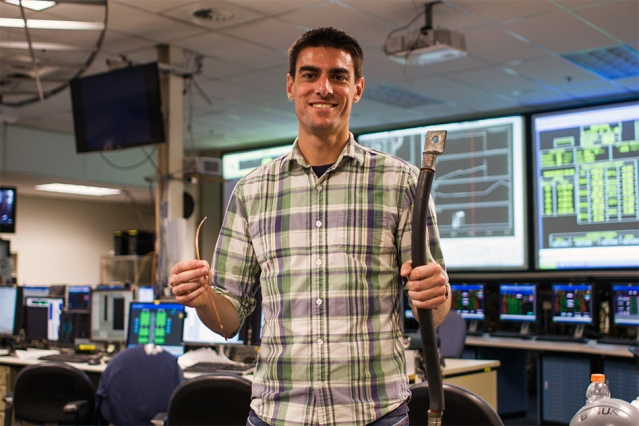
MIT PhD candidate Brandon Sorbom holds REBCO superconducting tapes (left), which are the enabling technology behind the ARC reactor
Instead of languishing for the next 20 years in some university laboratory, its potential for success should be assessed during 2016. If it displays potential, the USA should treat it like another Manhattan project and make it operational. Naturally this will be at least a 5 year project with the first unit operational within 10 years at best.
Then the chaste bridesmaid will become a welcome bride who will give birth to the world’s saviour – limitless non-polluting energy.
Battery technology – Providing 24 hour sunshine and wind
The one issue that has dampened the enthusiasm for renewal energy apart from its cost, is its intermittent and variable nature. How countries such as the UK have addressed this issue, is to use their nuclear power plants to generate their base load. The variability of the wind turbines is compensated by their use of expensive gas fired power stations.
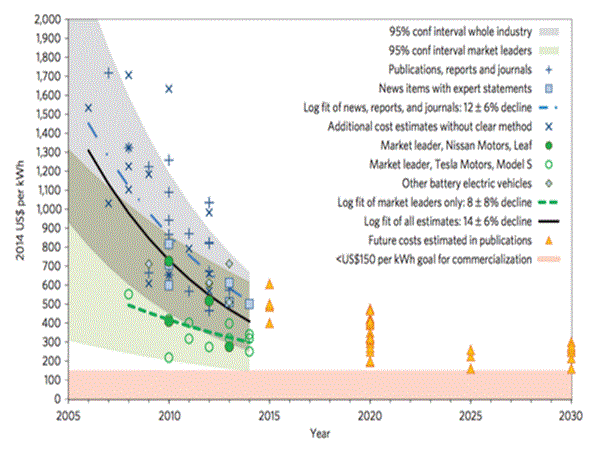
Cost of battery power
An enduring myth persists courtesy of the renewables lobby that renewal energy is as cheap as coal or nuclear – it is not – but once one takes into account the cost of additional facilities to ensure a smooth uninterrupted supply, the costs per kWh soar, becoming exorbitant.
A knight in shining white armour is on the left flank to rescue renewal energy from the doldrums. This saviour is battery technology.
The technology leading the charge at the moment is lithium-ion. Initially this technology was only used for small appliances such as PCs and watches. Lest anyone accuse South Africans of not being entrepreneurial, Elon Musk has scaled up this technology and is proposing to use it in his latest electric car and has introduced it as a consumer product for large scale electricity storage under the brand Power Wall.
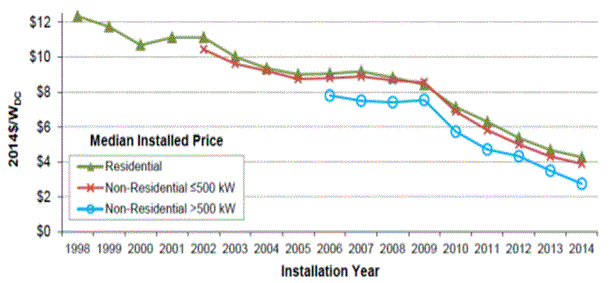
Cost of renewable energy
In this exciting field, human ingenuity has triumphed yet again. Scientists at Cambridge University have achieved a massive breakthrough in battery technology which is likely to transform the economics of energy storage – and making renewables an irresistible alternative to coal and nuclear. Their discovery of how to pack five times as much energy into a battery is consistent with continuous improvements that flow when Moore’s Law gets a hold.
Per Clive Cookson of the Financial Times:
This new method for transferring energy from organic to inorganic semiconductors, discovered at Cambridge University, could boost the efficiency of widely used inorganic solar cells.
The basic chemistry of lithium-air batteries is simple. The cell generates electricity by combining lithium with oxygen to form lithium peroxide and is then recharged by applying a current to reverse the reaction. Making these reactions take place reliably over many cycles is a formidable challenge.

The Cambridge scientists adjusted the chemistry in several ways to make it more controllable. For example, they converted lithium peroxide to lithium hydroxide (a compound that is easier to work with), they added lithium iodide to the system and they made a very porous “fluffy” electrode from graphene, a new form of carbon discovered 12 years ago at Manchester University.
What is not immediately evidence from all these articles is whether the lithium–air battery is also intended for large scale energy storage or not. Presumably it can be scaled up so that it can power whole communities, key emergency services and critical infrastructure. Making the jump from small to large capacity batteries that could provide back-up for the national grid in times of high demand has proved difficult. Lithium ion batteries offer high power density in a compact size and have many uses, although concerns have arisen about their potential to cause fires.
One technology focused on meeting large power needs is the Redox Flow Battery launched at the Dalian Institute of Chemical Physics in China 12 years ago as a leading player. Like other batteries, a redox flow cell contains electrolyte solutions and a positive and negative terminal, around which electrons flow when the circuit is connected.
If the battery is not charged, the electrolyte gradually loses its stored energy. How the redox flow battery differs is that in order to maintain energy, fresh electrolyte is continuously pumped into the battery.
The battery, or converter as it is called, is supplied with positive and negative electrolyte solutions held in separate plastic storage tanks. When the electrolyte solutions are supplied to the converter, power is instantaneous and can be varied simply by controlling the flow of electrolyte.
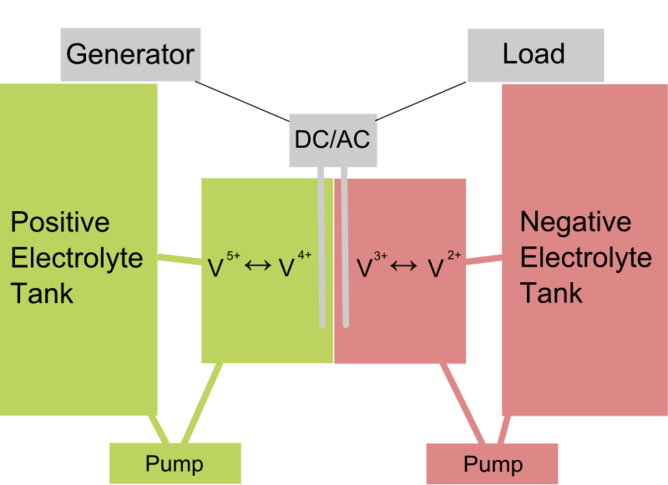
Operation of the Redox Flow Battery
An important advantage of redox flow is that it is relatively low-cost. The converter stays the same size for a given power density, but the duration of the power can be extended from four hours to more than 12 hours simply by installing larger plastic storage tanks to hold more electrolyte.
The electrolytes’ charge can be regenerated through connection to electrical power to reverse the discharge process – in other words, when mains power is connected the tanks charge, and when mains power fails the tanks discharge as back-up.
Perhaps the combination of both types of batteries rather than either / or would be the ideal solution. The lithium-air battery could serve the market below 20MW whereas the Redox Flow Batteries could serve the market greater than 20MW.

Using PowerWall batteries to store solar power
In this scenario, the electrical distributor could lease lithium-air batteries to households and small businesses whereas renewable energy plants could have Redox Flow Batteries installed on site.
Wind, tidal, light and wave power
All of these suffer from variability of supply and cost.
Human ingenuity has made significant strides in many of these fields especially solar and wind power. The reflexive stance of the naysayers as regards exorbitant costs is being increasingly challenged as the costs per kWh are a third of the price that it was a decade ago. These breakthroughs are the logical culmination of continual technological breakthroughs but, more importantly, the upsurge in production.

The earth in infra-red
From their haughty stance, as an act of penance these naysayers need to issue a contrite mea culpa when the cost curves cross. This is not to say that they will show contrition. Rather they will remain mute.
In all these categories breakthroughs will continue to be made. The one that should have applicability in South Africa is tidal power. Taking my home town, Port Elizabeth, as an excellent example, the Swartkops River mouth could serve as a first class test bed for the viability of tidal power. With its narrow mouth – 100 metres at most – and a huge expanse of water behind it, it could serve as a masterful way of generating electricity for Port Elizabeth. Naturally the period of the turning of the tides will be problematical.
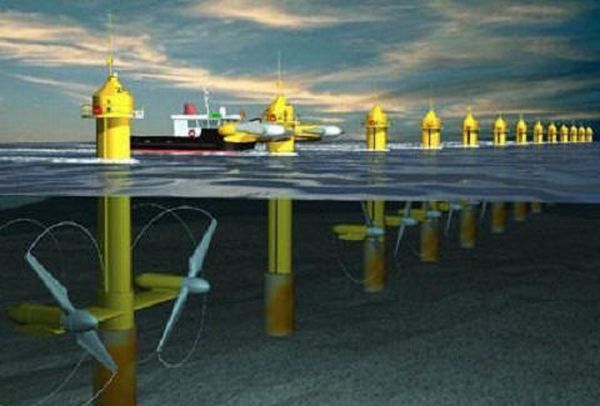
Penzhin Tidal Power Plant
As far as wind power is concerned, it will be futile to increase the size of the current wind turbines. Already transportation is increasingly challenged because of the size of the components. Individual blades and tower sections often require specialized trucks and straight, wide roads. Today’s wind turbines are also incredibly top heavy. Generators and gearboxes sitting on support towers 100 meters off the ground can weigh more than 100 tons. As the weight and height of turbines increase, the materials costs of wider, stronger support towers, as well as the cost of maintaining components housed so far from the ground, are cutting into the efficiency benefits of larger turbines.

Wind turbines
The alternative energy industry has repeatedly tried to solve these issues to no avail. One of the latest entries promises a radically different type of wind turbine: a bladeless cylinder that oscillates or vibrates.
The Spanish manufacturer, Vortex claims that its bladeless turbines will generate electricity for 40 percent less than the cost of power from conventional wind turbines.
Unless innovative designs such as this are embraced, turbine growth may have already peaked as it has reached its practical limit.

Bladeless wind turbines
The Future
The romantic notion that one solution will magically resolve the carbon conundrum is a fallacy. Many of the proposed solutions such as solar power cells on all rooftops could change the scale of production from mammoth 800MW plants to a multitude of small “plants”. Combined with the possibilities unlocked by 3D printing, this presages a new era of home industries. Furthermore this will in itself reduce carbon production due to shortened logistics chains and reduced traffic on the roads.

This would be a win-win situation for the planet, the environment and one’s self.
Time’s list of innovations is uninspiring. Some might have a profound impact in future years such as the self-driving cars but are any of these a portent of a new era.
Time Magazine’s List of Best Gadgets for 2015:
- Light L16 [Camera]
- Samsung 16TB SSD [hard drive]
- Little Bits Gizmos & Gadgets Kit
- Garmin Varia for motor bikes
- The DJI Inspire [Drone]
- OnePlus2 [Cellphone]
- New Horizons Probe [NASA Spacecraft approaching Pluto]
- Google self-driving car
- Self-balancing scooters
- Microsoft Hololens
Sources:
Time Magazine: http://time.com/4105591/top-10-gadgets/#4105591/top-10-gadgets/
Books: The Inconvenient Truth by Al Gore
Smaller fusion reactors will be faster to build. This justification seems very good until one realizes that the faster build reactors will be only that, built faster ad infinitum. They will be faster to build to try a better version to see if it works and then when it doesn’t, another version will be built sooner. This just makes for a more complex reactor to be built sooner, with no guarantee that they will actually be better. The reason why they will NOT be better, is that they all use the same flawed Standard Quantum Wave based Mechanics.
Two reasons why it is flawed. One is the waves in wave particle duality are inferred, not derived as the phenomena that explains the far field pattern in the 2-slit experiment. Two is there is not one device or item that has ever been developed that actually is based on Standard Quantum Wave based Mechanics. Transistors were started to be developed since, 1876, about 40 years before SQWM was a thing. Lasers, when first demonstrated, were tried to be shown as impossible by those in the SQWM arena.
Entangled particles are all de-cohering from being entangled after a short time of being coaxed into remaining entangled. That is why Quantum Computing devices, that depend on entanglement to have multi-state q-bits, also de-cohere and do not act like Q-bits after awhile. Any attempts to make any device act like it is based on the theory of SQWM, eventually has to be tweaked so much it has to have too many add-ons to make it too cumbersome to operate, if it still is able to operate as predicted by SQWM theory. The reason, the waves at the base of the theory are an inferred, but not an actual aspect of particles.
There is actually a third reason, that being thast there is another theory, fully developed that is a hundred times more accurate than is SQWM, has 3 fully developed items using the theory as a guide for designing those items and that do work according to that theory and work without ever needing tweaking. The first item is the mechanism of how the Free Electron Laser works, as accepted and used by the USA Department of Defense, for explaining how their Free Electron Laser works,
the second item is a Molecular modeler that is one hundred times more accurate and thousands of times faster and easier to use, than any modeler that is based on SQWM,
third item is the mechanism of an electron of the hydrogen atom falling below ground state that then uses the energy produced as a source of energy that is hundreds to thousands of times cheaper than any other source in existence. there are other items being developed using that theory, while not one item works if using SQWM.
That new theory was tested by Gerrit Kroesen, a plasma physicist at Eindhoven Technological University and found no explanation for the reaction that produces that energy that is based on SQWM. NASA commissioned a professor that is a rocket propulsion expert, to test the reaction. That expert also found no fraud nor any explanation for the reaction except for the possibility of the electron falling below ground state.
The theory is the Grand Unified Theory-Classical Physics. The first item developed according to this theory, was by Herman Anton Haus at MIT in 1986. the second item was at Millsian Corp, in 2010. The third item was developed at Brilliant Light and Power in 1990. A fourth item is almost fully developed, that uses the below ground state electron reaction to produce power, at Evaco LLC and at Brilliant Light and Power.
A fifth item is proceeding towards proof of principle where Huub Bakker, an Industrial Engineering Professor, is developing a first in the world anti-gravity device that works by manipulating space-time to get this effect at a predicted cost of 500 watts to lift 1000 tons.
A sixth item, that uses the model of the electron as is done by the other devices and items, is virtually indestructible plastics.
This all points to the old theory being very flawed, and the new theory GUT-CP being very accurate.
Is why the fusion reactors being developed currently, using SQWM do not work and cannot work, ever.