Port Elizabeth of Yore: From Commandant’s Quarters to Wool Market

Like many other sites in Central Port Elizabeth, this site has undergone a veritable melange of uses and buildings over the years. Originally it was the quarters of the Commandant of the Fort, Captain Francis Evatt. It was then used as the Court House, Jail and Police Station until August 1854 when it was burnt down. Subsequently it was used by a breakaway faction of St Mary’s Church to build their own church. That building was replaced by the Wool Market and in its final iteration, it became part of the market building.

Main picture: 1850 Castle Hill by H.F. White, better known for his construction of Whites Road, with the Commandant’s Quarters on the extreme left. The stand-alone building is the lock-up or jail.

Continue reading

Port Elizabeth of Yore: Union Castle Corner

In the early days, the area was simply known as the Corner of Main and Jetty Streets, descriptive but unimaginative and boring. The name Union Castle Corner only arose once the Union Castle Steamship Company occupied these premises in 1901. From 1820 until it was demolished in 1978 to become a bus terminus, it had effectively only had two buildings on this site but with multiple tenants over the years and one major upgrade. With the harbour being the centre of the town’s focus, this area was prime real estate.

This blog covers the buildings and their major tenants which occupied this site over the years.

Main picture: The original multi-storey building before the extension of the building down Jetty Street

Continue reading

Port Elizabeth of Yore: The Commissariat Building

In military parlance, the Commissariat is the department for the supply of food and equipment. Being a resupply point during the Frontier Wars, a Commissariat had to be established in Port Elizabeth. Initially the military rented premises in the town but in 1837 they constructed their own buildings.

Main picture: In the foreground is washed wool being dried. Main buildings in the area are annotated

Continue reading

Port Elizabeth of Yore: Disparate Uses of the Feathermarket Hall over the Years

This iconic building has served multiple disparate roles since its opening in 1885. During the 1970s, I watched the bands Freedom’s Children and the Troggs in action here. In 1993, the original building was extensively renovated and in keeping with this facelift, it was renamed The Feather Market Centre.

Below is a selection of several disparate uses of this building from the early years of its existence.

Main picture: Ostrich feathers being viewed prior to the auction

Continue reading

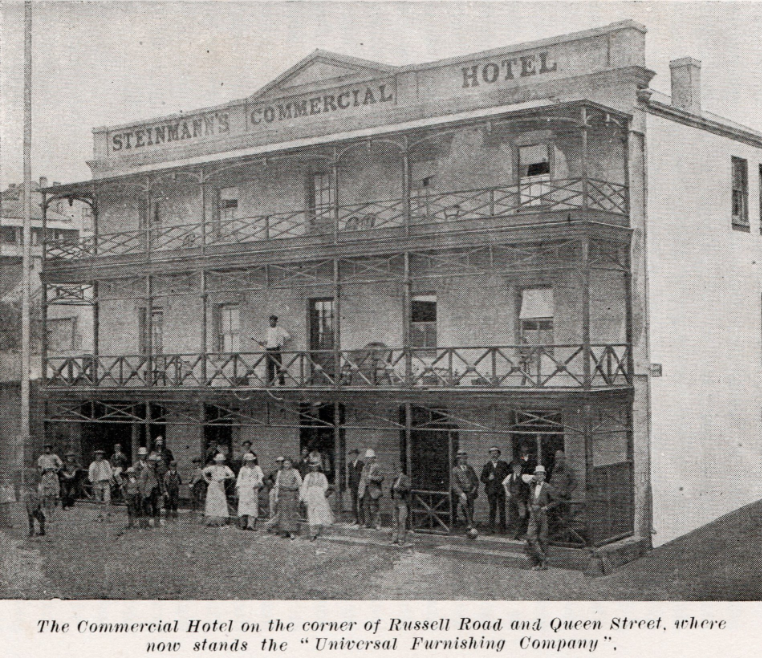
Port Elizabeth of Yore: Where was the Commercial Hotel located?

On the various Facebook sites related to Port Elizabeth, it is always stated that this well-known hotel from the latter half of the 19th century was situated on the corner of Russell Road yet none of the photographs of that corner actually show this hotel where it is alleged to be located.

After gnawing at him, and with his unpaid job on the line, the Technical Editor made a breakthrough at 4am this morning 18th April 2021. Unlike Archimedes’ Eureka moment, he was not lying in a bath of hot water, Blaine was lying in a hot bed. Neither did he break curfew and run naked through the streets of Plumstead disturbing everyone (and we are not talking about him shouting “EUREKA!” either. It could also have been called a lightbulb moment, but given the vagaries of Eskom, this is a rare event nowadays.

Moreover, why did this misunderstanding arise?

Main picture: Steinmann’s Commercial Hotel

Continue reading

Port Elizabeth of Yore: In the Era of the 1837 Royal Engineer’s Map

What can be learned from examining a map in detail? Plenty. But in this case not so much. Being a military map, it does not include all the non-military buildings. This does have an advantage as it eliminates all the clutter. Hence it provides an overall perspective

Main picture: The complete 1837 military map of Port Elizabeth as drawn by the Royal Engineers

Continue reading

Port Elizabeth of Yore: Was the Second Fortification Pointless?

During the first British occupation of the Cape, the puny settlement at Algoa Bay found itself threatened by raiding Xhosa and khoikhoi warriors. For defence, the British soldiers constructed an extemporised fortification known as Star Fort on the Ferreira River [today’s Papenkuils River]. This inexpensive fort dug in the shape of a star around Thomas Ferreira’s house, would act as the settlement’s first fortification.

With the imminent threat to the settlement, comprising mainly wattle and daub huts around the mouth of the Baakens River, a more substantial redoubt was required. To meet this exigency, shortly thereafter a blockhouse was constructed by the Royal Engineers at the drift across the Baakens Lagoon, now sadly no more. This would be Port Elizabeth’s second fortification but did it ever serve a useful purpose or was it ill-designed and located for the task at hand?

Main picture: 1803 Gesigt van Fort Frederick en Algoa Baai, Willem Bartolome Eduard Paravicini Di Cappelli, H103

Continue reading

Port Elizabeth of Yore: Development of the Hinterland by 1806

As the Trek Boere moved ever eastward during the 1700s, the eastern boundary of the Cape Colony was itself relocated to the next large river. Initially in the 1700s the area surrounding the future town of Port Elizabeth was simply known as Algoa Bay which fell under the large district known as Graaff Reinet. In early 1800s, this district was bifurcated with the southern portion being called Uitenhage after the town established in 1804.

Surprisingly even though Uitenhage was the seventh district to be established, within three decades after being populated by the Trek Boere, it had achieved a sizable heft in certain aspects.

This surprising situation is illustrated various tables shown in Theal’s Records of the Cape Colony.

Main picture: Districts of the Cape Colony in 1806

Continue reading

Port Elizabeth of Yore: William Londt – The Man and his Company

The name Londt does not resonate with the overwhelming majority of today’s residents of Port Elizabeth yet the word “Edworks” might do so. Unlike other entrepreneurs whose names are used as the name of the business, this never happened in this case. In short order, after a chance encounter between William Edward Londt and Frank Parker, they were instrumental in establishing a major footwear manufacturing facility in Port Elizabeth.

While none might have heard of William Edward Londt, at least some must have heard of his other legacy; the St John’s Stella Londt Retirement Centre, in Sunridge Park.

Main picture: Edworks factory

Continue reading

Port Elizabeth of Yore: James Mangold – The Man and the Company

Behind every successful company established in Port Elizabeth was an innovative entrepreneur. In the case of Mangold Engineering, it was James Christian Mangold, by training an ironworker and mechanic. James would establish Mangold Brothers in 1878 together with his brother Carl Christian which would rapidly become the largest engineering company in Port Elizabeth besides the Baakens River..

Main picture: Mangold Engineering in Horton Street in 1966

Continue reading