

Isandlwana is synonymous with the greatest defeat of British forces by a native army; that is, one only armed with spears and shields. The only way in which defeat is possible in such situations is by employing such overwhelming forces that the sustained rate of fire from the defenders’ guns cannot kill or wound sufficient of the indigenous forces thereby resulting in defeat. So how was that possible at Isandlwana?
Bureaucracy and discipline is what makes any organisation effective. Without it, nothing works. The men cannot be fed or ammunition will not be ordered. This applies to a myriad of other seemingly mundane aspects in any organisation which ultimately makes the army such a potent force.
Even though discipline is indispensable in any organisation and especially within the army, it’s application requires an open mind for only by understanding the underlying rationale for a bureaucratic practice that one is able to dispense with an aspect of that bureaucracy if need be in a crisis. Rigid adherence especially in the heat of battle where survival is of the essence could be catastrophic as Isandlwana was to prove.

This lesson was reinforced most notably at Isandlwana with the almost total annihilation of the British force of 1500 men.
When the political head of the British Colony in Natal, Sir Bartle Frere decided to advance the cause of British Imperialism in Africa and South Africa in particular, the outcome for the Zulu nation was never going to be propitious. The proud Zulu race with its incomparable army led by Cetswayo but modelled on the template laid down by the great warrior Shaka would be the object of Frere’s duplicity.
Being thousands and many weeks away from London, the control of the events on the ground would be firmly in the hands of the local Governor. In this case, the senior military figure, Lord Chelmsford, and Frere were of a similar mind. Knowing full well the eventual outcome, they would seek by fair means or foul any act or provocation which would goad the Zulus into war.
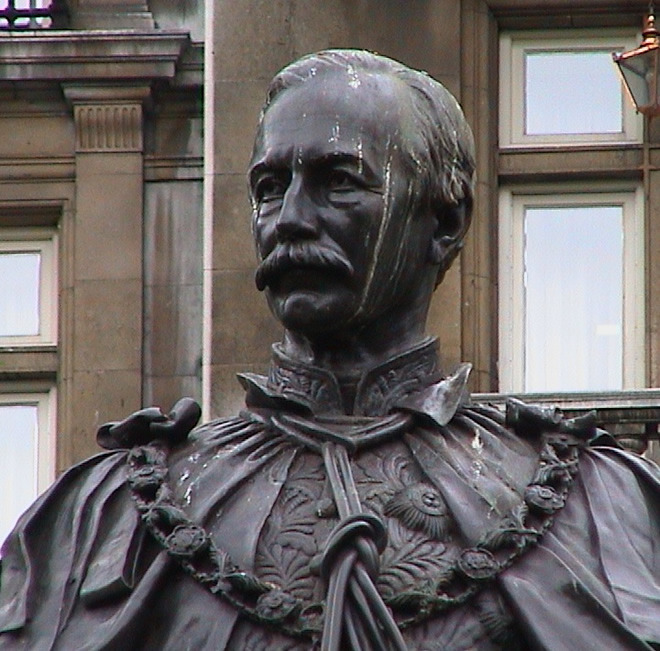
Sir Bartle Frere
Their first opportunity arose when a border dispute arose between the Boers and the Zulus. When this found in favour of the Zulus, Frere reverted to Plan B: the demand to Cetswayo that the Zulu Army be disbanded within 30 days. As the centre piece of Zulu society since Shaka’s time had been the Army, this was a non-negotiable request.
Cetswayo could not and simply would not accede to this impertinent request. For all the undoubted British strengths, Cetswayo was entrapped in a lose-lose situation.
So Cetswayo prevaricated
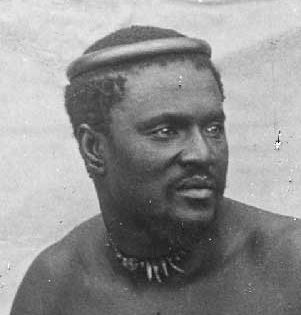
Cetshwayo
So on the expiry of the 30 day deadline, the casus belli would be non-compliance of an iniquitous demand and needless to say, war was declared.
Even in the Imperial times in which such devious means of overcoming one’s opponents was in vogue, this action was considered an article of bad faith and Frere was recalled in ignominy some two years later but the deed had by then long since been done and the Zulu forces roundly trounced and subjugated.
Even though Frere has been dubbed the villain in the piece, this judgement is not entirely fair. As an agent of the British government, it was their “manifest destiny” to advance the cause of British Imperialism and in the case of South Africa there were two additional considerations viz the consolidation of the four colonies into one united country and perhaps more importantly it was the vision of a Cape to Cairo railway through British colonies. From the outset, the Zulus would be an impediment to this ambition but not the last. In the immediate aftermath of the Anglo-Zulu war, the implacable Boers came into the British sights for they held the key to the north through the Zuid Afrikaanse Republiek. Little did the enraptured Boers in the ZAR on hearing of Cetswayo’s dismal defeat understand that they themselves would be the next target of Imperial ambition.
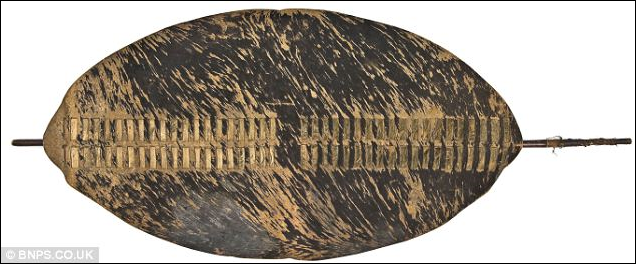
Zulu war shield or isihlangu
With the arrival of two fresh British Battalions by sea, Chelmsford rear was secure. He had divided his force of 15,400 into five columns of which only three would advance through Zululand in order to capture Cetswayo’s capital, Ulundi.
The main attacking force was led by Chelmsford himself. On the morning of the declaration of war, Chelmsford entered Zululand across a ford close to Rorke’s Drift which itself would attain as much fame as Isandlwana itself within a few days.
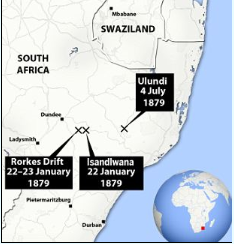
Map of battle grounds
Let us compare the opponents. The Zulu force was overwhelming armed with traditional weapons, the iklwa, the short stabbing spear with a cowhide shield – the isihlangu – as a protection. Some carried two throwing spears. Some carried the potent skull crusher or knobkierrie. Included in the force was a smattering of Zulu warriors bearing the unwieldy muskets which the British had since Waterloo battle in 1815 replaced with the breach loaded Martini Henry. These allowed the incredible rate of fire of 12 rounds per minute as opposed to the one or two of the old barrel loaded muskets.
This would be the first use of this advanced weapon in actual warfare. All of the Operating Procedures relating to this weapon’s employment would be tested under battle conditions for the first time. Herein lay part of the problem! Bureaucratic minds had not applied themselves to accommodate battle field conditions especially the exigencies that invariably arise.
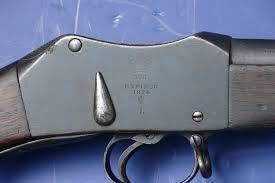
Martini-Henry rifle
In one respect, the British forces in South Africa were still using old-dated equipment and that was their uniform. It was still the impractical red uniform with white leather belts hence the name Redcoats. By that time, the rest of the British Army had already adopted the more serviceable and practical and more concealing khaki colour uniform. Instead of the star red and white against a green, brown or drab background, there was the now camouflaging khaki. Traditionalists were no doubt turning in their graves but expediency and practicality triumphed over long-held tradition.
As an interesting aside, one often views the box shaped formations of traditional armies that is of the Waterloo epoch as being risible and imbecilic but it reality they were not. With less than 10% of the musket balls in reality being able to strike a hostile box formation, one was relativity safe. Furthermore the box formation facilitated the synchronised volley firing
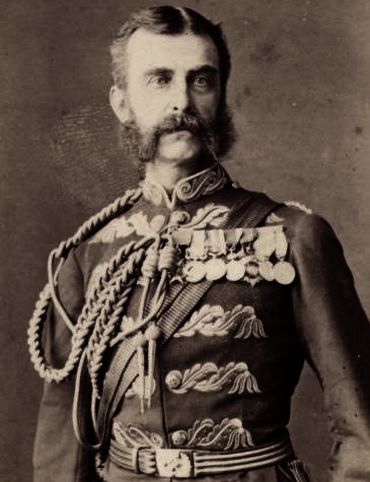
Lord Chelmsford
Chelmsford with the main body of British forces started to ford the Buffalo River adjacent to Rorke’s Drift on 11th January. With muddy and wet conditions underfoot – it being the rainy season – progress was slow.
The speed of the Zulu advance compared to the British is marked. The Zulu impi had advanced over 80 km in five days while Chelmsford had only advanced slightly over 16 kms in 10 days.
On reaching Isandlwana, the British forces ceased their advance and encamped beside the mountain which they nicknamed The Little Sphinx whereas ironically in Zulu it meant The Little Hand. The standard procedure of the Boer forces would have been to form a laager and in the case of the British to entrench themselves. In disdain at the Zulu’s martial abilities, Chelmsford foreswore the requirement for either.
Suffice to say that Chelmsford went ahead to reconnoitre and left command to Lieutenant Colonel Henry Pulliene. Colonel Pulleine might have had 24 years of experience in the British Army but none of them were battle experience. This was his forte: administration and logistics.
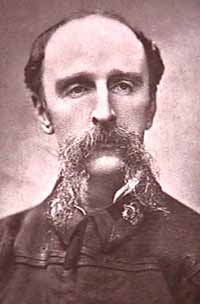
Henry Pulleine
Following Chelmsford example and being aware that their possible departure was imminent, Pulleine never rescinded Chelmsford’s order not to entrench the 5 companies of troops under his command at Isandlwana.
On the morning of the 22nd, Cetswayo’s forces fell upon Pulleine’s forces. The first to bear the punch of the Zulu impis was the screen of British soldier’s serving as lookouts about 200 metres outside the encampment.
With their sustained, accurate and disciplined rifle fire from their Martini-Henry rifles, the Zulus were kept at bay. As the highly trained British foot soldier – pedes in Latin – was able to manually load and fire 12 rounds a minute, these forces were soon running low on ammunition.
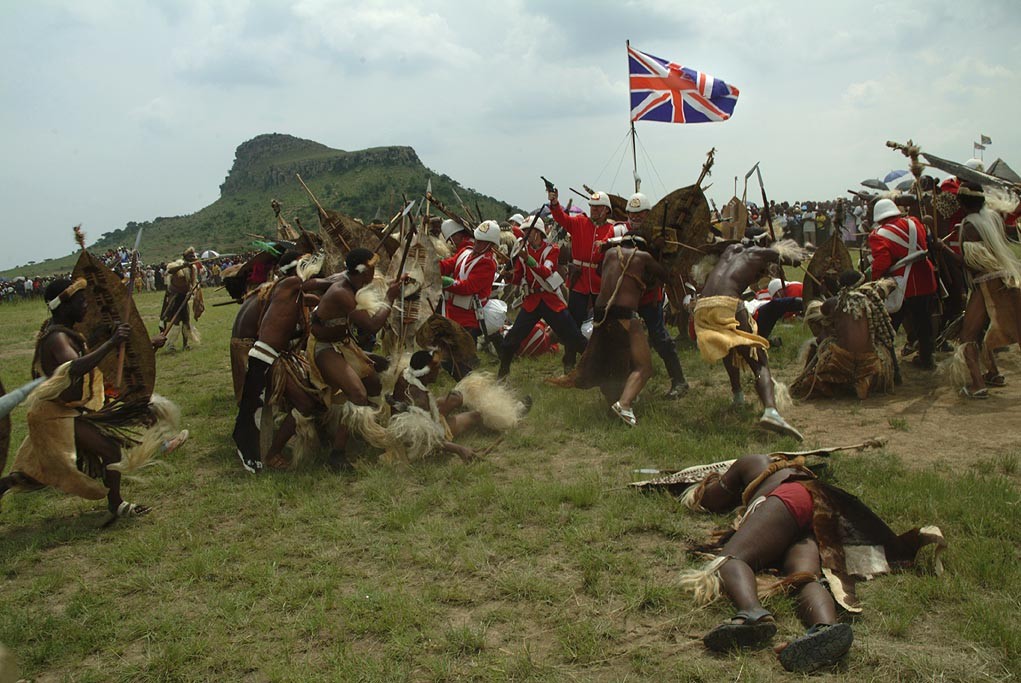
The Company Commander would dutifully send his black messengers & assistants back to their Company wagons for additional ammunition. It is at this point that inane bureaucracy took over. As these desperate men dashed back to the wagons in order to obtain this vital ammunition, they were faced with a number of daunting obstacles. Firstly the officious Quarter Master more concerned with some ill-conceived military regulation more appropriate for peace time duty than frontline exigencies, baulked at issuing ammunition to men who unable to identify themselves properly and from which Company on whose behalf they were collecting for.
If the bamboozled messenger eventually found the correct wagon, was issued with the ammunition, it then had to be dutifully signed for by an illiterate person making a piece of paper with an X. On lugging this box 200 metres, the final obstacle awaited them: the box was so over-designed that the average soldier battled to prize it open thereby wasting yet more precious time.
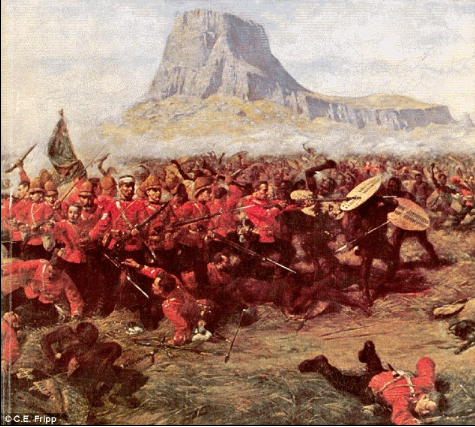
Between all these impediments placed on the obtaining of replenishment ammunition, the rate of fire declined. Sensing an opportunity, the Zulu warriors crept ever closer. Pulliene was in dilemma. Lacking practical military experience, he ordered the simultaneous withdrawal of half the men to the camp itself.
At this moment, the rate of fire dropped precipitously. The Zulu warriors rose up and stormed at the retreating British soldiers. In the resulting maelstrom and melee, most were killed within minutes. None waivered and fled. All of them did their duty and fended off the Zulus as best as they could. They used their rifles as knobkierries, they bayonetted the advancing Zulus. It was all to no avail. Being skilled at manoeuvring their shields, the Zulus parried the thrusts with their cow-hide shields or isihlangu.
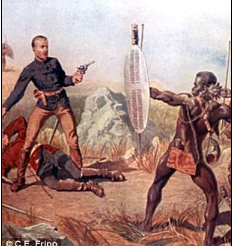
It was a bloodbath. All 1500 British troops in that main body were massacred to a man.
To the one flank away from the main body was the Natal Native Contingent led by white British officers. As the Zulus in the left hand horn skirted their position and overran the rocket detachment, these poorly trained undisciplined troops broke and fell back towards Rorke’s Drift. All instructions by their British Officers were blatantly ignored. Rank insubordination abounded. The half a dozen white officers had no alternative under the grim circumstances. They fled too.
The only survivors of this catastrophe were these troops that had deserted their posts when the firm order had been given to “Stand your ground.”
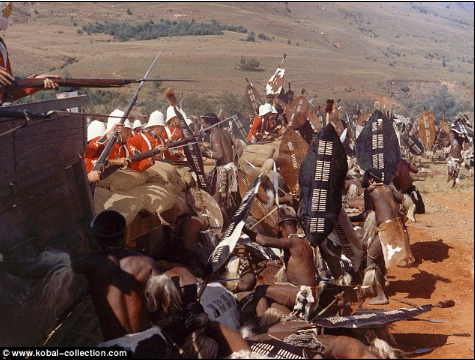
In the case of the British troops in the Isandlwana encampment, they had all hued to the discipline instilled in them. For this they had paid the ultimate price: their slaughter to a man whereas those who had been guilty of gross insubordination including the luckless officers, survived the battle.
By being cowards like the Arab soldiers during the Six Day War and Mussolini’s New Roman soldier’s during WW2, all of the members of the Natal Native Contingent had survived.
In the case of the case of the British at Isandlwana, the bureaucracy maintained by the diligent but officious Quarters Masters in that dire situation had been imbecilic. Did it matter which Company received which Company’s ammunition? Was the signing for the issue of ammunition of any importance under the circumstances? In peace time it would have been of extreme importance as the loss of even one round of ammunition is crucial to prevent.
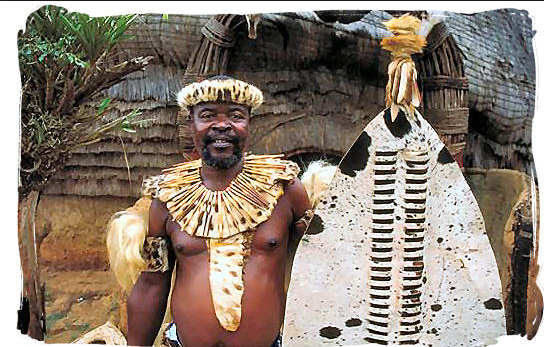
Induna in full regalia
Can the cowardice of the untrained black troops in the Natal Native Contingent be deemed to be treasonous or can it be condoned based upon their lack of military training and skills? Like many mercenaries, they lack all the fundamental attributes necessary of a “professional” army.
The thoughtless application of discipline and bureaucracy can have tragic and unintended consequences.
On the other hand, the thoughtless non-application of discipline and bureaucracy can also have tragic and unintended consequences.
The dull mind of a insular bureaucrat can never make that distinction.
If a Chelmsford, a Durnford or a Glyn had been in camp, I contend that they would have grasped the nettle and ordered the discarding of all such useless procedures.
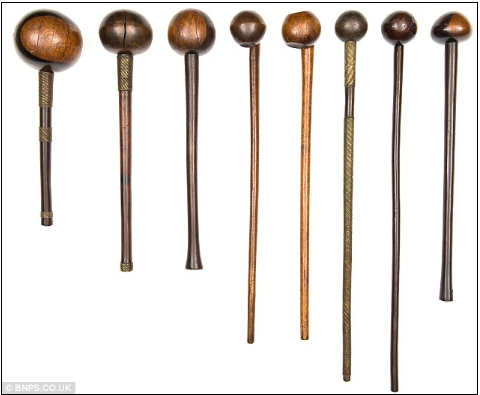
Hardwood knobkierries
But they were not. Pulleine, the archetypal little grey man was.
To their detriment.
And their untimely death.
Excellent article!
As an aside, I have always found the fact that a solar eclipse took place in the middle of the battle incredible. At first I didn’t believe it, but numerous accounts and historical data attests that in the middle of the battle the sun went out. Apparently the Zulu name for the battle translates as “the day of the dead moon”.
One could say that for a while, the sun went out for the whole British Empire.