The Opinion Pieces are an eclectic bunch on current affairs & history often with a human interest aspect. The Movie/DVDs reviews are mainly on documentaries with a smattering of movie reviews.
South Africa always seems to hit the worldwide headlines for all the wrong reasons. Normally, the reasons are self-inflicted but South Africa has again become a household name when a South African Variant of the SARS-CoV-2 was discovered and found to be more infectious, if not more lethal. Luckily, we’ve been upstaged by a new variant, known as the Brazilian Variant, that popped up in Manaus and overwhelmed their medical system within 24 hours.
Up until 1942, Prince Alfred’s Guards had always been an infantry unit. This was to change after the Battle of Alamein when it was converted into an armoured unit forming part of the 6th Armoured Division. It was at this juncture that Lt. Arnold (Coley) Colenbrander was posted into this Port Elizabeth unit as a tank commander. This blog covers the miraculous escape by Coley when his tank, an M4 Sherman, was destroyed by a German 75mm anti-tank gun outside Celleno in northern Italy, killing three of his crew.
Main picture: Coley’s Sherman after the battle at Cellano on 10th June 1944. Coley was in the turret when the shell struck the tank
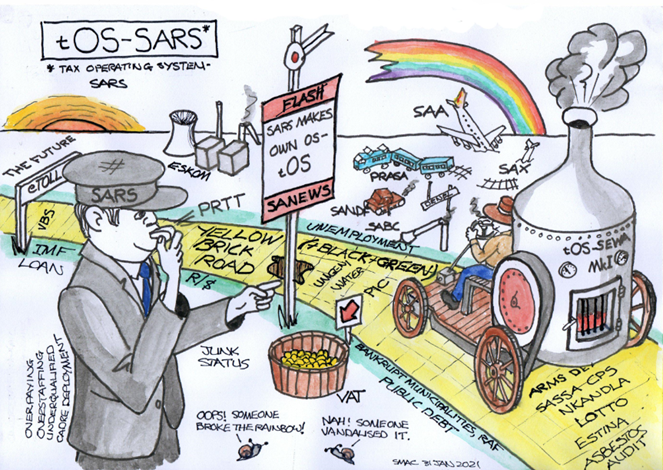
Since July 2017, Adobe has been telling the world that they were pulling their Flash Player as at 31 December 2020. SARS woke up to the problem too late and could only migrate half their input forms to the new method in time. On 24 January 2021, they announced that they had created their own browser which could accept the plug-in to solve their self-created problem. This is a very dangerous approach given that they are dealing with highly sensitive and confidential information and given it takes an immense effort to ensure that any home-grown software is unhackable. In addition, it does not run on the Apple operating system, iOS. This led me to think whimsically about SARS creating its own operating system, tOS-SARS (Tax Operating System – SARS) or tOS for short.
Coincidently, one month prior to Adobe’s announcement, Mmamathe Makhekhe-Mokhuane was appointed Chief Officer – DIST (Digital Information Systems and Technology, I presume). Who can ever forget that hilarious interview in October 2018 on SABC-TV conducted with her where she struggled to answer softball questions? This led her to plead, “Ma’am, can you give me protection from yourself?” In reply to a parliamentary question, Tito Mboweni provided the following information on her qualifications:
A due diligence was conducted on the following qualifications prior her appointment and were Verified:
(1) Diploma in Practical Accounting, Damelin, 1996
(2) Diploma in Bookkeeping, Damelin, 1996
(3) Diploma in Business Organization & Management, Damelin, 1997
(4) Diploma in Personnel Training and Management, Damelin, 1997
(5) Master of Business Administration, University of North West, 2004
A due diligence was not conducted on the following foreign qualifications prior her appointment:
(6) General Certificate of Education. University of Cambridge, 1985
(7) Diploma in Information Technology, Square one, Data processing College, 1987.”
Moegeng Moegeng’s day job is to be the Chief Justice but his real passion seems to be a ranting televangelist in the style of Pastor Mboro et al. Rounding off a thanksgiving address with a prayer at Tembisa Hospital in December last year, he stomped around behind the podium railing against suspect vaccines: “I lock out any vaccine that is not of you. If there be any vaccine that is of the devil, meant to infuse 666 in the lives of people, meant to corrupt their DNA … Any such vaccine, Lord God almighty, may it be destroyed by fire, in the name of Jesus.”
While he might not have directly accused anyone of producing a vaccine that would corrupt DNA, the unsophisticated listener might have made the connection that they do exist otherwise why would a venerated person get so worked up about it. With a worldwide rollout of vaccines gaining momentum, it’s worthwhile revisiting that topic. * Song by Neil Young released in 1972
On 26 January, Cyril Ramaphosa addressed the WEF and accused rich countries of “vaccine capitalism” and essentially stealing and hoarding the supplies that should have been destined for poor countries.
Mustard gas was first used in WW1 and thereafter according to Wikipedia it has been used another 14 times. Yet in the immediate aftermath of WW2, numerous people in Port Elizabeth were to endure the effects of mustard gas. How did this occur and why was mustard gas stored in Port Elizabeth during WW2?
This tearoom has formed the focal point of this hamlet for a century, its centennial being celebrated in 2018. From a rambunctious start as The Hut Tearoom in 1918, the tearoom has also experienced its lean time with the war years probably being the most difficult. The post war years were just as lean but the decision to renovate and rebrand the restaurant as the Sacramento revived its fortunes. On a macabre note, this establishment has witnessed two murders, one being of my uncle, Francis McCleland.
Main picture: The crowds gather for tea at The-Hut-Tearoom-in-Schoenmakerskop in December 1922
Most countries, at some stage or another, have promoted large families. It would seem that fecundity is a source of national pride if not a desire to outnumber their enemies in the long term. Hitler avidly promoted this and Stalin created the medal, Mother Heroine, in 1944 for mothers who raised over 10 children. This was awarded 430 000 times by 1991 when it was discontinued. There were also other medals for woman who were not as fecund or who were perhaps more sensible.
Main picture: Soviet propaganda poster, 1944 & Soviet Mother Heroine Medal
Last year was supposed to be the Chinese Year of the Rat but the year had hardly started and it transmogrified into the Year of the Bat. It not only created genocidal mayhem but also drove the world schizophrenic with false narratives and bad data. This blog focusses on the latter with particular reference to South Africa.