The Post Office Could Get Nothing Right

For my research, I am always purchasing second-hand books on the internet. As reports had indicated that the service at the Post Office had improved, I took a chance. Instead of paying a courier R100 for a delivery within two days, I would save some money and pay R55 for the Post Office. I might have to wait a few extra days but that was not the end of the world.

Or so I incorrectly thought.

Main picture: Post Office International Mail

Continue reading

Port Elizabeth of Yore: The Diocesan Grammar School, from School to Synagogue, Then Church to Café

Not many buildings in Port Elizabeth have experienced such a varied usage over their lives. If buildings could divulge their secrets, this humble unprepossessing tiny building on the corner of Belmont Terrace and Western Road, would have many tales to tell.

Main picture: The Diocesan Grammar School on the corner of Belmont Terrace and Western Road

Continue reading

Port Elizabeth of Yore: Ushering in Electricity and Lighting

The lack of street lighting in the pre-electricity era must have made walking outdoors at night particularly dangerous. If nothing else, this factor must have induced the Town Council to expedite the installation of street lighting as the technology enabled this feature. Furthermore commerce and industry required electricity to operate all manner of equipment, apparatuses and appliances which the use of electrical power enabled. To do so, Port Elizabeth would ultimately require its own generating equipment which in turn would
require it to import coal.

To say that the introduction of electricity would fundamentally change society was a gross understatement. It would transform society in ways which were unthinkable previously. Apart from facilitating nocturnal social intercourse, it would also facilitate the introduction of shift work in industry.

Main picture: Installing overhead electricity cables

Continue reading

Port Elizabeth of Yore: The First Tarred Roads

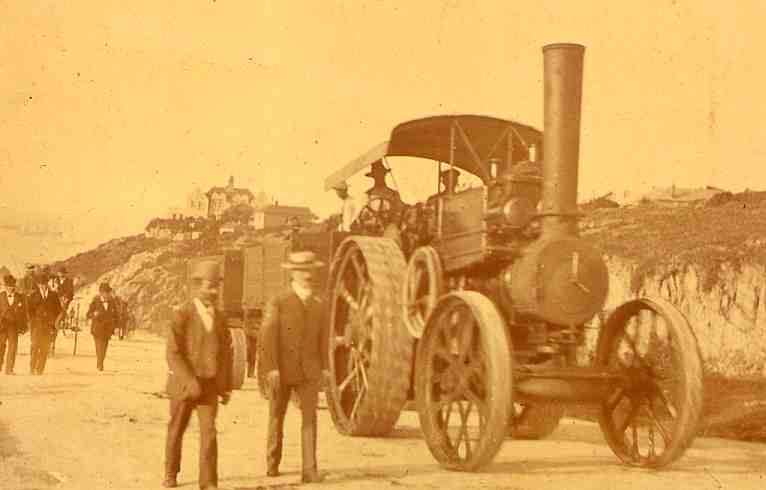
Steamroller used in laying Albany Road

The renowned economist John Maynard Keynes once famously exclaimed that “The difficulty lies not so much in developing new ideas as in escaping from old ones”. Whilst that might have been true in most instances, it is doubtful whether anybody except the most curmudgeonly would have objected to this innovation. But who knows? Progress always has its naysayers. Perhaps others ignored it as being fatuous!

Main picture: Steam roller on the opening of Albany Road. The prominent building on the hill is the Erica School for Girls, designed by architect William White Cooper and opened on 4 November 1903.

Continue reading

Port Elizabeth of Yore: Korsten – A Subtext for Freedom

Human nature seeks freedom and the best for themselves and their children. It is an innate urge. By now the dismal track record of politically motivated false choices should have been exposed as a chimera. So it was for Korsten. Instead of readily agreeing to their being relocated to the new “model township” of New Brighton, the black residents of the inner-city locations defied the authorities and moved to an unserviced area outside the municipal boundaries called Korsten.

Thus Korsten’s roots are nourished by the natural human desire for freedom.

Main picture: Elkana Street, a respectable area in Korsten where children play happily in the street

Continue reading

Port Elizabeth of Yore: Development ignited by the Saltpans

In a manner of speaking, the salt pans which span over the northern areas of Port Elizabeth, are its mineral wealth. Unlike the mines in the north, their minerals are easy to extract without expensive machinery or underground excavations. Furthermore their lifespan is measured in millennia and not decades.

It is thought that in all likelihood, these salt pans have been used for millennia by the local Khoikhoi but not on an organised basis. The saline deposits of this district have long been famous, but until the foresight of Frederick Korsten, that there had been no attempt at systematic development. It was the entrepreneurial spirit of this one man that turned this untapped resource into an asset for the area.

Main picture: Swartkops salt pans

Continue reading

Port Elizabeth of Yore: My Second Great Uncle’s Reminiscences of the 1870s

Balfour Turton Dix-Peek (1868-1932) was one of the sons of my maternal great-great grandfather, George Dix-Peek, thus aking him my second great uncle.  In these letters by Arthur to his great-niece Anita, (and thus a cousin of mine) in 1931 and 1932, he elaborates what life was like in Port Elizabeth during the 1870s i.e. when he was very young

Main picture:  Market Square in 1874

Continue reading

Port Elizabeth of Yore: Disaster on Christmas Eve

The morning of the Thursday 24th December 1931 was not unlike any other Christmas Eve. Whether those passengers crammed into buses and trams had already completed their Christmas shopping, this was a day when many residents of Port Elizabeth would make that trip to Main Street to experience the thrill and excitement of this special day.

Instead many would witness a tragedy which would blunt their enthusiasm and joy over the festive season.

Main picture: St Mary’s Church in 1931 showing the businesses on Main Street being demolished

Continue reading

Port Elizabeth of Yore: Bethelsdorp – The First Organised Settlement

Even though farmers had been living in the area since 1776, the tiny settlement of Bethelsdorp, nestled on a hillside 10km north -west of Port Elizabeth, near the Little Swartkops River, was Port Elizabeth’s first organised settlement. Founded in 1803 by a missionary from the London Missionary Society, Dr Johannes Theodorus  van der Kemp, and assisted by the Rev James Read, the settlement became a catalyst for racial conflict. Bethelsdorp is the site of the oldest London Missionary Society (LMS) station in South Africa and today it forms part of Port Elizabeth.

Main picture:A fanciful view of Bethelsdorp with van der Kemp Kloof in the background

Continue reading