
From the early days in the Cape of Good Hope pioneering farmers had always felt compelled to move out from the Cape. The established pattern of settlement had long since been ingrained in these hardy people. As copious almost inexhaustible acreage of fertile well-watered land was available for the taking, they were able to select a prime section of land outside the control of the DEIC, cultivate it and raise a family. Their modus vivendi was to scout ever eastward until they found a suitable area in which to settle down. Here they would construct their own home outside Dutch control and raise a family. When their offspring reached maturity, the parents would bequeath the farm to the eldest son whereas the younger sons were expected to move on and find their own land.
Survival was not given on a plate. Rather it was the most resourceful, the most hardy and those most impervious to danger who would succeed. It was into this milieu that Theunis Botha would be born.
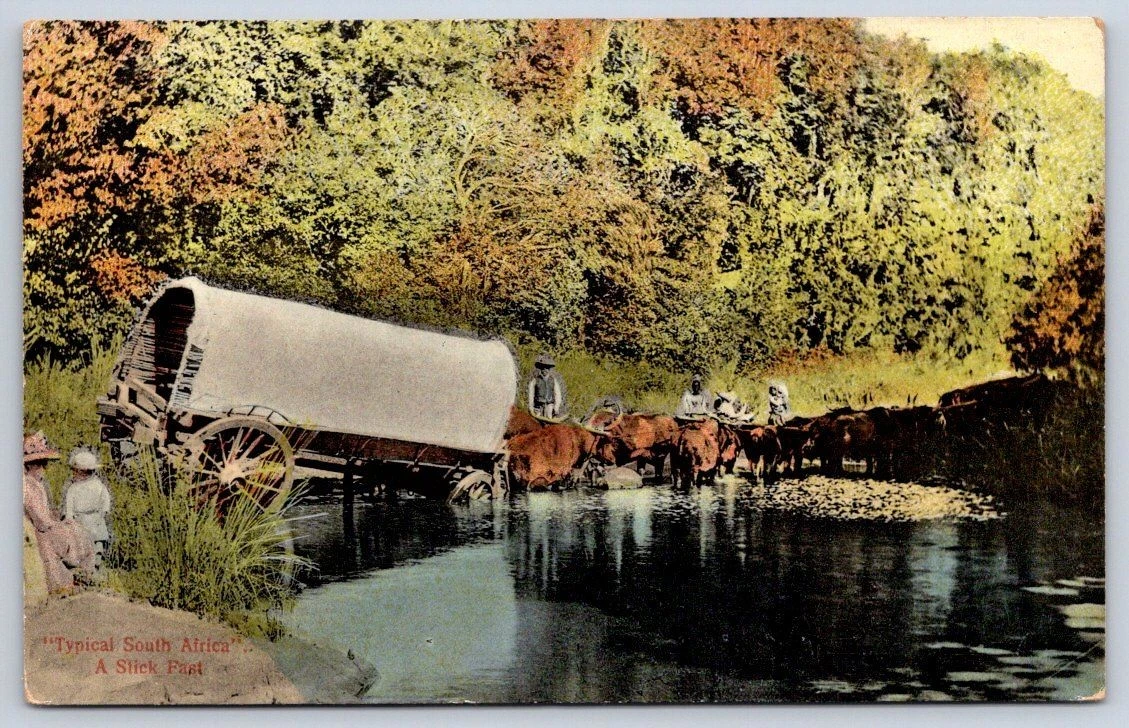
Main picture: An ox wagon stuck in the mud
Breaking with custom
According to De Villiers [SC1],Theunis’ did not adopt the norm of insisting that his eldest son must find his own farm. Instead Theunis raised his family on his parent’s farm as it was considered large enough as well as productive enough to support several families. It should not be inferred that Theunis was not considered able to develop his own separate farm. Rather it was a function of the farm’s size that was the decisive factor. The birth of his eldest son, Jacobus Theodorous on 17th March 1776 was shortly followed thereafter by Governor, Van Plettenberg, issuing a grazing permit to Theunis Botha. According to the permit [SC2] “the agriculturist Theunis Botha is authorised to pasture his cattle on the farm Buffel’s Fontain lying between the Kragga Camma and the Company’s Beacon.”
Theunis Botha’s fortunes change
During the 25 years from 1776 and the receipt of their Grazing Permit, the Botha family resided peacefully on their extensive farm until early 1799 when their fortunes changed dramatically.
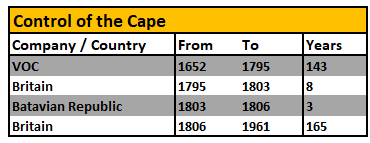
In September 1795, the British occupied the Cape with the objective of safeguarding their interests in the east during their war with the French. With limited resources at their disposal, the British were compelled to administer the Cape through the existing systems and civil servants as previously utilised by the Batavian Republic. Implicit in this decision was the recognition that land tenure and districts would operate on the same basis as previously.
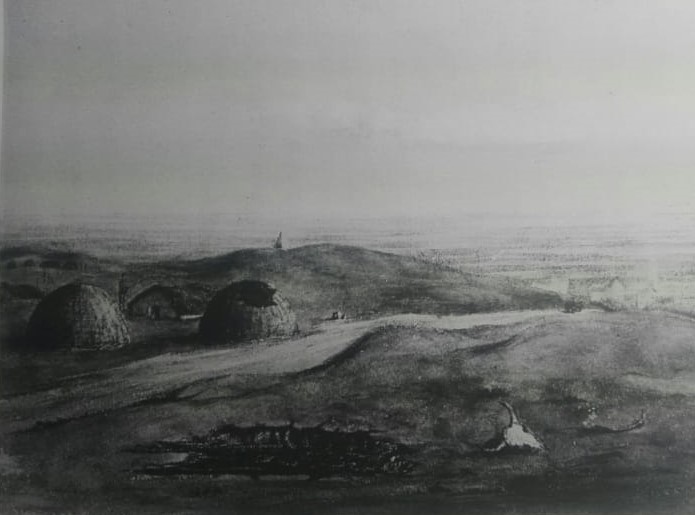
Like most inhabitants Buffelsfontein and its occupants, Theunis Botha, were largely unaffected by the new civil administration.
The Van Jaarsveld uprising
Upheaval did arrive but on two counts it was self-inflicted and did not relate to the change of administrative control. During January 1799 one of the Trekboers, Adriaan Van Jaarsveld, was arrested and charged for forgery. The subsequent action by other farmers in forcing his release resulted in a revolt against the government in Cape Town. Theunis Botha would unwisely elect to throw his lot in with these miscreants and support their revolt by taking command of part of this group. This foolhardy decision would cost him both his liberty and his land.
The rebellion never made headway and soon petered out. Most rebels surrendered to the British military commander, the authorities in Cape Town which had acted incisively and decisively to suppress the insurrection. Theunis Botha found himself on his own with less than 100 men who were all was rounded up. Along with Adriaan Van Jaarsveld and his son, Zacharias, Theunis was put aboard the Sloop, the H.M. Rattlesnake and transported to Simon’s Town. [SC5]
Charged with taking up arms against the Crown and inciting others to do so Botha was found guilty by the Court of Justice which recommended the death penalty. The sentence of the Court announced on 3 September 1800 called for the rebels “to be delivered to the executioner, blindfolded and having kneeled upon a heap of sand he is to sway the sword over their heads for punishment and then to be [SC6] banished.
Status – personal and Buffelsfontein
The judicial process took an inordinate length of time. It was 15 months before the accused were brought before the Court whereupon the proceedings had to be referred to London imposing another year’s delay. Instead of accepting the delay, the Acting Governor, Major General Dundas, commuted the sentence to one of imprisonment. Theunis Botha remained a prisoner in the Cape Town Castle until released in April 1803 by the returning Batavian administration.
In the intervening period with no cash inflow, the rent payments had in all probability lapsed. No evidence can be traced to imply that he had been dispossessed – it was leased anyway- or that any member of his family was authorised to retain it. From the correspondence and journals of Dr van der Kemp and James Read, both confirm that Botha’s Place was vacant in 1802.
London Missionary Society station
In 1801 Graaff Reinet had been chosen as a site for a new London Missionary Society station among the Hottentots and Dr. Van Der Kemp and others went there to set it up. A combination of adverse factors, not least the hostile attitudes of local farmers, forced him to move away to the protection provided by the military garrison at Fort Frederick where he arrived with his party of Hottentots on 6th March 1802.

With rumours of the suspension of hostilities among the European powers, only temporarily as it turned out, a state of uncertainty prevailed in the Cape. Major Le Moigne, the British commander at Fort Frederick, was reluctant to give orders for the permanent siting of a mission station but aware of the Acting Governor’s desire to help the Hottentots, he suggested Botha’s Place, “a farm belonging to the Government, about 7 English miles to the west of Fort Frederick and 3 miles from the sea shores.” [SC3]
“Whether we shall stay here, or have another place given us, is quite uncertain,” he wrote, “by digging wells we find, the water amply supplied the fertility of the ground (is) beyond most parts of the country so that what will not grow in other places without much watering grows here in abundance without that trouble. Its nearness to a large and perhaps the best salt pan in the country renders the situation very advantageous, we have in great plenty fine Timber of the Different Kinds which this country affords, and of excellent Limestone which we think will make excellent pots and Bricks….”
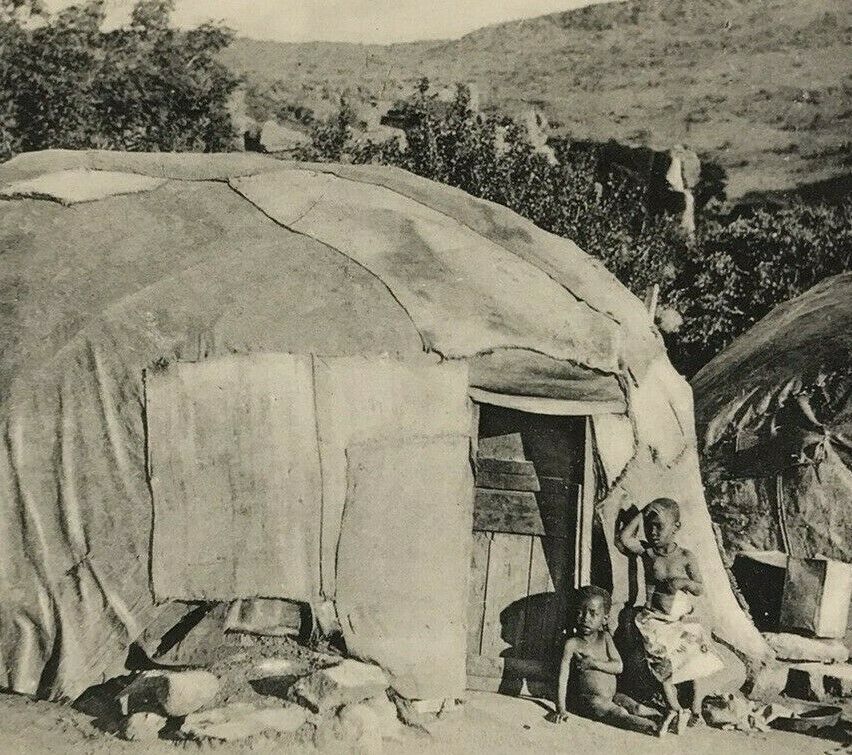
This seemingly ideal site for the mission station was not to last. In the annual report, penned a year later from Fort Frederick, James Read was writing: “…we had to labour on all sides with difficulties and opposition which threatened us some time with total destruction” enlarging on this by explaining that “the war between the farmers with the Cafferians and plundering Hottentots was going on very cruelly…………”
Attack on Botha’s Place by rampaging Hottentots
At the end of September 1802, the military garrison at Fort Frederick was withdrawn. James Read goes on: “…….after they had departed 8 days, a Troop of plundering Hottentots attacked our place in the middle of the night, and having fired about 50 times with muskets took away all our cattle …. “ After further attacks Van Der Kemp and Read were forced to evacuate the farm and return to the shelter of Fort Frederick from where James Read wrote his letter of 31 March 1803 including the report that “…….all our houses in Botha’s Place being laid to ashes……” Van Der Kemp later established the mission station at Bethelsdorp. [SC8]
Dutch retake control of the Cape
On the resumption of the Dutch administration, Theunis Botha, now pardoned, was likely to have returned to Buffelsfontein to reclaim the land and re-establish the farm and its buildings. The countryside around Algoa Bay was far from quiescent with bands of pillaging Hottentots and African tribesmen roaming about at will. Theunis Botha is believed to have died in a skirmish with one of these bands; his eldest son, Jacobus Theodorus, then with a young family, would almost certainly have taken over the farm and worked it as best he could.
Lawlessness continued in the frontier area for some time after the second British occupation in 1806 with the garrison at Fort Frederick providing little security. Military operations to restore order began following the appointment on 8 October 1811 of Lieutenant Colonel John Graham as Special Commissioner for the Eastern Districts. With a force of less than 1,000 cavalry and infantry, the latter drawn mainly from his Cape Regiment, he achieved quick success. In a letter to him dated 2 April 1812 the Cape Government described the area as “Fertile districts rescued by your exertions and His Majesty’s arms from the former anarchy”. In a Proclamation of ear1y 1812 the government of Sir John Cradock declared its intention “to found extensive settlements from Algoa Bay, the future naval mart of those quarters, to Uitenhage and Graaff Reinet.” [SC12]
Theunis’ son takes over Buffelsfontein
Civil administration was re-established more effectively with, amongst other aspects of local government, reregistration of the land. If they had not already done so, Dutch farmers were encouraged to return and provided proof could be produced to show entitlement, land was made over to them either as loan places or as grants. Jacobus Theodorus Botha is recorded as having paid the quitrent for Buffelsfontein in 1815 and on 1 July 1816 the farm was officially granted to him at an annual quitrent of Rxd130. As surveyed, it measured 2979 morgen 408 square roods (sq. rds.). [SC13]
The Opgaaf Roll of the Uitenhage District for 1822 (CAD, J.1 08) provides an indication of the farming activities of Buffelsfontein at that time – 19 breeding horses, 40 draught oxen, 262 head of breeding cattle and 130 sheep. Extensive areas were under cu1tivation sown with barley and oats. The livestock included racehorses from which the Bothas were to build up a reputation as breeders of bloodstock and produce several future winners.
Visit to Buffelsfontein by Captain of the 42nd Highlanders
This is a verbatim extract from the book by Captain James Edward Alexander of the 42nd Highlanders.
Another afternoon, I rode out with Major and Mrs. Michell to visit a respectable Dutch böer, (farmer,) Mynheer Botha, of Buffels Fontein. We found the neat whitewashed and one-storied house in a valley; a flower and vegetable garden, enclosed with rails, was on the slope before the door: a wagon stood by; out-houses occupied one side; and beyond them were kraals (enclosures) of thorn bushes for the cattle. The old böer came out to receive us, wearing a white nightcap under his hat and clad in a blue jacket and corduroy trousers. His son was smartly equipped in a jacket of a military cut; the mother and her daughters wore black dresses, well made after the English fashion, and the house was very clean, consisting of a large hall and side rooms, the floors of all of which were shining with black polish.

To show me the varied talents of the böers, often living scores of miles from town or village, the major said to young Botha, ” Young Piet Rademayer can make a wagon. ” — ” So can I,” replied to Botha, ” iron work and all.”-” Young Rademayer makes his own shoes. “-” Look at these boots which I have on, ” cried Botha: ” I made them with my own hands. You see this tiled roof: I have just put it on instead of the old thatched one; and that fiddle, hanging on the wall, is of my workmanship. ” Loop-holed barricades of bricks and boards were raised on the low wall which surrounded the house with the assistance of which, the whole family meant to defend their property, having already buried a great deal, (even looking-glasses); and the young ladies had insisted on their brother giving them lessons in loading and firing.
We rode out before dinner to inspect the farm; and, ascending some heights, saw a noble and extensive South African landscape. Grassy plains stretched far before us, undiversified by a single tree, though wood was seen occupying hollows in various directions while towards the north and west, arose the grand features of the Elands and Winter Hoek mountains, and the beautiful ranges of the Zitzikamma.
” Still be it mine to wonder and admire,
While in their pleasing rounds the seasons roll.
Still be it mine to fan the hallowed fire,
That ‘ mid the scenes of nature fills the soul.
These, these are themes most worthy of a man,
These can each wild tumultuous passion quell.
While pondering on creation’s mighty plan,
Thoughts how sublime within the bosom dwell! “
From the scarcity of water, or rather from want of effort to collect it on the part of the Dutch farmers, who sometimes make a deficiency of water a pretence for asking for an additional grant of land, a full- sized farm is reckoned from two to three thousand morgen, or double that number of acres. Buffels Fontein was two thousand morgen; and the annual quit- rent was one hundred and thirty rix- dollars: a rix – dollar being one shilling and sixpence. This, however, was considered unusually high. The old surveys of the farms are very defective, generally inaccurate as to dimensions, and being mere diagrams, which show only the roads and water without indicating the inequalities of surface. Loan farms pay one pound sixteen shillings per annum to government, and only half transfer dues, because they have not been surveyed at all; and thus, the colonial chest has suffered from the insufficient strength of the surveyor- general’s department.
Sources
[SC1] De Villiers, Pama, Genealogy of Old South African Families, page 79
[SC2] [Cape Archives Depot (CAD) RLR 24/1 No.100
[SC3] James Read, Letter datelined Botha’s Place near Algoa Day, South Africa, 18 March 1802 addressed to the LMS, London)
[SC4] James Read, Letter datelined Botha’s Place near Algoa Day, South Africa, 18 March 1802 addressed to the LMS, London).
[SC5] PRO, Kew, ADM 36 14955 and ADM 51 1298
[SC6] Theal, Records of the Cape Colony, iii, Page 295
[SC7] Ibid, iv, page 113
[SC8] Cory, The Rise of South Africa, 1. pp 112 & 113
[SC9] Old Times and Odd Corners, EPH, March 3, 1868
[SC10] Narrative of a Voyage of Observation among the Colonies of Western Africa by Captain James Edward Alexander of the 42nd Highlanders
[SC11] A significant proportion of this article is based upon an article by Bernard Johnston Part 1: Botha’s Place 1776 to 1850
[SC12] PRO, Kew, CO 48 15).
[SC13] (PRO, Kew, CO 48 65).