

Apart from his name and a few other biographical details, there is a paucity of information regarding Howard Mapplebeck (1847-1909)and his stay in Port Elizabeth. Despite appearances that he was a prosperous individual, I was unable to establish much apart from the fact that he lived in a plush house on Emerald Hill. Having uncovered numerous photos of a Mr Howard Mapplebeck on Flickr, I was intrigued as they cast a light on an elegant milieu and a graceful lifestyle.
Main picture: Howard Mapplebeck (1847-1909) with family and friends, at Emerald Hill, Port Elizabeth, in 1886. Howard is in white with pith helmet. Seated in front of him are his children Sybil Mapplebeck (1875-1955) and Sydney Mapplebeck (1877-1904). Nanny Marie stands to the side. Photo taken in 1886 at the age of 39.
Apart from those threadbare facts, the one of the two other mentions that I can uncover about the mystery man is an entry in Margaret Harradine excellent tome: Port Elizabeth-a Social Chronicle to the end of 1945. The entry is dated January 1883 in which Margaret recounts that “The South African Kennel Club was formed. For many years dog shows were held at the Show Ground as part of the annual Agricultural Show. The first show was held on 14 and 16 March 1883 with about 200 entries. The judge was H Mapplebeck. Breeds represented were pointers, setters, retrievers, greyhounds, foxhounds, harriers, beagles, spaniels, sheepdogs, newfoundlands, bull dogs, bull terriers, rough-haired terriers, pugs, toy terriers, Pomeranians, mastiffs and boar hounds.

Howard was born 1847 in Aston, Warwickshire. On the 13th May 1874 he married the 19 year old Mary Wilkes who was born in 1855. They had two children Sybil and Sydney. In 1881 they were still residing in England except that it was now in Worcestershire. Howard separated from Mary prior to 26th May 1882 when he departed from Dartmouth and bound for Cape Town. Howard’s ultimate destination was to Port Elizabeth. Family records suggest that Howard went to the area for the gold rush of the 1880s. This is supported by newspaper articles and share certificates which later confirm his commercial interests in mining properties. His wife was only to pass away many years later in 1914 at Villa Paul in Hyeres, France dying 5 years after Howard who passed away in 1909. The probate record indicates that she left her estate to their daughter, Sybil.
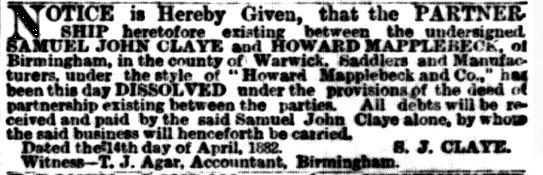
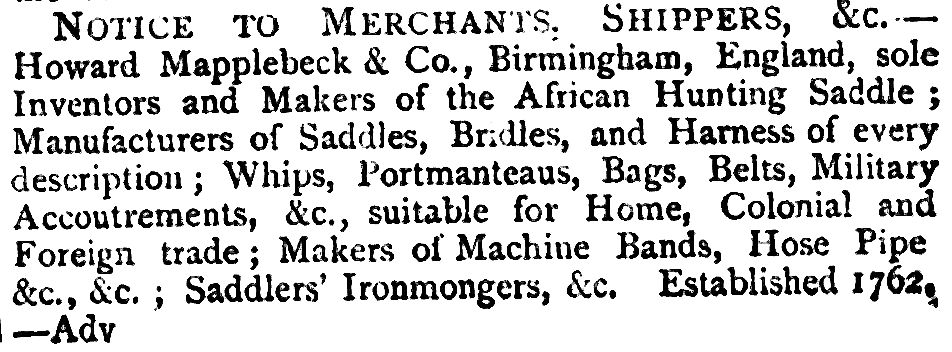
What I have been able to establish is that by the age of 22 in 1867, Howard was a partner with a certain Mr Samuael John Claye in a Leather Manufacturing Company based at Number 44 Bradford Street, Birmingham. Howard must have been involved in the leather business from this point onwards as an advertisement in the New Zealand Evening Post of 1881 refers to saddlery of a Mr. H. Mapplebeck.
Rekindled interest
Mapplebeck’s interest in dog breeding must have developed during the period prior to his arrival in Port Elizabeth in 1881 as a number of books of the period make mention of various of his dogs especially his New Foundland. Many of these animals have been painted for posterity and are still being sold. It appears that Howard had taken an interest in dogs prior to living in Port Elizabeth. Howard rekindled his interest by attending a dog show at the Show Ground in North End. In the early years of the town, only dogs which possessed some utilitarian value were favoured. In this regard, the most prominent role that they played was as hunting dogs with the most prominent such event being the almost week long hunt at Wycome Vale by the Easter Hunt Club. This was no more than a carnival of slaughter in which hundreds of animals were killed in an orgy of death.
Kennel Club
As dogs were increasing acquired for their aesthetics for breeding rather their utilitarian value, members of the Easter Hunt Club founded the South African Kennel Club [SAKC] in Port Elizabeth in February 1883 imitating the British model. The club defined its intended audience through an annual subscription of £1 1s and garnered no fewer than 158 members among Port Elizabeth’s middle class within just a few months. This cash infusion and fraternal ties with the PEAS enabled the SAKC to mount the colony’s first dog show as part of the town’s annual agricultural show in March 1883 in a purpose-built shed in the show yard. The response exceeded all expectations, attracting more than 200 entries and 900 visitors in the two weekdays that it was open and the more than £300 invested by the Club in buildings and prizes was amply recouped by the windfall from entrance fees, gate money and catalogue, ensuring that the dog show became a permanent imperium in imperio in the town’s annual agricultural show.
A founding member of the SAKC, William Armstrong, put up a £5 5s prize for the best “bush dog”, which was awarded to a “half-breed Foxhound” in accordance with the prevailing consensus among the town’s hunting squirearchy. The decision was rudely and publicly rejected by another competitor
At the risk of being hoist by their own petard, the SAKC quietly dropped the “bush dog” category from future shows and relied upon committeeman Howard Mappleback who had “considerable experience in such Shows in England” to save them from any future embarrassment caused by unwittingly putting their backveld mongrel preferences on public display.
What this does indicate to me is that life in Port Elizabeth in 1883 was no longer in survival mode. Instead there was time to embrace the finer, more cultured things in life.
Offspring
Prior to their separation Mary had already conceived two children, Sybil and Sydney. Like her mother Sybil had been unsuccessful in marriage marrying twice, firstly to Charles Stephenson in 1895 who died in 1907 following divorce proceedings and then in 1910 she married Thomas Burbidge. Sybil had one child, Marie Gertrude Stephenson de Souviron in 1908. Sybil died in 1963 in Slough, Berkshire. Sadly Sydney died in his twenties in Singapore in 1901.

In all of the photos in this collection taken at Emerald Hill, were taken in 1886, Howard is dressed in white with a pith helmet. Furthermore his children are also often included being his son Sydney Mapplebeck (1877-1904) and his daughter Sybil Mapplebeck (1875-1955). Their nanny Marie is also often shown. His wife Mary is not shown in any of these photographs as she had separated from Howard prior for his departure for the southern shores.

As far as I can ascertain, Howard Mapplebeck was born in Birmingham in 1847. One of the photos of Howard as a young man is taken in 1865 at 18 years of age in Birmingham.
Dog breeding
Whilst still residing in Birmingham, Howard had developed a passion for dog breeding. Howard had many of his prize breeds painted in water colour and these paintings are still extant. In fact he was extremely well known as a breeder of note even today.


Without any additional information, it is possible that Howard only resided in Port Elizabeth for a short period and, as a minimum it must have been from March 1882 when he departed from Dartmouth bound for Cape Town and perhaps was a judge in a dog show until sometime in 1886 when all the other photos of Howard in Port Elizabeth were taken.

In 1891 Howard is recorded as attending the Shire Horse Show on 26th February 1891. Hence closest date of departure from Port Elizabeth and relocation back to England is between 1886 and 26th February 1891.
In his excellent book Port Elizabeth in Bygone Days, Redgrave makes mention of a Mr Maplebeck [sic] who occupied a famous farm on Emerald Hill. Presumably, Maplebeck and Mapplebeck are one and the same person. Redgrave records that a hotel licence was granted to Mr. Mapplebeck. In his article on Emerald Hill in the 2007 edition of Looking Back, Richard Tomlinson refers to the Emerald Hill Hotel which a Mr. Eduard Steinmann opened in April 1883. He then goes on to state that Mr. Steinmann was succeeded by a Mr. Howard Mapplebeck as proprietor. Apparently eventually Mr. Mapplebeck’s extensive house became the property of the Dominican Sisters who rebuilt it in order to run it as the St. Dominic’s Priory. The photo used in the blog from the Bensted Collection showing this house, confirms it size.


Panoramic view
From the Emerald hill homestead, one is afforded a panoramic view of the entire coast line around Cape Recife and the Bushy Park Estate which stretches for miles along the coast towards Cape St. Francis. Whether Howard ever experienced the warm-hearted hospitality of Bushy Park’s first owner, Charles Lovemore, one can only speculate. The chances are good that these two neighbours did indeed socialise. Maybe Howard did not share Charles’ passion for game hunting.


Whoever Howard Mapplebeck was, he was certainly affluent and enjoyed the finer things in life.


Information supplied by Richard Day
Out of the blue, I received an email from Richard Day informing me that Howard Mapplebeck was his great grandfather and then proceeded to supply me with a significant volume of information regarding Howard Mapplebeck and his family. All of this information related to his life in England whereas the information that I had uncovered related to his life in Port Elizabeth. Hence I now have a fuller picture of the man.
What is important to note is that Howard Mapplebeck, after his South African odyssey, came back to England and started a relationship with Mary Ann Masters (1860-1951). They had four children together:
Charles Samson Wutheimer Masters (1892-1912)
Evelyn May Masters (1896-1990)
Muriel Mary Masters Matthews (1901-1970)
George Howard Matthews (1902-1974
Howard Mapplebeck is indeed listed as a boarder at 61 Redcliffe Road in 1901. But this does not reflect the reality that he and Mary Ann lived together for about 18 years and he was the father of her four children.
Concerning Howard’s earlier life, he appears to be the youngest of five children to William Batty Mapplebeck (1807-1893) and Martha Harrison (1808-1891). His father was an ironmonger, merchant and factor originally from Rotherham in Yorkshire, who came to Birmingham as the industrial revolution gathered pace through the 19th century.
The siblings appear to be as follows:
- Sarah Nancy Mapplebeck (1839-1930)
- John Edward Mapplebeck (1842-1925)
- William Batty Mapplebeck (1843-1926)
- Edward Mapplebeck (1845-1937)
- Howard Mapplebeck (1847-1909)
.
For Howard there are census records, directory entries, newspaper articles and other documentation to support the following timeline:
1851 First census record, age 4, in Aston, Warwickshire.
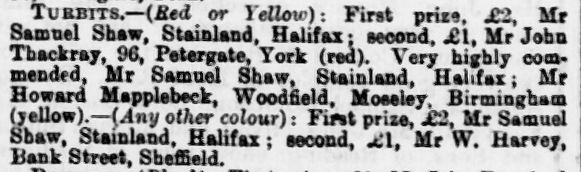
1865 At age 18, first record in newspaper of prize awarded for showing of poultry. Many more would follow in the 1860s and early 1870s.
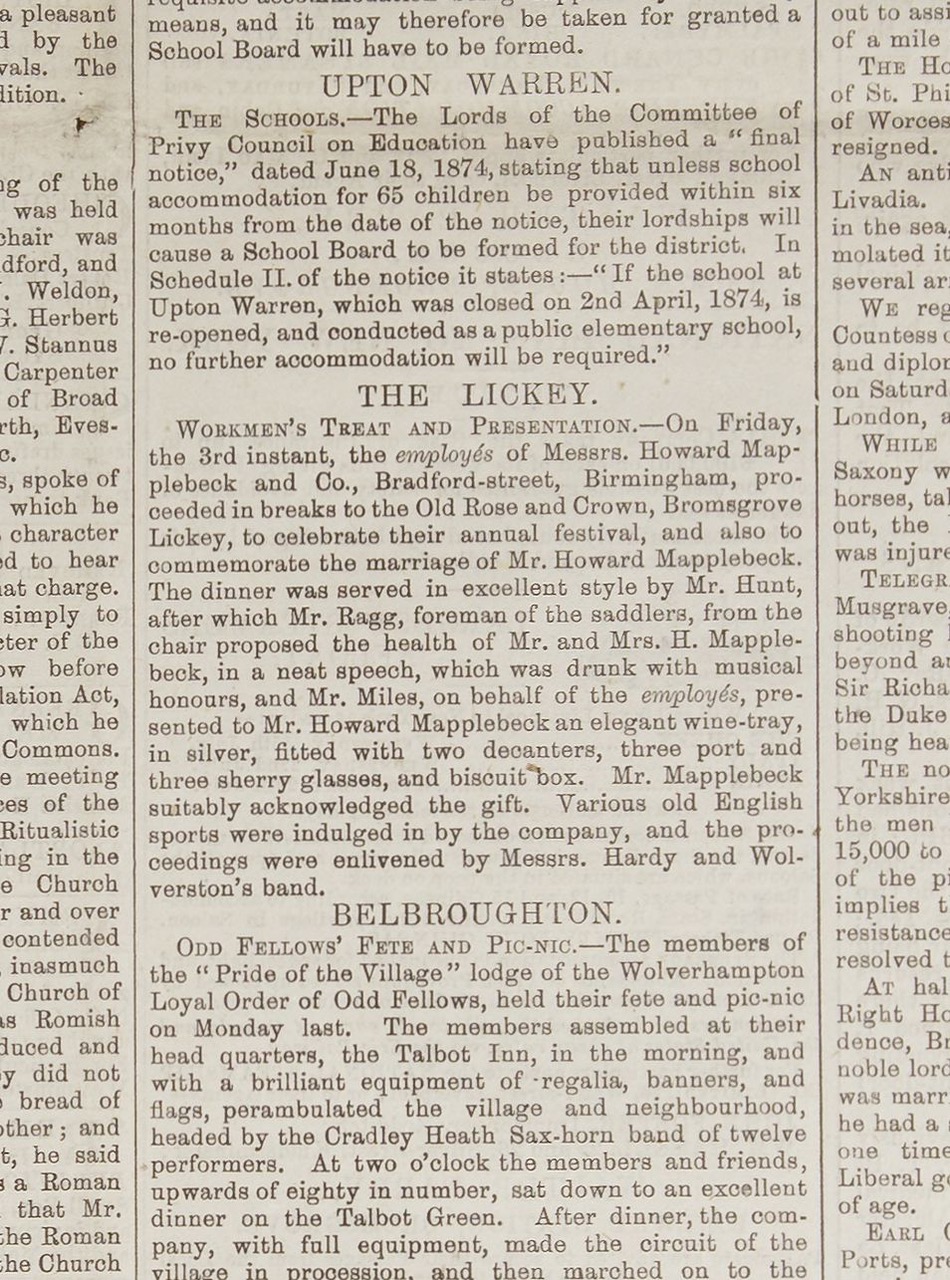
1871 At age 24, he is working as a saddler’s clerk in Birmingham.
1872 23rd March Howard acquires the saddlery and harness manufacturer of Horton and Grundy.
1872 Mapplebeck & Co Saddlery and Harness maker advertised.
1874 Advertising shows Howard’s business as “inventors and makers of the African hunting saddle” .
1874 Marriage to Mary Wilkes
1875 Birth of daughter Sybil
1878 Birth of son Sydney
1881 Census return shows Howard at age 34, a manufacturer, at Knowle, Solihull, with wife Mary and their two children.
1882 14th April Notice of dissolution of partnership in saddlery company.
1886 Photo album shows Howard, his children, a nanny and friends at the Emerald Hill estate, Port Elizabeth. Notes accompanying the images confirm the date.
1891 26th February Howard is recorded at The Shire Horse Show in Islington, returned from a “long sojourn in South Africa”
1892 Howard fathers Charles Masters, son of Mary Ann Masters (1860-1951).
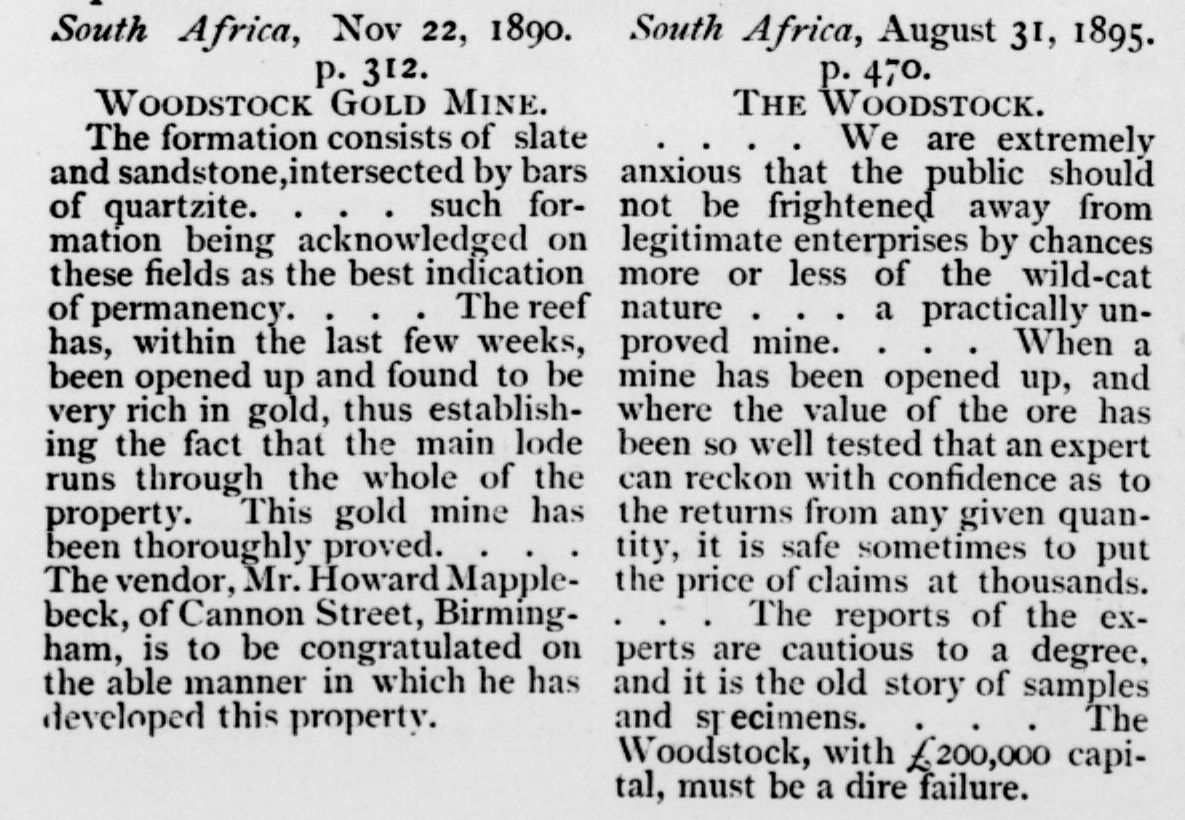
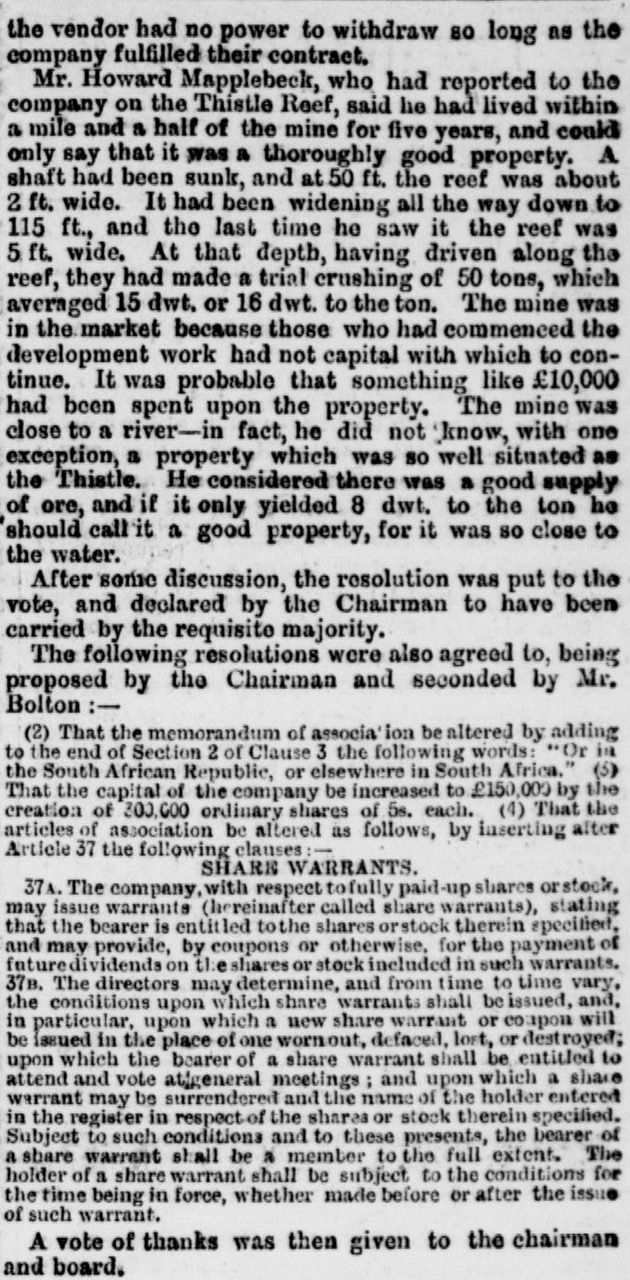
1893 Record of an Ordinary General Meeting of the New Eberhardt Company, in which Howard reports on the Thistle Reef gold mining property.
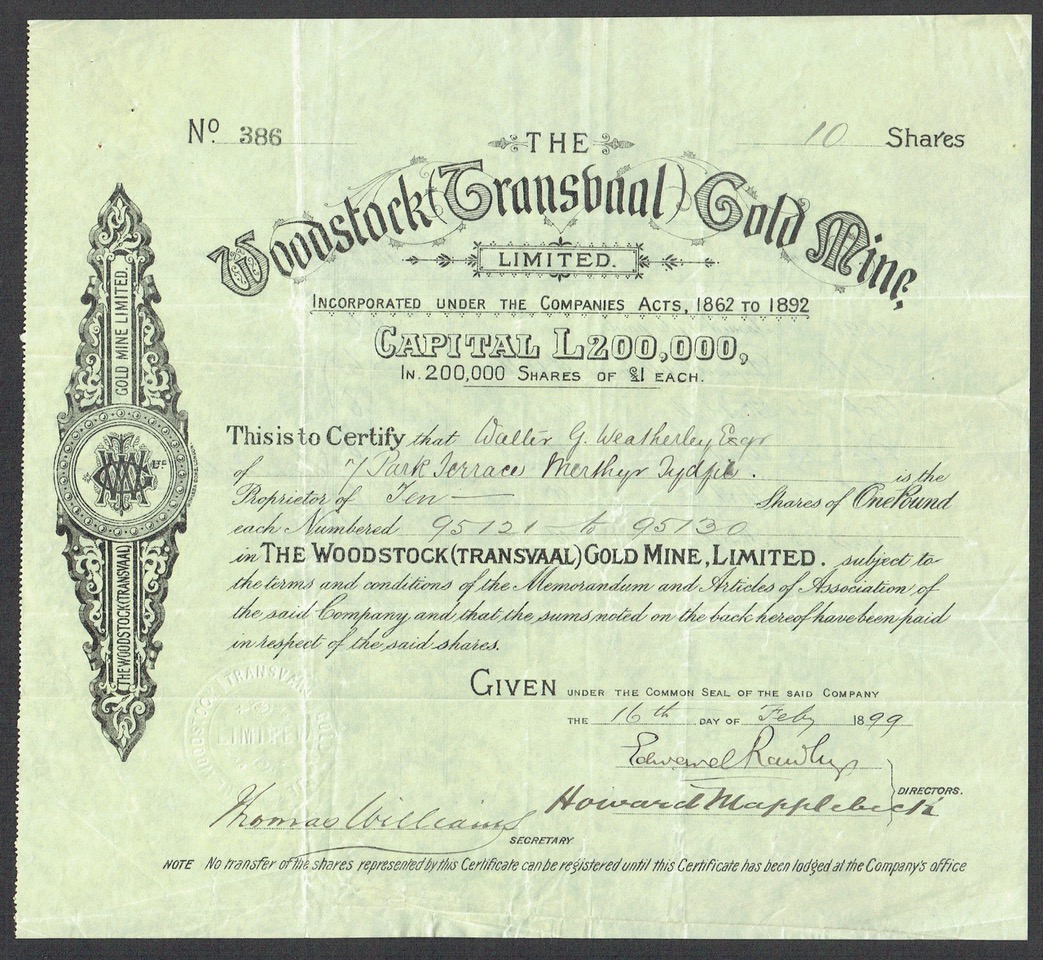
1895 Share capital raised for the Woodstock Transvaal Gold Mine Ltd, of which Howard is a director.
1896 Howard’s second child with Mary Ann is born Evelyn May Masters.
1901 Howard is shown at Mary Ann’s property in South Kensington as a boarder and financial agent.
1901 Their third child is born Muriel Mary Masters Matthews.
1902 Mary Ann gives birth to their fourth child, George Howard Matthews.
1909 Howard’s death at age 62 in South Kensington.

Sources
Newspaper images courtesy of Findmaypast
WoodstockTransvaal Gold Mine Ltd share certificate courtesy Scriptoworld
Port Elizabeth: A Social Chronicle to the End of 1945 by Margaret Harradine
Port Elizabeth of Bygone Days by JJ Redgrave
Photos from the Bensted Collection on Flickr
Emerald Hill: The Farm, the Hotel and St. Dominic’s Priory by Richard Tomlinson in Looking Back 2007
Class and Canicide in Little Bess: The 1893 Port Elizabeth Rabies Epidemic by Lance van Sittert
https://www.flickr.com/photos/bensted/15397206386/in/photostream/
Howard Mapplebeck at Ancestry (free account registration required):
https://www.ancestry.co.uk/family-tree/person/tree/1416409/person/-1945267047/facts
Richard Day provided the majority of images which were used in my initial blog. They were sourced from Richard Day’s Bensted Collection on Flickr. Selected data from his family history research on Howard and his family are now included in this updated version of the blog.
I found your information online and found it very interesting as we believe he was my great grandfather. He wasn’t married to my great grandmother her name was Mary Masters, who when living with Howard Mapplebeck in Chelsea, London was known as Mrs Matthews. Her youngest son George Howard was my Grandad. My Dad is called Howard. Howard Mapplebeck is connected to the company Mapplebeck and Lowe makers of Agricultural equipment in Birmingham, UK.
Hi Juliet, Do you by any chance have any additional information about him such as when he arrived in Port Elizabeth, what his occupation was, did he ever return to the UK and when he died?
What I should say also that before my great grandmother lived in Chelsea as a land lady with Howard Mapplebeck in Chelsea on a previous census she had worked in service in Solihull. I wonder if Mary Masters was actually Maria the nanny that are in the photos. Of course this is just a guess but why would you have a servant in photos?
Hi Juliet. I also found that fact intriguing
I remember my great gran talking about visiting Uncle Howard in South Africa as a young girl. She remembered he had dogs which she loved. She kept in contact with Sybil. Howard was one of the younger sons of William Mapplebeck of Mapplebeck and Lowe , agricultural machinery and metal home implement makers. They had a shop in the bull ring in Birmingham which was burned down by the chartists in 1842 riots. I have a family tree which includes Howard but I would love to follow down the descendent route. As the primary inheritance route we have a bit of info on the antecedents if you are interested. Would love to follow up
Hello Jane,
I would appreciate any information that you have on the Mapplebacks and Howard in particular.
Why did he emigrate to the Cape Colony? He must have arrived at Port Elizabeth with some of his wealth because I am not sure how he could have lived the life of a gentleman in Port Elizabeth without an ostensible source of income.
Dean McCleland
deanm@orangedotdesigns.co.za
082 801 5445